It started as a side itch. I was experimenting with OpenAI Codex to generate 2D sprite sheets, building Maximum Firepower, a 2D shmup inspired by Capcom's classic arcade shooter U.N. Squadron. I kept pushing code, tweaking movement, and tightening the feel until an actual, addictive gameplay loop clicked. To test it, I handed the build over to my nephew. Now, my nephew has watched me build a million things over the years and usually just gives me the standard polite nod. But this time? He played it, stopped, looked right at me, and said he was actually impressed. When your own nephew gives you real props on a game, you know you hit a nerve. Then my friends Luiz and Alex played it and said straight up: 'James, you need to put this on the App Store.'
Then came the overnight breakthrough. I put the $200 Claude plan to work on Bigglesworth Studios while I was asleep. It was running Blender in the background, upgrading 3D models, and generating gorgeous 3D dioramas for the studio planet that looked identical to the aesthetic of the game. Seeing an AI execute at that level of speed and visual fidelity made a lightbulb go off: why am I only building new prototypes? Why not resurrect the project that literally founded Bigglesworth Studios LLC back in 2013 during my graduate school days at Full Sail?
Back then, Invasion of the Burmese Python was my master's thesis, a registered copyright design document, and a crowdfunding campaign on RocketHub with our mock morning show Wake Up! Florida starring Chief Todd Rowley and his 9-foot python Tiny. When that funding fell short, I pivoted Bigglesworth Studios into a media, video, and technology company to survive—shooting nightclubs and weddings, writing technical docs, and engineering websites for over a decade. But Bigglesworth was always an indie game studio at heart. For 13 years, building the actual game was impossible because I couldn't afford an 80-person studio or multi-million-dollar engineering salaries to solve soft-body simulation. People can talk shit about AI all day, but it made my dream come true. I jumped into Unreal Engine on my PC, and today, that game is an actual functioning reality running right here on my MacBook.
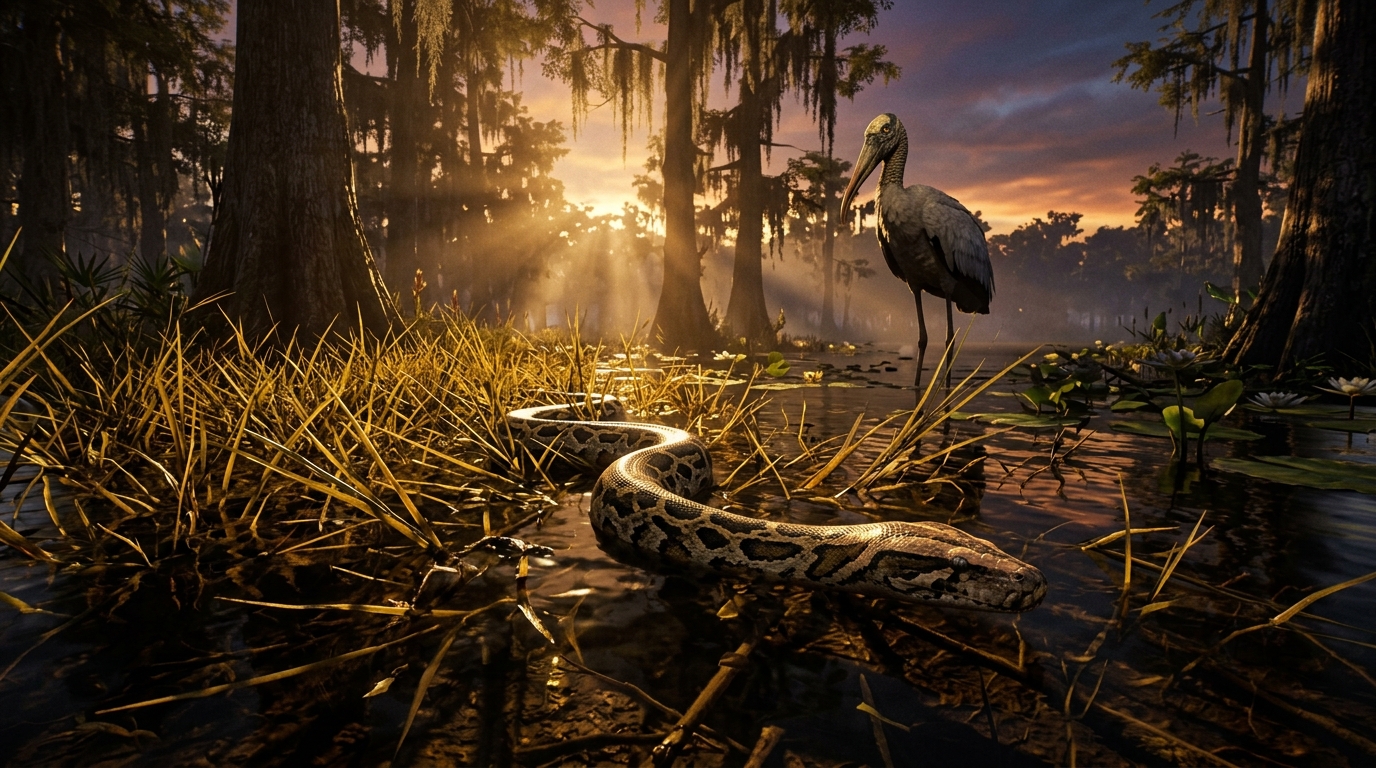
And the wildest part isn't just that it runs—it's that playing it is delivering the exact impactful experiences I predicted on paper back in 2013. You don't start as an apex predator; you start as a vulnerable young snake, which means you are prey. You get your ass kicked Elden Ring-style. In one autonomous play session, I saw a bird looming over the snake that looked like a towering prehistoric dinosaur. It was a Heron, and I thought the scale was broken until Claude verified that the engine is built 1:1 to real life. When you are a two-foot snake on the ground, a Heron isn't just a wetland bird—it's a Jurassic terror stalking you from above. (And digging into the Compendium later, I learned that birds like the Wood Stork pack a Guinness-record 25-millisecond bill-snap—the science is even crazier than fiction).
Then I had a multi-round water fight with an alligator that felt like a heavyweight boxing match. I grappled, struck, retreated to recover stamina, and finally took it down—only for the game to remind me I couldn't even swallow it because my jaw couldn't clear its girth. I took fatal damage for a meal I couldn't consume, learning the brutal ecological lesson that in nature, you should have just slithered away. Later, I stumbled upon a creature with electric blue, green, and purple plumage and thought it was a glitch. It turned out to be an actual native bird: the Purple Gallinule. That discovery sparked the in-game Field Compendium—a Pokémon Snap-style taxonomy index of all 59 Everglades species, designed so anyone who actually lives in the Florida swamp can play this game and say: 'Wow, holy shit, this is my backyard.'
We’re taking that realism into combat with mechanics nobody has ever built. You get graded Devil May Cry-style (S-Rank for predatory execution), but grounded in herpetological science. A python doesn't just squeeze with static force; it feels for the prey's exhalation and ratchets tighter so the lungs can't re-expand, spiking blood pressure to trigger cardiac arrest. We’re channeling that into the controller haptics as a rhythmic pulse: time your squeeze to the breathing to cut off circulation fast, or risk the prey thrashing free. And if you're fighting near the water? Drag them off the bank and drown them under the black water in real time—an organic, player-driven fatality.
So much has evolved in the Everglades over the past 13 years while the game was on ice. Marsh rabbit populations have collapsed by over 90% due to pythons, leading scientists to deploy robotic decoy bunnies with cameras. Influencers like Taylor Stanberry won the 2025 Florida Python Challenge pulling 60 snakes from the swamp, and companies like INVERSA Leathers are turning invasive python hides into luxury boots and loafers. All of that real-world culture, seasonal population cycles, and ecological tension is going straight into the game. And with Grand Theft Auto VI about to shine the biggest global spotlight in gaming history on South Florida, the timing to deliver a mature, serious Interactive Documentary couldn't be better.
Of course, it wouldn't be indie game dev without a near-fatal disaster. While migrating the game from PC to Mac to show friends and prep for PC/Mac Early Access, an automated cleanup command went rogue and wiped 870 GB of data from my PC—Documents, Downloads, Desktop, completely empty. I tried saving it onto an old USB-A drive that crawled for 24 hours only to show 0 bytes. Walmart and Target had nothing in stock, so I drove all the way to Micro Center, dropped $150 on a 2TB USB-C drive, and watched it rip through the recovery. But the real savior was the MacBook: because I already had the game ported and running multi-platform on macOS, development never stopped while the PC was in the ICU.
This is what game development looks like in the new Wild West: where developers can decompile classic Xbox code to run Halo multiplayer in a browser, where a 13-year-old dream gets resurrected from a grad school PDF into a playable reality, and where you survive an 870 GB disaster to ship. Welcome to DevLog #1. Bigglesworth Studios is back in the game.
Explore the Research Behind the Game
Every encounter described in this DevLog—from the 25ms Wood Stork reflex to the Purple Gallinule and keystone aquatics—is cataloged in our 67-species Field Compendium.