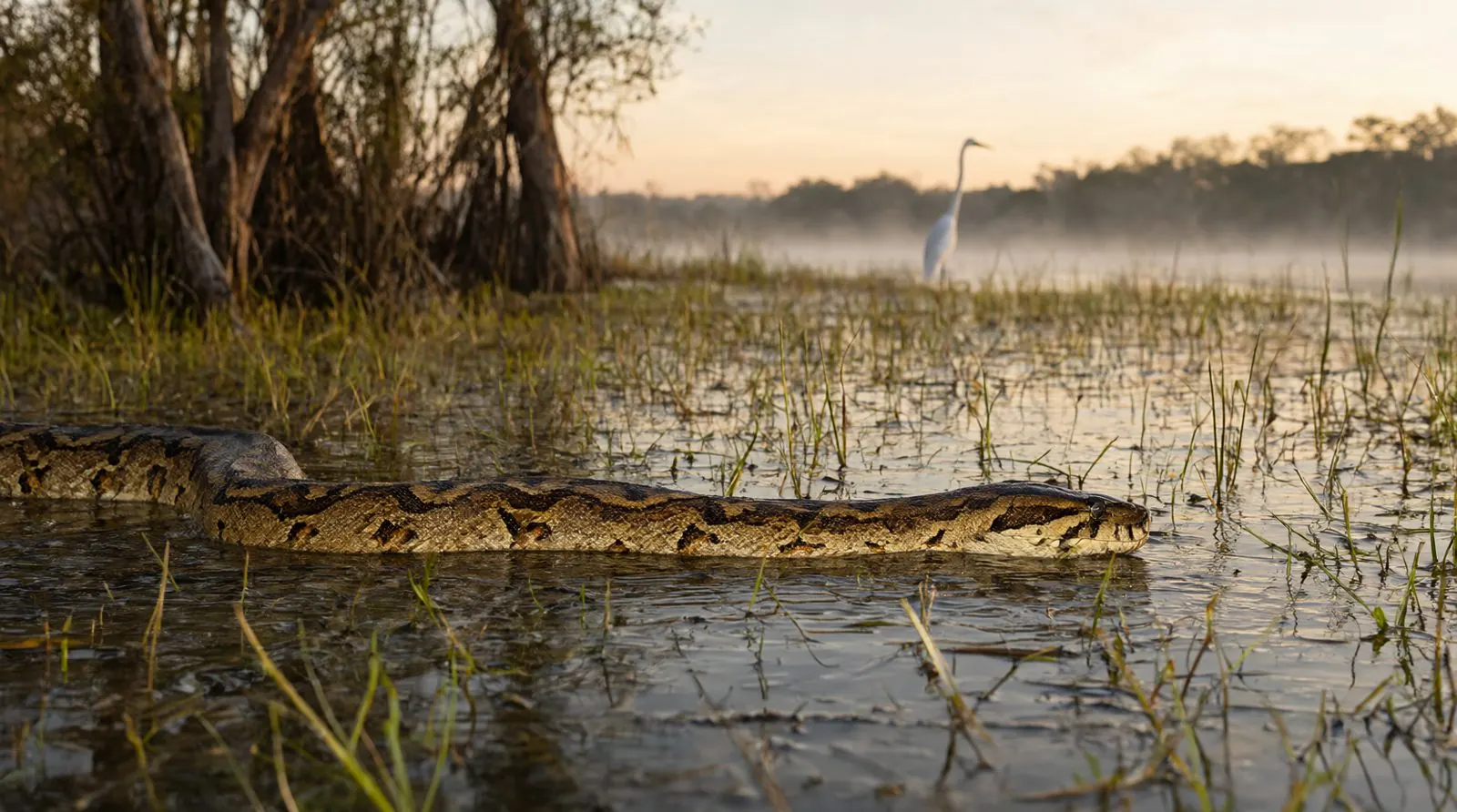
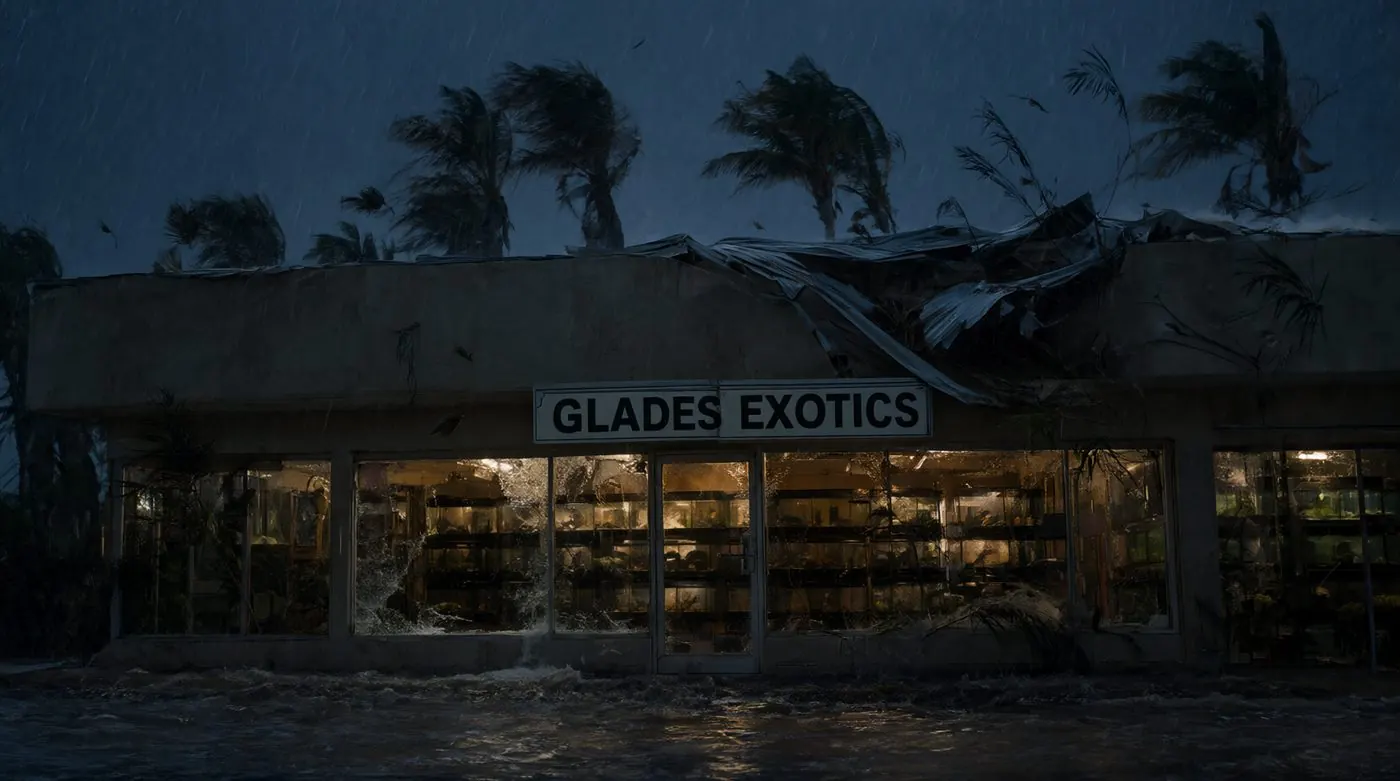
You are a Burmese python released into the Everglades by Hurricane Andrew on 24 August 1992. Live out a real python's life in a real, living swamp, under its real sky, until you die of old age.
“Now the serpent was more crafty than any other beast of the field that the Lord God had made. He said to the woman, ‘Did God actually say, “You shall not eat of any tree in the garden”?’ And the woman said to the serpent, ‘We may eat of the fruit of the trees in the garden, but God said, “You shall not eat of the fruit of the tree that is in the midst of the garden, neither shall you touch it, lest you die.”’ But the serpent said to the woman, ‘You will not surely die. For God knows that when you eat of it your eyes will be opened, and you will be like God, knowing good and evil…’”
Genesis 3:1–24 ESV
“You have once again entered the world of survival horror. Good luck…”
Resident Evil
“It is our failure to become our perceived ideal that ultimately defines us and makes us unique. It’s not easy, but if you accept your misfortune and handle it right, your perceived failure can be a catalyst for profound re-invention.”
Conan O’Brien
1Introduction
1.1 The original introduction
From the 2013 design document, verbatim6 February 2013
I first had the idea for “Invasion” in the summer of 2012 while I was watching a nature show on Animal Planet. The program described the incredible strength constricting snakes have when crushing their prey. They calculated that the P.S.I. was equivalent to a human body being crushed by the weight of a school bus. I idealized a game that placed the user in control of a snake movements which were manipulated via the touchscreen. This would allow the user to move, sneak, strike, constrict and consume its prey more realistically than any application that has existed. As I gathered knowledge and added gameplay elements, I also become more informed of a real life issue that would work perfect as the scenario for the game.
The Burmese Python is a popular exotic pet that becomes expensive and difficult to manage due to their rapid growth and costly maintenance. Many times these unwanted pets are released into the wild as they are hard to sell once they have exceeded comfortable levels of sustainability. Burmese Pythons released into the Everglades ecosystem have adapted well to their environment. The temperature has an effect on the sex of the hatchlings causing the majority of these snakes to develop female. These females are capable of producing broods of up to 100 eggs at a time. These conditions have worked in favor of Burmese populations, but their collective appetites are causing strain on the native species in the Everglades.
In 1992 Hurricane Andrew was the costliest storm to reach American land. On August 24th of that year an exotic pet store was damaged and the inventory of Burmese Pythons were enabled to escape. Twenty-one years later these snakes have become a serious threat to the natural ecosystem of the Everglades. This mobile app will include the sights, sounds, environments and as many possible details to make the user feel as though they are on an expedition into south Florida’s swamp. I am hoping this project will entertain as much as it will enlighten the user on themes relating to conservation, invasive species and natural ecosystems.
James Henry Deter Jr.
1.2 Thirteen years
Thirteen years later the touchscreen snake runs in Unreal Engine 5.8, the swamp is built from USGS elevation data and the real 1992 weather record, and the python still has to earn every meter of her length. This edition keeps the 2013 table of contents as its structure and records, section by section, what has been decided and built since.
Plate 1The 36-page edition, registered 3 January 2014.2013 documentPlate 2The first logo, in red ink: a python around Florida. Today's title art is the same idea.2013 sketchPlate 3The first draft, “Mobile Application Design Document,” Bigglesworth Productions, copyright pending.2013 .docx
Twelve years on the shelf
The timeline below on one scale, 2012 to 2026. Filled dots are its key moments.
The idea, from an Animal Planet segment on constriction. “That's a superpower in nature… the touchscreen would work perfect to maneuver the snake and wrap it around prey.”
Mobile Application Design Document, Bigglesworth Productions, copyright pending. iOS first; Invasion, Swamp and Arcade modes; a 20–25 year in-game life.
Bigglesworth Studios, 36 pages: Practice and Demo modes, gesture controls, a camera plan, 25 species, 7 habitats and the influences. Written while studying at Full Sail University.
The “Everglade Snake” teaser, a studio recruitment video, a python feeding shoot for the crowdfunding campaign, storyboards by Kelsey Dickson.
US Copyright Registration PAu003700993.
Wake Up! Florida, a mock talk show shot at Full Sail with snake handler Todd “Chief” Rowley as script consultant. A PRLog release and a RocketHub campaign pledged part of the proceeds to the Everglades Foundation. The Miami New Times called it “Myst meets Oregon Trail.” A Unity prototype (v1.5) went out for Android. The campaign did not fund the game.
Twelve years on the shelf.
First Unreal commit: the python asset pack, a playable pawn, the first hunt and the first constriction loop in one weekend. The original design was re-read and aligned the next day.
Migrated to Unreal Engine 5.8.
The coil solver, the custom alligator, Shark Valley, the real 1992 weather, the Master Design Bible, Coco, the one-take intro film, the full hunt loop, seven biomes and creature AI.
Two bursts of work: late April, and the turn of October
Commits per week, 2026: 665 from 26 April to 9 October. The project slept through most of the summer. The hatched bar is a part week, Monday 5 to Friday 9 October.
Source: IBP git history, all branches
1.3 The week it came alive: 3–9 October 2026
On 3 October an 870 GB drive wipe took the development PC. The project moved to a Mac the same day and kept going. In the next seven days it took 187 commits and about 254,000 added lines across 5,833 files of code, data and assets. On 9 October it handed back to Windows at a verified stable point, and that night the studio PC was rebuilt with its local image and video models, which made the plates in this document.
Sat 3 Oct9 commits
Drive wipe; development moves to macOS and Metal.
The Danger Room combat arena with facial strike latch, renamed the Snake Pit.
Bigglesworth bumper and teaser wired into the boot flow, with instant skip to title.
All six campaign biomes built with full vegetation and wildlife spawns; the campaign becomes a six-chapter water corridor.
An adventure-map travel cinematic with the python sticker as the marker.
Skip digestion: time jumps forward.
Thu 8 Oct41 commits
The arena roster reaches 40 species, with Blender rigs and combat clips for the bald eagle and limpkin.
Red and black mangroves; the eastern diamondback rattlesnake.
14 CC0 creature and water recordings, NPS public-domain audio, a full audio manifest.
The Field Guide reaches 67 plates. Snake Pit opponent menu. Work formally split between Claude, Codex and Gemini.
Fri 9 Oct67 commits
Real tree climbing for hatchlings and juveniles: 17 climbable trees, concertina loops, a tail helix, drop-strike from a branch, perches that hide her.
Level 1 laid out from its map art (Human Edge v2) and opened by New Life.
Unified controls steps 2 and 2b: one stealth curve from stick pressure, Circle releases, no climb button, one fixed control bar.
COIL step 1: the alligator loses to its own physiology. Alligator counter-attack telegraphs animated.
Eight Hurricane Andrew prologue keyframes; 40 more 3D species emoji; crash triage; hand-off to Windows.
Each bar is that day's commits on one scale; 9 October, with 67, is the longest. Source: IBP git history.
1.4 Who builds it
One creator directs. AI collaborators work in lanes the creator assigned. Claude writes the game code, compiles, tests and builds; Opus 5.5 is co-author on 316 commits. Codex works only on content in Blender and the Unreal Editor: rigs, creatures, UI art. Gemini makes reference and concept images, the website and read-only analysis, and never opens the engine. Each keeps its own overnight log. Cinematics and stills are made in Hybrig, the studio's own AI video tool, on local models running on the studio GPU.
Part one
The Game
“With the HUD off, any frame should read as wildlife footage.”Design pillar, §2.4
Shark River Slough · Plate, Qwen Image 2.1
2Executive Concept
A documentary-realism stealth survival game. The player is one female Burmese python living a whole life, from a pet-store tank on the night of Hurricane Andrew to old age.
2013“Sandbox environment to navigate the Burmese Python in a new, yet accommodating environment, Everglades National Park.”
“She is the camera, the controller, the progression system, the ecological disturbance, and the emotional contradiction of the whole game: beautiful, powerful, invasive, and dangerous because she is simply surviving too well.”Core thesis
PC and Mac on Unreal Engine 5.8; Early Access is the stated goal. Touch remains the native design language; mobile is a later port.
Engine
Unity (UDK considered)
Unreal Engine 5.8
Minimum system
Multi-touch, a modern smartphone chipset, accelerometer, gyroscope, GPS
Not yet set. Development reference: an RTX 4090 PC; an Apple Silicon Mac runs Level 1 at about 29 fps. Target: 60 fps at 1080p.
Audience
5th grade to adult; adventure, action and simulation fans; nature-show enthusiasts
Unchanged
Lifespan
15–25 years of in-game life
18–25 years, drawn at birth (default 21)
2.2 High concept
One python, one life, one real place. The simulation is the game: “You just play the game until the snake dies of old age.” Hurricane Andrew opens it, a rare documentary host frames it, and the systems play out the life between.
2.3 Vision, in the creator's words
The modern Snake. “In 20 years from now I want people to look back and be like, yo, do you remember the Invasion of the Burmese Python.”
Scale in detail, not size. “We're just going to stick to the swamp, but it better be the best swamp in any video game ever made.”
It plays itself when you put it down. Idle, the python goes on autopilot and the camera turns documentary.
Moving is the reward. Anyone handed the controller should want to play just to move her.
Look over God's shoulder and copy his answers. Real geography, weather, sky and behavior.
Coming out swinging. “I've been sitting on this needle for over a decade, so I don't want to come out looking like trash after waiting this long.”
2.4 Key features and design pillars
Pillar
Requirement
Embodiment first
No idle slither loop, no car-style turning. The body is the interface. 2013: touch control that “mimics the movements of a snake more realistically than any game to date.”
Survival before power
At 60 cm she is prey for herons, raccoons, otters and gators. The early game is close to survival horror.
The COIL system
Contact, Orient, Immobilize, Lock. Constriction wins through the prey's physiology, not a damage bar.
Wildlife has lives
Every animal has needs, a routine and a reason to be where it is.
World as documentary
With the HUD off, any frame should read as wildlife footage.
Education through play
Every rule is a real fact. Every success deepens the silence in the sawgrass.
2.5 Goal
2013“Utilize the touchscreen to manipulate proper movement. Conquer the Everglades National Park.”
Survive, grow and live a whole python life down the water corridor to Florida Bay, and leave the swamp measurably changed.
3Interactivity
3.1 Game modes
Mode
2013 plan
2026 design
Invasion
Story mode from Andrew through maturity
The campaign: six chapters down the water corridor (§6)
Swamp
Replay any age or area reached in Invasion
Sandbox with a Time Machine: any date 1851–2100 on real NOAA weather (§7)
Practice
A pet python, its owner dropping in prey
Practice and the Field Guide
Snake Pit
(new)
An 11 m arena, 40-species roster, instant reset (§7)
Demo / attract
Narrated clips after 15 s idle
Attract mode after 45 s: the swamp plays itself
Photo
(new)
Inside every mode
3.2 Controls
Touch is the native design. Every controller verb translates a 2013 gesture.
Touch
2013 intent
Controller
Slow drag from the head
Short swipes slither silent
Light left stick: sneak, stalk
Strong drag
A long, fast swipe at top speed
Full stick: slither, burst
Flick at the prey
The strike
R2 tap
Hold on contact
Keep the bite
R2 hold: squeeze
Circles
Constrict; bigger prey, bigger circles
L2 tighten, Lead to orient the wraps
Vibration
“As much as possible,” fading as the prey succumbs
Haptics for impact, grip, struggle and heartbeat
Lead
Left stick
Steer the head; when latched, orient the coils.
Gather
L2 hold
Load the S-coil, dive, brace, tighten.
Commit
R2
Tap: strike, ambush, drop-strike. Hold: squeeze.
Release
Circle
Let go of prey or tree; surface.
Sense
□ △ R3
Taste the air, heat pits, focus on prey.
Cross is context: eat, swallow, regurgitate. Spec: Docs/UNIFIED_CONTROL_PLAN.md; steps 1, 2 and 2b done, 3–9 open.
4Cameras
Parameter
Value
Pitch range
−86° (top-down, the Snake view) to +26°
Zoom
0.2× to 4.0×, up to 38 m
Hatchling distance
About 1.85 m behind, scaled by length (exponent 0.6)
Lock-on
Triangle; the camera holds the target without manual control
Attract mode
Documentary angles chosen by a camera director, as in 2013's Demo mode
2013Third person “slightly above and behind the snake,” pinch to zoom, a camera button cycling preset angles, an overhead view named after Snake for the strike and the wrap, and lock-on from Ocarina of Time's Z-targeting. All of it survives.
5User Interface
5.1 Startup and attract
A four-block legal slate (photosensitivity, the agency disclaimer, the Bigglesworth rabbit insignia, the Dolly Parton “Snake in the Grass” sync credit); the Bigglesworth and Unreal bumper, unskippable for 4 s; then the title over a looping Andrew vortex. After 45 s idle, attract mode begins.
5.2 Main menu
Six items. Modes are not nested; you leave one by pausing and choosing Return to Title.
5.3 HUD
Design language Field Journal × Nature Documentary: tannin panels, marl paper, sawgrass gold and one sunset-amber accent, with red reserved for danger. Cormorant Garamond for names, Inter for reading, Barlow Condensed for labels; this document uses the same set. Elements fade after 6 s, and the center of the screen belongs to the swamp. One fixed seven-slot control bar shows PlayStation glyphs on a pad and keys on a keyboard. Over it sits an era skin: the fictional station WGLD Channel 9 “Glades Watch” in CRT style for 1992, modernizing to flat graphics after 2016.
Plate 4The fixed control bar, in engine. The scene is greybox.In-engine · Oct 2026Plate 5Body-first feedback: the HUD counts wraps on the prey instead of showing a health bar.Concept artPlate 6The approved corner HUD: the life-bar grows from 1992 to 2012.Concept artPlate 7The 1992 era skin, WGLD 9 “Glades Watch.”Ming Image Design
5.4 Pause screen and Field Guide
2013Time, date, weather, location and health on the pause screen “allows for full screen use during gameplay.”
The Field Guide holds 67 species plates, each sourced to USGS or NPS.
Plate 8A Field Guide entry.Ming Image Design
Part two
One Night, One Life
“Whether it freed a single python is a legend. What came after is not.”The legend card, §6.1
2013“You start the game during Hurricane Andrew in 1992 and live the life of the snake through maturity.” That is still the campaign.
6.1 Opening film: “August 24, 1992”
About 2:20 in three acts (The Calm, The Storm, After). A TV radar; a strip-mall pet store called Glades Exotics (placeholder name); the card August 24, 1992. 4:52 AM.; the roof tearing away; a tank tagged “Burmese python, captive bred, $65” holding three hatchlings; floodwater; dawn; the title; and the legend card: “Whether it freed a single python is a legend. What came after is not.” A 58-second one-take cut already ships as the intro: a Powers-of-Ten descent from orbit through Andrew's eye into the tank, made in Hybrig from 13 keyframes chained with MiniMax H3.
Six beats: glass tank, storm pressure, broken containment (a squeeze-through), the store floor (stealth by occlusion; no full hunt yet), the exit into floodwater, and the drainage canal. It ends as the python “disappears into vegetation just before dawn, not as a villain, but as a survivor.”Status: not built. New Life currently runs title, make-a-snake, briefing, Level 1.
6.3 Campaign structure
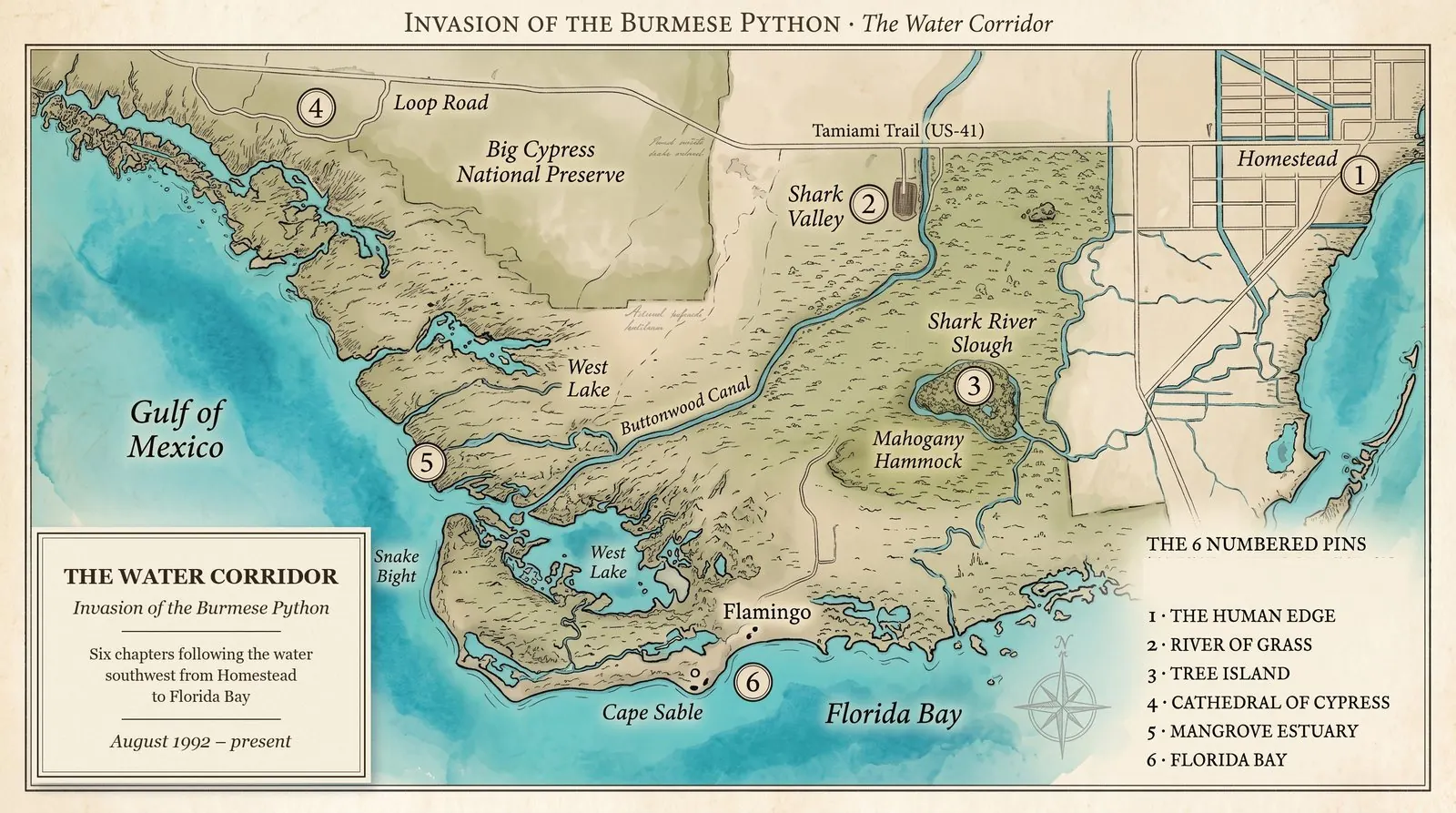
Six chapters down a geographic water corridor. Gates: credited kills, a size threshold, and from chapter 3 a legendary animal. Total: 300 kills plus the final boss. Pine rockland is deliberately left off the route: dry, high, and it burns.
Plate 10The Water Corridor, chapters 1–6.Game art · map texture
The thermometer drops to 26 °F; frozen iguanas fall from the trees; officers find 9–13 ft pythons dead in the sawgrass. The player survives in a 72.4 °F limestone solution hole beside a dormant 11 ft bull alligator. The real freeze left a genetic mark on the survivors (Card et al. 2018).
Plate 11January 2010.Qwen Image 2.1
6.5 Ending: “The Victor”
Main-on-end credits cut against vignettes of the life: the facility, the raccoon, a crushed $4,000 robot decoy rabbit, a Judas-snake collar, the freeze, an 18 ft Elder on a chickee, airboat hunters, the gator death roll, the range map. Post-scripts state the real numbers (§11). Stinger: a hatchling in Charlotte County, 2026. “The invasion will continue.”
7Swamp Mode and the Snake Pit
In 2026 Swamp mode is a sandbox with a Time Machine: any date from 1851 to 2100, on the real NOAA record, with shared setup screens.
2013Swamp mode as the reward for Invasion: start anywhere you've been, at any age you've reached.
The Snake Pit (built 3 October as the Danger Room) is an 11 m-radius arena: pick an opponent from a 40-species roster with emoji cards and specimen flips, fight, read the debrief, reset instantly with R.
8Session Experience
8.1 Character selection: make-a-snake Known issue
2013“The default Burm is a female named ‘Baby’ in reference to a python living at the Serpent Safari Park in Illinois.”
Still true. 2026 adds a python genome behind a Randomize button: head scale, girth, warmth from olive to rust, darkness, contrast, fused blotches, mottling and pattern offset. She is always a natural Burmese python; a broad head leans her toward Jaws, a heavy body toward Coil, a slender one toward Stealth and Strike. Known issue: Randomize and Start fall off screen at 1280×720.
8.2 Saves, death and the next life
2013 had three save slots and resumed after a snake's life expired. In 2026 death (old age, a gator, the cold) is final for that snake and closes with an obituary card. The next life starts at the pet store or as a hatchling from her own clutch, and the world she changed carries forward.
Plate 12The obituary card.Ming Image Design
Part three
The Body Is the Interface
“Anyone handed the controller should want to play just to move her.”Vision, §2.3
Stick pressure is one dial: still, sneak, stalk, slither, burst. Speeds run from about 50 cm/s creeping to 265 cm/s at a burst; the keyboard slithers at 0.78 pressure. Movement scales with body temperature and size.
9.2 Sneaking
2013“The closer you get to your targeted prey, an audible heartbeat will signify the proximity. The tempo increases the closer the gap.”
Kept. There is no sneak button. Water hides her (0.85), night hides her (0.35), and on a perch she is spotted at 35% of normal range with 70% less noise.
A burst more than doubles the distance she can be spotted from
Spotted-in-the-open distance by gait, in meters, from the engine's stealth self-test. The dashed bar is stalking at night.
ibp.Stealth.SelfTest · PASS
9.3 Striking and constriction
2013“Once connected, the user must wrap the prey up by swiping the touchscreen in circles to constrict.”
L2 loads the S-coil against a sweet-spot bar; a dead-center release lands at 2.4× velocity in about 35 ms and stuns for 2.6 s. Once latched, constriction is not damage over time: the squeeze cuts the prey's blood flow in proportion to its pressure. In the engine's physiology test a full squeeze renders an alligator unconscious in 5.4 s, a loose coil held for 120 s does not, and the heart stops 7.5 s after unconsciousness under a held coil. In water deeper than 120 cm, drowning compounds it.
9.4 Swallowing
2013“This process occurs in rapid fashion but not an immediate gulp… The bigger the kill, the bigger the growth benefit.”
Head-first only, within 165 cm of the snout, as a 14-second three-shot documentary sequence. Afterwards she is encumbered (up to −50% speed, no strike) until digested; holding Cross regurgitates to flee. Carcasses are fresh for 4 game hours, tainted from 4 to 10 (a 28% “meat poisoning” hit), scavenged after.
9.5 Surviving
Growth comes only from digested mass, at 32% efficiency young and 8% old. Mass follows about 0.9 × L2.8: 6 kg at 2 m, 44 kg at 4 m. Length caps at 5.75 m; the Florida record is 5.72 m.
Start: 0.62 m and 0.25 kg. Largest meal: 1.10× her mass, +3% per Jaws point.
Levels: one per ~25 cm, about 20 in a life, each an instinct point across Stealth, Strike, Coil, Jaws, Constitution and Senses (10 max, +5% each). A life is about 150–250 hunts.
Vitals: Vitality (below 30% she limps), Stamina (2.2%/s in a burst; Exhausted below 15%), Caloric reserves (digest only above 24 °C body temperature), Breath (a 50 s bar standing for 45 min of real apnea).
About a meter a chapter, from hatchling to the 5.75 m cap
Length band for each campaign chapter, in meters, labeled with the chapter's years. The bands run 0.5 to 6 m; she hatches at 0.62 m and the engine stops her at 5.75 m (the faint end of chapter 6). Dashed: the Florida record, 5.72 m.
Data/Campaign/CAMPAIGN_CHAPTERS.json
Hunger stages · Docs/LIFE_CYCLE.md
Stage
Duration
Effect
Digesting
until done
Can't strike
Sated
4–45 game days
Full strength
Hunting window
21 days
Optimal time to hunt
Hungry
up to 90 days
Coil and stamina ×0.9
Starving
after
Coil ×0.7, stamina ×0.75, −0.4% mass a day
How warm she is changes how she moves
Body temperature
Locomotion
Strike
Constriction
Below 18 °C
0.65×
0.60×
0.60×
28–32 °C, optimal
1.05–1.15×
1.20×
1.00×
Above 36 °C
0.90×
–
–
9.6 Climbing and swimming Built 9 Oct
2013“If young, slither in trees and after building mass, sneaking on the ground.”
Built 9 October. Only hatchlings and juveniles climb. Contact starts a climb; a branch holds her if its circumference is under half her length; mount and dismount blend over 0.25 s; from a perch she drop-strikes 250 cm out and 450 cm down. Swimming reads real water depth; Gather submerges; a submerged Commit is an ambush.
10Concept Art and Production Design
10.1 Visual style
2013“The app is to appear as though it is a documentary show similar to an episode of Animal Planet… If it looks real it will be taken more seriously.”
Kept and sharpened: scale in detail, not size; nothing bought, everything custom or CC0; reference first; no clones; every creature judged in close-up beside the alligator. The 2013 cel-shaded option is parked.
HatchlingNear-black saddles, rust borders, white flanks.
Adult to old giantWarm tan and gold; later grey-olive and scarred.
Plate 13Hatchling coloration.Qwen Image 2.1
10.2 Audio environment
2013“As many possible sound effects and noises that you would hear out in the middle of the Everglades National Park. The natural orchestra.”
Positional, recorded sound in stereo through Atmos and binaural; real thunder that falls silent beyond 20 km; the prey's heartbeat in the hunt.
10.3 Music
No music during play. Music is reserved for the films. See §19 for the open question.
10.4 Cast
2013“Any living thing appearing in the app must be known to exist in The Everglades National Park,” with gators, panthers and manatees given priority.
The rule stands. A documentary host appears rarely, at life-stage turns; casting is open (§19).
Part four
The Real Invasion
“She was not the first. She was one more.”The python's own line, §11.1
Python and alligator · Plate, Qwen Image 2.1
11Alien Invasive Species
Burmese python, Python bivittatus. The game is fiction built on a true story. This is the true story as the agencies and the science tell it in 2026.
~28,000pythons removed in Florida since 2000, as of August 2026 (FWC)
99.3%fewer raccoons seen on park roads, 2003–11 vs 1996–97
76prey taxa in 1,716 python stomachs, 1995–2021
~30,000km² of South Florida occupied
11.1 Origins
The US imported 127,356 live Burmese pythons from the late 1970s to 1994, mostly from Thailand and Myanmar, and 160,655 from 1994 to 2011, almost all from Vietnam. A road-killed 3.58 m python was collected on US-41 at the park's northern edge in 1979. The first two documented inside Everglades National Park were found near West Lake in December 1995. By 2000 the population was described as breeding and established.
The legend the game keepsOn 24 August 1992 Andrew wrecked an exotic-animal breeding facility near Homestead; inspectors later spoke of “hundreds of large snakes” loose.
What the science saysCapture patterns don't fit a mass release. The likeliest founders were a few pet pythons released near Flamingo before 1985 (Willson, Dorcas & Snow 2011). Andrew may have added escapees; it did not start the invasion.
The game holds both, under its creative-truth rule and the python's own line: She was not the first. She was one more. Genetics agree the founders were few: nuclear diversity is about half that of native populations, and 13 of about 400 snakes carry Indian python DNA (Hunter et al. 2018).
11.2 Impact
Where pythons spread, the mammals all but vanished
Decline in mammal sightings, southern Everglades National Park, 2003–11 against 1996–97. Orange: not seen at all. Deer from secondary coverage.
Dorcas et al., PNAS 2012 · deer from secondary coverage
Birds are the most varied prey; rats are the staple
Kinds of prey (taxa) found in 1,716 Florida pythons. This counts kinds, not meals.
Romagosa et al. 2022, USGS
Radio-collared marsh rabbits released in the park: pythons caused 77% of deaths within 11 months, against none at sites without pythons (McCleery 2015). Cotton rats and black rats are 45% of the diet. No fish, frog, turtle or snake has been found in a Florida python, and the game makes that a rule (§12). Alligators are both prey and predator: in 2005 a 13 ft python burst after swallowing a 6 ft gator, and gators win most encounters.
11.3 Response
The Lacey Act banned import and interstate transport from 23 March 2012. Florida moved the species to its Prohibited list on 29 April 2021. Paid contractors (SFWMD since 2017, and the FWC) have removed about 19,000; all reported removals since 2000 total almost 28,000. Detection runs from 0.01% to 1.46% per survey, so the tools are inventive: radio-tagged “Judas” males that lead hunters to breeding females, detection dogs, eDNA from water samples, and in 2025, 40 heated, solar-powered robot rabbits. USGS says eradication is not possible with current tools.
Since 2021, each Challenge has removed 195 to 294 pythons
Pythons removed per Florida Python Challenge. There was no event in 2014–15 or 2017–19.
FWC, SFWMD; 2013–21 via Wikipedia
Removals passed 28,000 in 2026
All reported removals in Florida since 2000, at the agencies' milestone figures. Lines join the milestones; they are not measured between them.
FWC 2022–26; Florida governor 2019
Records: a 215 lb female carrying 122 eggs, found by tracking the scout male “Dionysus” (2022); a 19 ft python from Big Cypress (2023). In the 2026 Challenge, 907 hunters removed 280; Tom Rahill alone took 96. In July 2026 the FWC declared an established satellite population in Charlotte County, north of the Everglades: the setting of the game's final stinger.
12Indigenous Species
The 2026 roster: 16 species with researched behavior scripts plus the pig frog and apple snail; 40 in the Snake Pit; 67 Field Guide plates.
2013Endangered and indigenous species included “to show them in their natural environment.”
Every animal runs on hunger, fatigue, fear and thermal comfort under the real sun and weather, and a 17-observer matrix decides who flees, watches, hides or attacks.
12.1 Diet rule and food web
The python eats only what Florida pythons eat: rodents, rabbits, raccoons, opossums, deer, wading birds and alligators up to 1.8 m. Never fish, turtles or other snakes. Much of the swamp eats her back while she is small: who wins depends on size.
Python eats it
It eats young pythons
Both ways: size decides
Can't be caught
Size not stated
11.82.5345 m
Drag to grow her from hatchling (0.62 m) to her cap (5.75 m). Lines in the web switch at the sizes this document states, with stages mapped to the chapter bands in §6.3. Faint dotted lines are pairings the document gives no size for.
12.2 The alligator
The adversary. It decides by mass ratio every 0.5 s: at two or more times the python's mass it hunts; between 0.6 and 2 it defends; below 0.6 it flees (×1.3 in water). Bite force runs to 12,900 N for a 4.2 m bull. Its lunge winds up for 0.3 s and lands 81% of the time above water and 57% below; the death roll spins once 73% of the time. Fighting comes in 20–40 s bouts. Wrapped, it can counter-bite, roll out or drag her under. Telegraph clips (tail tense 0.4 s, jaw swing 0.5 s, body coil 0.6 s) are animated but not yet wired.
Legendary animals · LEGENDARY_BOSSES.json
Name
Species
Size
Arena
Hammock Bandit
Raccoon
3.6 ft · 38 lb
Tree Island
Cypress Hunter
River otter
4 ft · 35 lb
Cypress
Mangrove Warden
American crocodile
16 ft · 1,100 lb
Mangrove
The Last Sovereign
American alligator
17 ft · 1,300 lb
Florida Bay
12.3 Coco
Plate 14The creator's 2013 sketch of Coco.2013 sketchPlate 15Her ears became the studio's mark.Studio logoPlate 16The north rim of the pond.Qwen Image 2.1
Coco was the creator's rabbit and the inspiration for the Bigglesworth Studios logo. She has passed away. In the game she is all white with domestic ears; the right ear stands and the tip of the left rolls down to show the studio's magenta-pink (#CF4A9B), real folded geometry approved on 28 September 2026. She lives on the north rim of the pond. There is exactly one of her. She cannot be caught: she clears every strike. Find her resting and she is in the 2013 sploot, with lettuce.
13Everglades National Park (River of Grass)
Real geography in truthful compression: each level is the real place its map was drawn from, with the pause-map marker in its true position.
Map edges are exits; you arrive on the opposite edge of the next map. Beyond a readable natural edge sit a 4 km horizon ring and an 8 km water plane. Terrain is USGS LiDAR. Water is typed: canal, tea-colored slough, blackwater, clear marl, brackish (5–30 ppt, 0.3 m tide), salt (30–45 ppt).
Homestead fringe, C-111/L-31 canal, levee, culvert, Andrew debris
24 Aug 1992, 05:30, hurricane
17
Level 1; built from its map
Sawgrass & Slough
Shark Valley tram road, tower, gator holes
17:55, fair
15
The vertical slice
Tree Island
Mahogany Hammock, tannin moat
14 Jan 1997, 08:20
18
Cypress
Loop Road, Sweetwater Strand, a dome
12 Feb 1999, 16:50
18
Prairie & Pineland
Long Pine Key, Pa-hay-okee
8 Nov 2005, 16:30
16
Off the campaign route
Mangrove
West Lake, Snake Bight, Buttonwood Canal
6 Jan 2010, 09:10
17
Adds the American crocodile
Coast & Bay
Flamingo, Florida Bay over marl
18 Jul 2016, 17:40
16
Plate 23Level 1's map art (top) against the level as built (bottom). Plate 24, opening Part Five, is the same level from the player start.In-engine check · Oct 2026
Part five
The Build
“We're just going to stick to the swamp, but it better be the best swamp in any video game ever made.”The creator, §2.3
Plate 24 · Level 1, Human Edge v2, from the player start · In-engine, Oct 2026
14Influences
Influence
What it gives the game
Since
Nature documentaries (Animal Planet, National Geographic, PBS)
The look, the camera, the attract mode
2013
Flight Control
Drawing a path with a finger as the core control
2013
The Sims
A cycle of needs; open, consequence-driven play
2013
Metal Gear Solid 3: Snake Eater
Stealth and camouflage; “remaining hidden… is crucial”
2013
Grand Theft Auto
A world that runs, and plays itself if you watch
2013
The Legend of Zelda: Ocarina of Time
Z-targeting lock-on for the strike and coil
2013
Pokémon Snap
The virtual expedition; photo mode
2013
Nokia Snake
The overhead camera; the “modern Snake” ambition
2013
Horizon, Tears of the Kingdom, Microsoft Flight Simulator
Living worlds, systemic play, real-world data
2026
2013“Some of these influences were seeds, while other expanded upon.”
15Technical Flowchart
2013Artificial Intelligence: “not going to be able to be fully completed until experts have been consulted.” User Interface: this heading was empty.
The answer, thirteen years on, is a research base (28 behavior files, USGS diet data, field studies) behind one shared creature mind, fed by real-world data and closed into a loop by the python's own hunting.
Real weather and sky records feed the sky, weather and water stage; USGS LiDAR feeds the biome levels. Both feed the creature AI (needs, routine, fear, temperature), which drives a 17-observer reaction matrix. The player python's senses (taste, heat pits) and the reaction matrix both feed the hunt: stalk, strike, COIL, swallow, digest. The hunt feeds growth, traits, hunger and temperature, which loop back to the player python, and it feeds ecosystem pressure carried forward, which loops back to the creature AI.
Data flowThe loops the python closes
FigureHow one hunt changes the swamp, and the swamp changes the next hunt.
16Available Technologies
Area
2026
Engine
Unreal Engine 5.8; C++ module Source/IBP; Blueprints for wiring
Content
Blender (procedural rigs and clips); Epic's Unreal MCP server for agent-driven editor work
NOAA solar position, Meeus lunar model, Yale bright star catalogue
Film and stills
Hybrig on the studio GPU: MiniMax H3 (video with sound), Qwen Image 2.1 and Ming Image Design (stills)
Development
The creator directing Claude (code), Codex (content) and Gemini (reference and web)
2013One word under the heading: “Unity.”
17Asset Dependencies
40species in the Snake Pit roster
67Field Guide plates
151HUD sprites awaiting import (5 life stages, 7 eras)
17climbable tree meshes with collision
The python: 4K original textures; Gemini's tan-and-chocolate hatchling skin, not yet wired.
The custom adult alligator v2; Coco with the folded ear (in her model files, not yet in Unreal).
Audio: 14 CC0 recordings plus NPS public domain; 8 close alligator bellows and 4 hisses.
About 1 GB of Blender creature work and ~600 files exist only on the Mac. Don't copy the stray ArtSource/Blender/C:\Users\Owner\… folder; its name breaks a Windows checkout.
2013This heading was empty.
18Production Status and Roadmap
As of the Mac-to-Windows hand-off, 9 October 2026, branch codex/python-constriction-prototype at c887960c.
18.1 Verified 9 Oct 2026
Level 1 laid out from its map (1200 × 606 m); the pause-map dot is accurate.
Climbing with drop-strike; the fixed control bar; the full hunt loop.
Biome and weather data packaged; cheaper volumetric clouds.
The performance pass nearly doubled the frame rate
Shark Valley, median frames per second at 1080p, before and after the pass. The dashed line is the 60 fps target.
Docs/status, 29 Sep 2026
Climbing peaked at 37 of 100, then slipped to 30 in Level 1
The critics' score for tree climbing, out of 100, by iteration. The dashed step is the score in Level 1.
Docs/TREE_CLIMBING.md
18.2 Known issues
Make-a-snake doesn't fit 1280×720.
The packaged game climbs 11 hand-placed trees; the editor finds 1,374 (scattered foliage isn't registered when cooked).
Level 1 opens at Andrew's dawn, 05:30 in a hurricane, and is very dark.
Trees read as smooth pipes; the python is still black and orange; fields look bare from the air.
Top crash: a dangling fauna pointer in the ambient spawner (6 of 18 Mac crash logs).
18.3 Roadmap
Order: snake movement, then constriction and swallowing, then needs and ecosystem, then species, then polish and UI. First milestone: a vertical slice in Shark Valley with one complete loop (stalk, strike, constrict, swallow, grow, get hunted) at 60 fps in 1080p, then a 60–90 second trailer and a Steam page, toward PC and Mac Early Access. Controls next: a timed exhale squeeze, bite location, gator telegraphs, body-first feedback, then the creator's showcase playtest. Still to build: the pet-store tutorial and the documentary host.
19Open Decisions12 open
The working documents disagree here. The Master Bible wins where it speaks; these need the creator's ruling.
Chapters and order.Seven biomes with Prairie & Pineland as level 5 (bible), six chapters without it (runtime), or eight biomes and seven chapters (roll-up). Kill targets total 300 or 365.
Level 1's south exit.Tree Island (runtime data; “mostly south is chapter 3”) or the Mangroves (travel graph; shipped pause map).
Time scale.30× (48-minute day), 60× (24-minute day), or one real hour per game year. A life runs 20 or 60–90 hours.
The 2010 freeze.The chapter 4 film is January 2010, but chapter 4 spans 2002–08 and the film's python (15.4 ft) is above the chapter's band.
Life stages.Four incompatible models, and an XP curve that conflicts with “a level per 25 cm.” Climbing unlocks at subadult in one file and ends after juvenile in another.
Music.“No music, ambient only,” against a Dolly Parton sync credit on the title slate. Gameplay only?
The HUD.No HUD in play with vitals on pause (2013 and the earlier bible), or the permanent telemetry built now.
Fish.The diet rule says never; the proposed prey table includes bluegill, bass, gar and bowfin.
Heat and taste buttons.Five mappings across the documents.
Coco.Exactly one, or a 15% wild spawn. Eyes dark or ruby.
The host and narrator.Three ways to cast the host: the person from the creator's own video (link to re-supply); Todd Rowley with a talent release; or the creator performs it and a digital host wears it, with face capture (52 expressions per frame, the names Unreal's face rigs use) driving a 3D host in the game's own world. The Unreal bridge for that third option isn't built yet. Narration follows from whoever hosts.
Small facts.Landfall at 4:30, ~5:00 or 4:52 AM; Andrew as Category 4 on the film's radar and 5 elsewhere; engine 5.5 in the README against 5.8; 59, 64 or 67 Field Guide species.
20Credits and Sources
Creator. James Henry Deter Jr., Bigglesworth Studios. Design, direction, story.
2013–14. Todd “Chief” Rowley, script consultant and on camera, Wake Up! Florida. Kelsey Dickson, storyboards. Aarti Seaton, host. Necole Pynn, media contact. Full Sail University.
2026. Claude (Anthropic), code and builds. Codex (OpenAI), Blender and editor content. Gemini (Google), reference art, web and analysis. Coco, logo and inspiration.
Science. Guzy et al. 2023, NeoBiota 80:1–119. Dorcas et al. 2012, PNAS 109(7). McCleery et al. 2015, Proc. R. Soc. B. Willson, Dorcas & Snow 2011, Biological Invasions. Hunter et al. 2018, Ecology and Evolution. Hunter et al. 2015, PLOS ONE. Card et al. 2018. Romagosa et al. 2022, USGS data release.
Agencies. USGS Wetland and Aquatic Research Center. FWC Python Challenge releases 2022–26 and Prohibited species rule (2021). SFWMD Python Elimination Program. US Department of the Interior, Lacey Act listing (2012).
News and film. ABC News, Charlotte County, 11 Jul 2026. Smithsonian, the 2022 record female and 2025 robot rabbits. NBC News, the 19 ft record, 2023. National Geographic, python and alligator, 2005. CBS News, 2018. PBS Nature: Invasion of the Giant Pythons, 2010. The Python Hunt, Xander Robin, 2025–26.
IBP press, 2014. PRLog, 28 Jan 2014. Terrence McCoy, Miami New Times, 5 Feb 2014.
Invasion of the Burmese Python, Game Design Document
Edition
2026 Edition, 9 October 2026
Author
James Henry Deter Jr., Bigglesworth Studios
Copyright
US Registration PAu003700993 (3 Jan 2014)
Supersedes
Original design document, 6 February 2013
Authority
Where this document and the Master Design Bible (IBP_MASTER_BIBLE.md) disagree, the bible wins.
About the plates. Plates marked Qwen or Ming were made for this edition on the studio GPU with Qwen Image 2.1 (scenes) and Ming Image Design (interface), three seeds each, best kept. They are illustrations, not game footage. Plates marked In-engine are the current build, unretouched. Original plates are scanned from the 2013 documents. The python that grows along the title bar and the margin as you read is a Nano Banana 2 study of a Burmese python, cut into a repeating skin and a head.