INDEPENDENT SIMULATION STUDY // FIELD REF #EBO-1992-2026
Everglades Ecosystem — Taxonomic Field Compendium
Independent biological identification plates for native wildlife, protected keystone species, botanical architects, and invasive apex constrictors across the River of Grass.
Total Cataloged Taxa:120 Species (119 Wild + 1 Mascot)
Native Keystones:111 Species
Invasive Threats:7 Species (Python, Feral Hog, Armadillo, Cichlid, Fire Ant, Roof Rat, Oscar)
Legendary Escapee:1 (Coco the Bunny)
Specimen Plates:100% Verified (120/120)
Audubon Field Journal Standard • Independent Educational Simulation
Educational Notice
Notice of Research Independence & Collaborative Mission:
This digital field compendium and the simulation Invasion of the Burmese Python are independent educational works developed by wildlife conservation enthusiasts and interactive software designers. While biological data is rigorously aligned with public research published by the U.S. Geological Survey (USGS), the University of Florida (UF/IFAS), and the Smithsonian Institution, this project is not an official publication of, nor endorsed by, the Florida Fish and Wildlife Conservation Commission (FWC) or the National Park Service (NPS). We operate with immense admiration for Florida's state biologists and Everglades rangers, and warmly welcome formal dialogue and collaborative educational partnerships.
The Genesis of the Python Invasion: A Nuanced, Systemic History
▲ HIDE OVERVIEW
Invasion of the Burmese Python approaches Florida's invasive constrictor challenge not through villainization or caricature, but through an objective, systemic examination of how natural disasters, international commerce, and ecological adaptation converged over thirty years.
1. August 1992: Hurricane Andrew
On August 24, 1992, Category 5 Hurricane Andrew slammed into southern Miami-Dade County. The 165 mph sustained winds obliterated commercial exotic reptile breeding facilities and research centres near Homestead, directly releasing hundreds of hatchlings and breeding adults into adjacent sawgrass marshes overnight.
2. Decades of Market Growth & Human Fallibility
Between 1970 and 2005, tens of thousands of captive-bred and imported pythons were legally sold in the American pet market. Reptile hobbyists and local pet retailers were operating legal small businesses. However, pythons grow from 20 inches to over 15 feet. Over decades, accidental enclosure breaches during tropical storms, combined with overwhelmed owners unable to house 150-pound apex carnivores, created dispersed escape vectors.
3. The Perfect Subtropical Haven
The Everglades provided thousands of square miles of shallow, warm freshwater sloughs, dense sawgrass camouflage, and an abundant prey base with zero natural apex competitors capable of challenging adult constrictors. The species simply did what nature has programmed it to do: adapt, survive, and reproduce.
* Note: This simulation explicitly rejects scapegoating any single community. Responsible ecological conservation requires recognizing the complex systemic collision between human markets, catastrophic storms, and evolutionary biology.
Geographic & Ecological Survey Map
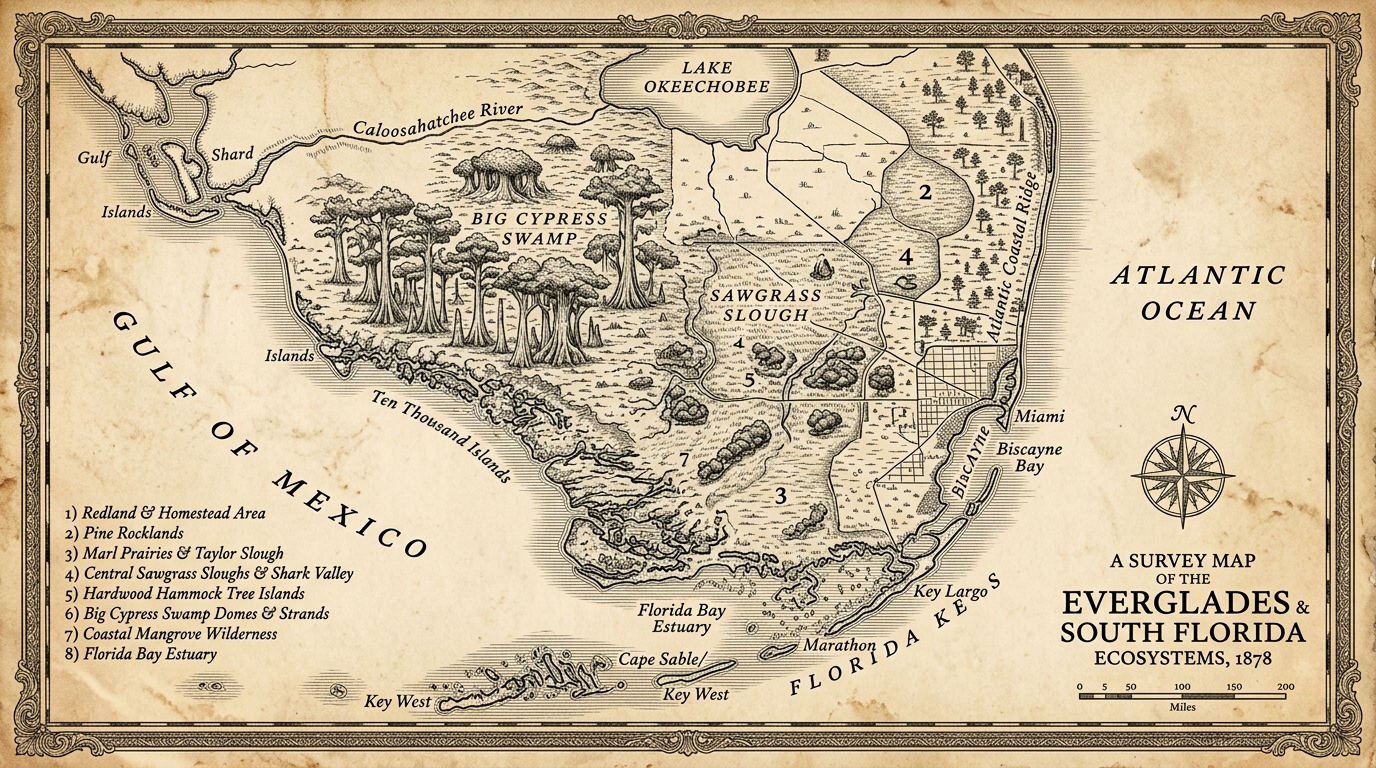
The Everglades: Cartographic Survey of Biomes & Habitats
Lake Okeechobee → Florida Bay // True South Florida Geography
Ecological Dispersion Reality: Pythons do not travel along a linear path or highway; they disperse freely throughout all contiguous subtropical wetlands. This survey delineates the 8 foundational ecological biomes where the python feeds, grows, and breeds — from the Hurricane Andrew facility origin in Homestead through Shark Valley's sawgrass, into the deep buttressed cypress domes of Big Cypress, and out to coastal mangroves and Florida Bay.
1. Redland & Homestead Area
Origin Point (Aug 1992): Commercial exotic breeding facilities breached by Category 5 Hurricane Andrew. Neonates and hatchlings (0.5–1.2 m) shelter in agricultural canals, packing houses, and nursery groves.
2. Pine Rocklands
Limestone Ridge Habitat: High-ground oolitic limestone outcroppings (Long Pine Key). Exposed solution holes, slash pine canopy, and dense palmetto understory providing dry winter refuge.
3. Marl Prairies & Taylor Slough
Seasonal Hydroperiod Basin: Calcitic marl flats and scattered dwarf pond cypress. Rapid wet-dry seasonal transitions force prey concentrations into shrinking solution holes.
4. Central Sawgrass Sloughs & Shark Valley
The River of Grass: The central artery of freshwater sheet flow. Continuous dense Cladium beds, deep open sloughs, and the 15-mile Tamiami tram loop teeming with wading birds and marsh rabbits.
Deep Bald Cypress Wilderness: Vast depressional swamp domes, pop ash sloughs, and towering buttressed cypress knees. Prime breeding territory for giant matriarch pythons competing with bull alligators.
7. Coastal Mangrove Wilderness
Ten Thousand Islands Estuary: Intertidal prop-root labyrinths and brackish rivers along the Gulf. Pythons swim open tidal creeks and adapt to marine crab and mullet prey.
8. Florida Bay Estuary & Cape Sable
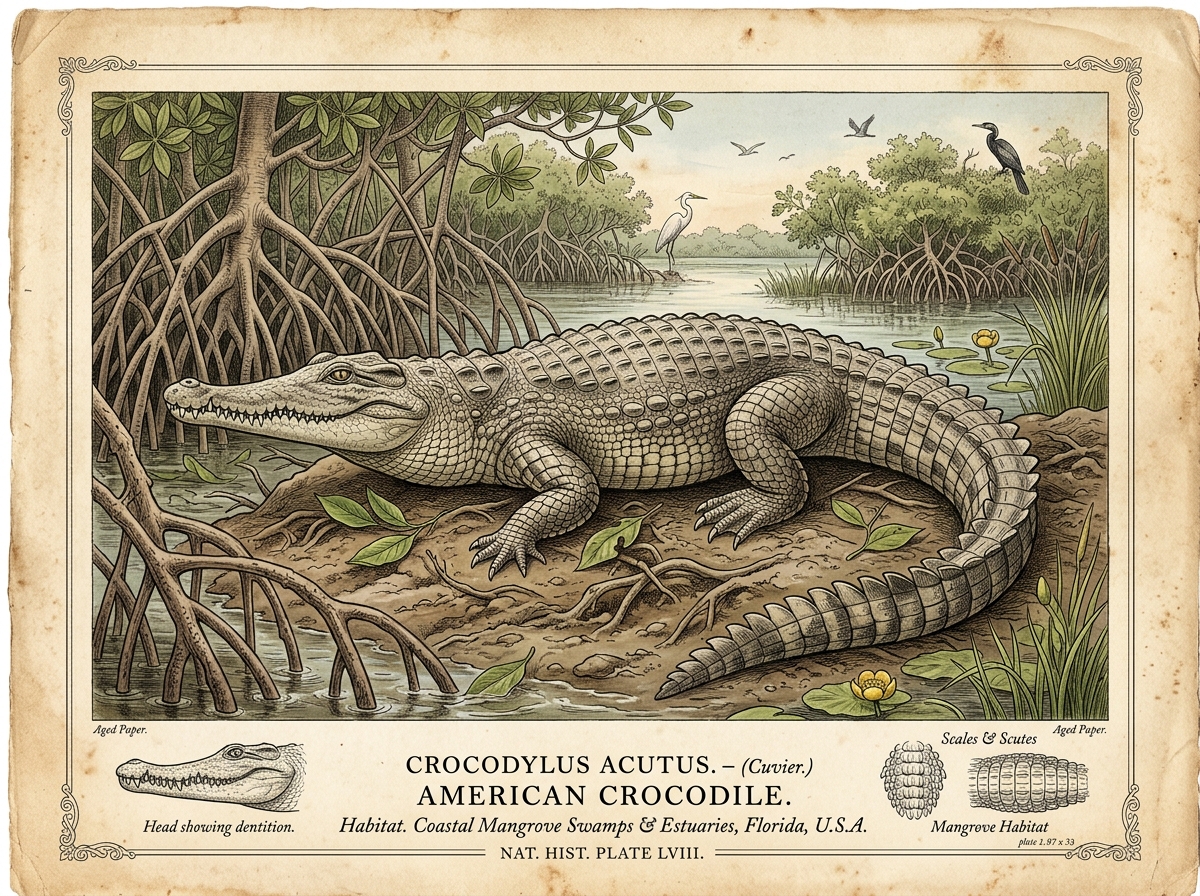
Southern Marine Boundary: Hypersaline mud banks, coastal buttonwood hammocks, and American Crocodile rookeries where massive apex pythons reach record 18+ ft lengths.
Plate #01 • Apex & HerpetofaunaThreatened
► Living Plate (Hybrig LTX 2.5)
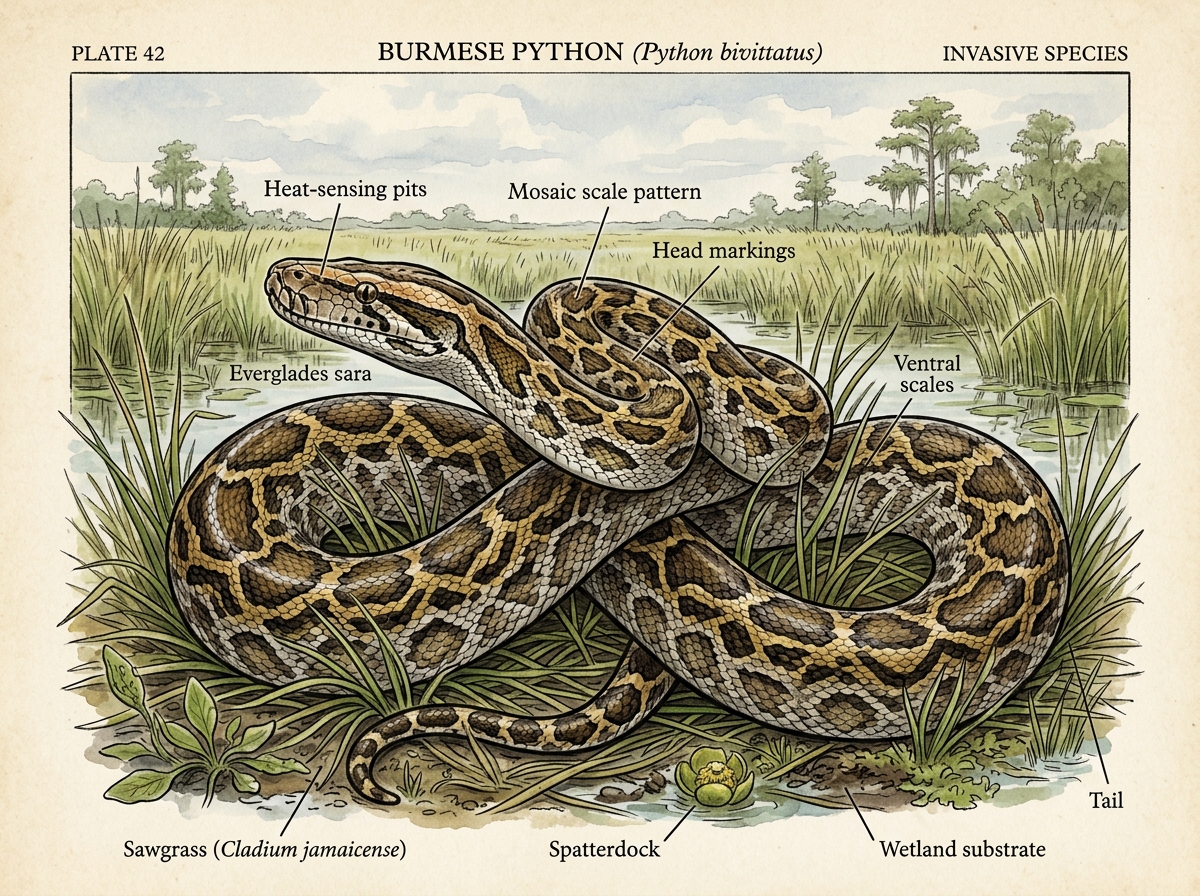
Burmese Python
Python bivittatus[Pythonidae]
Status:IUCN Vulnerable (native range); USF
Diet Role:Invasive apex ambush predator. Diet
Mass / Length:Length: 2.5–5.5 m (8.2–18.0 ft), excep
Habitat:Sawgrass sloughs, hardwood hammocks, t
Distinct dark arrowhead on head dorsum; dark subocular wedge through eye; infrared heat-sensing pits located exclusively on upper labial scales.
RANGE: Sawgrass sloughs, hardwood hammocks, tree isl
Plate #02 • Apex & HerpetofaunaThreatened
► Living Plate (Hybrig LTX 2.5)
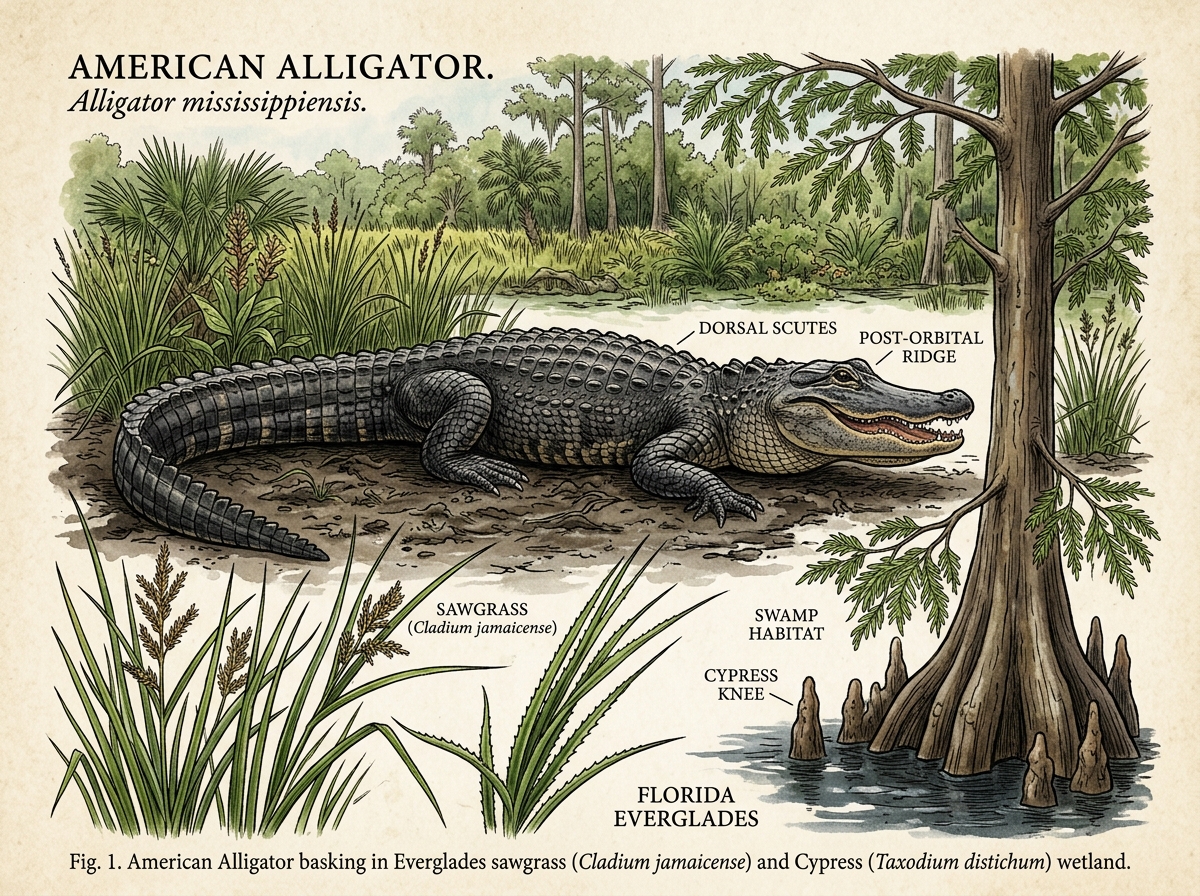
American Alligator
Alligator mississippiensis[Alligatoridae]
Status:IUCN Least Concern; USFWS Threatene
Diet Role:Keystone apex predator and ecosyste
Mass / Length:Males: 2.5–4.5 m (8.2–14.8 ft), mass 9
Habitat:Freshwater sloughs, marl prairies, can
Broad, rounded U-shaped snout; dark nearly black dorsal armor; only upper teeth visible when jaws close. Bidirectional Apex Arms Race. Adult alligators are the primary native predator capable of killing and consuming adult pythons. Conversely, pythons exceeding 3.5 m frequently kill, constrict, and ingest juvenile and subadult alligators up to 2 m in length.
Mass / Length:Length: 1.2–1.8 m (4.0–6.0 ft), rarely
Habitat:Pine flatwoods, dry hammocks, and elev
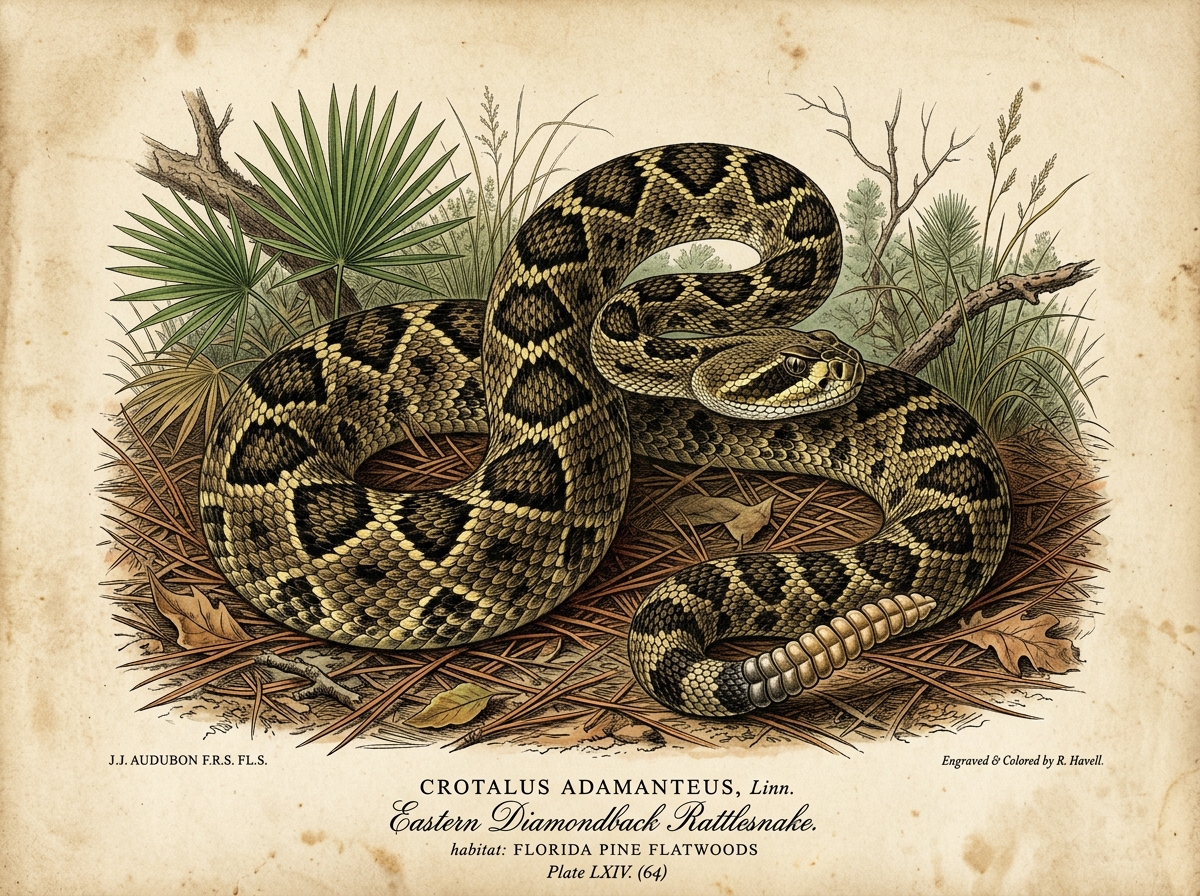
Prominent dark brown/black dorsal diamonds outlined in white/yellow; heavy triangular head with vertical pupils; loud segmented keratin tail rattle. Preyed upon by subadult and adult pythons. Pythons possess natural physiological resistance to crotalid venom ingestion; constriction neutralizes the viper before defensive envenomation.
RANGE: Pine flatwoods, dry hammocks, and elevated sa
Plate #05 • Apex & HerpetofaunaNative
4:3 Verified Plate
Florida Cottonmouth
Agkistrodon conanti[Viperidae]
Status:IUCN Least Concern; Unlisted
Diet Role:Semi-aquatic ambush scavenger and p
Mass / Length:Length: 0.7–1.5 m (2.3–5.0 ft). Mass:
Habitat:Cypress strands, wet prairies, canal b
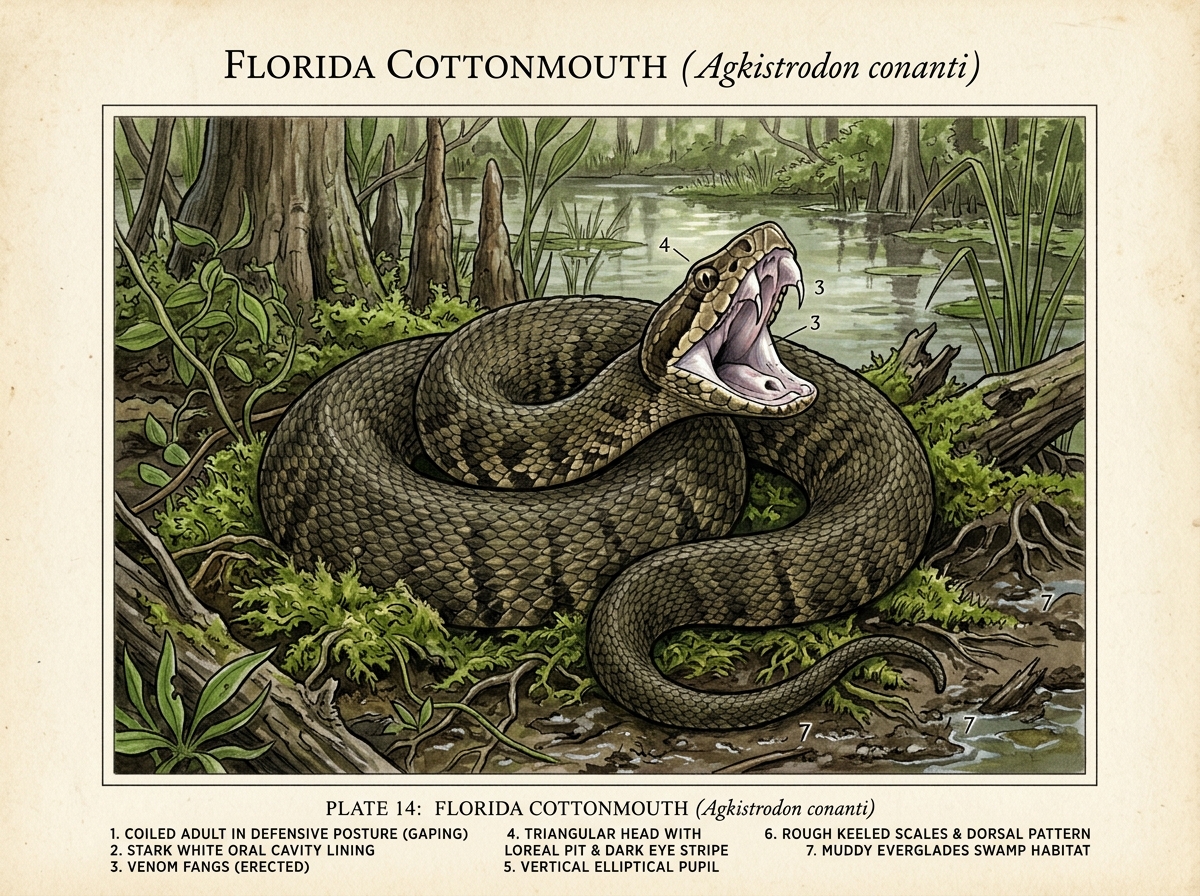
Dark facial mask obscuring eye; spade-shaped head; white "cotton" interior mouth display when threatened. Substantially depredated by juvenile to subadult pythons. Remains frequently recovered in python gut content necropsies due to habitat overlap.
Mass / Length:Length: 0.6–1.2 m (2.0–4.0 ft). Mass:
Habitat:Ubiquitous in freshwater sloughs, cana
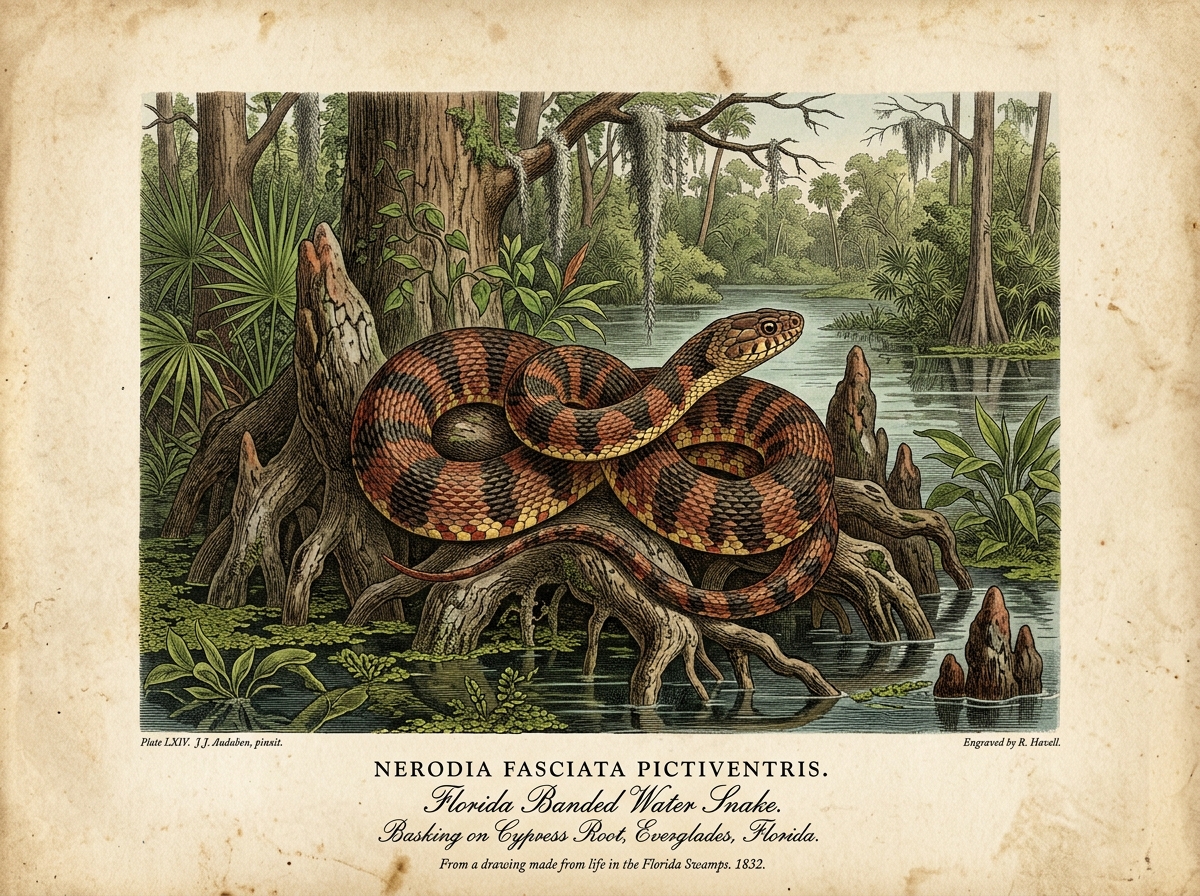
Dark uninterrupted transverse dorsal bands; red and black square vermiculations across belly; round pupils (contrasting with cottonmouth vertical slit). Direct prey for hatchling and juvenile pythons, serving as a primary caloric subsidy during early python life stages.
RANGE: Ubiquitous in freshwater sloughs, canals, and
Plate #07 • Apex & HerpetofaunaKeystone
4:3 Verified Plate
Florida Softshell Turtle
Apalone ferox[Trionychidae]
Status:IUCN Least Concern; Native Protecte
Diet Role:Benthic carnivore and scavenger (sn
Mass / Length:Carapace length: 15–60 cm (6–24 in). M
Habitat:Canals, deep sloughs, and sandy mud fl
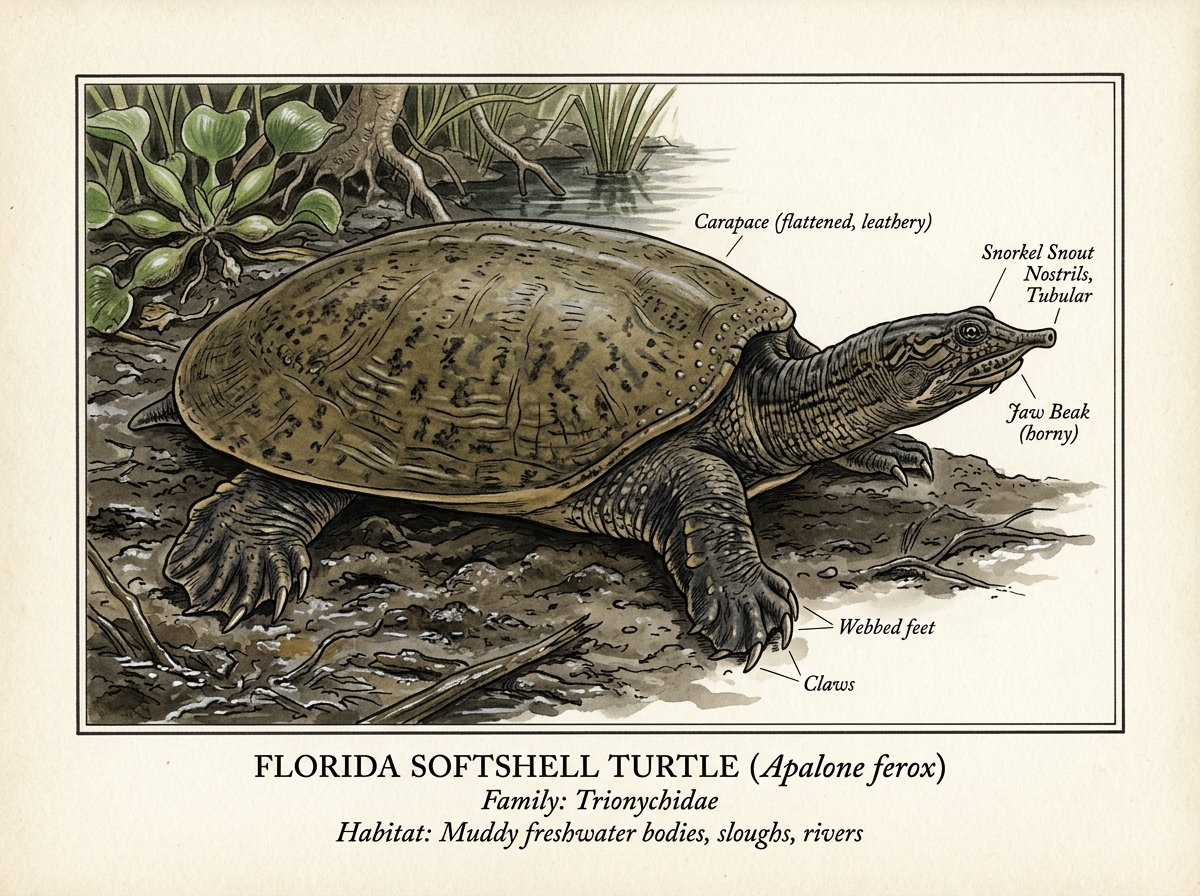
Leathery flattened pancake-like shell lacking bony scutes; long snorkel-like tubular snout; aggressive defensive snap. Generally avoided by pythons due to wide horizontal shell rigidity, though small juveniles are occasionally consumed.
RANGE: Canals, deep sloughs, and sandy mud flats.
Plate #08 • Apex & HerpetofaunaNative
4:3 Verified Plate
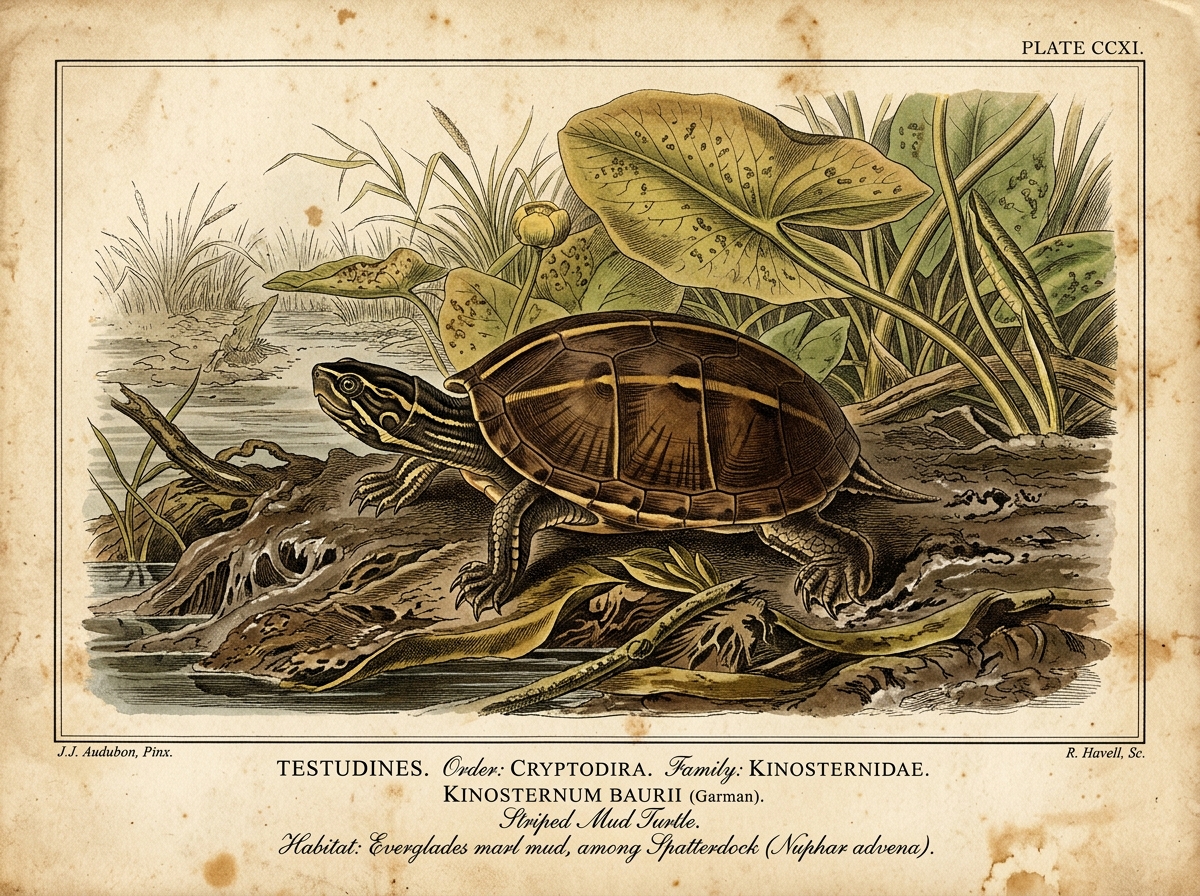
Striped Mud Turtle
Kinosternon baurii[Kinosternidae]
Status:IUCN Least Concern
Diet Role:Omnivorous bottom-forager feeding o
Mass / Length:Carapace: 7.5–12.0 cm (3.0–4.7 in). Ma
Habitat:Shallow sawgrass marshes, cypress slou
Three distinct yellowish longitudinal stripes running down dark carapace; double-hinged plastron. Minor; ignored by adult pythons due to low caloric yield and hard shell.
RANGE: Shallow sawgrass marshes, cypress sloughs, we
Plate #09 • Apex & HerpetofaunaThreatened
4:3 Verified Plate
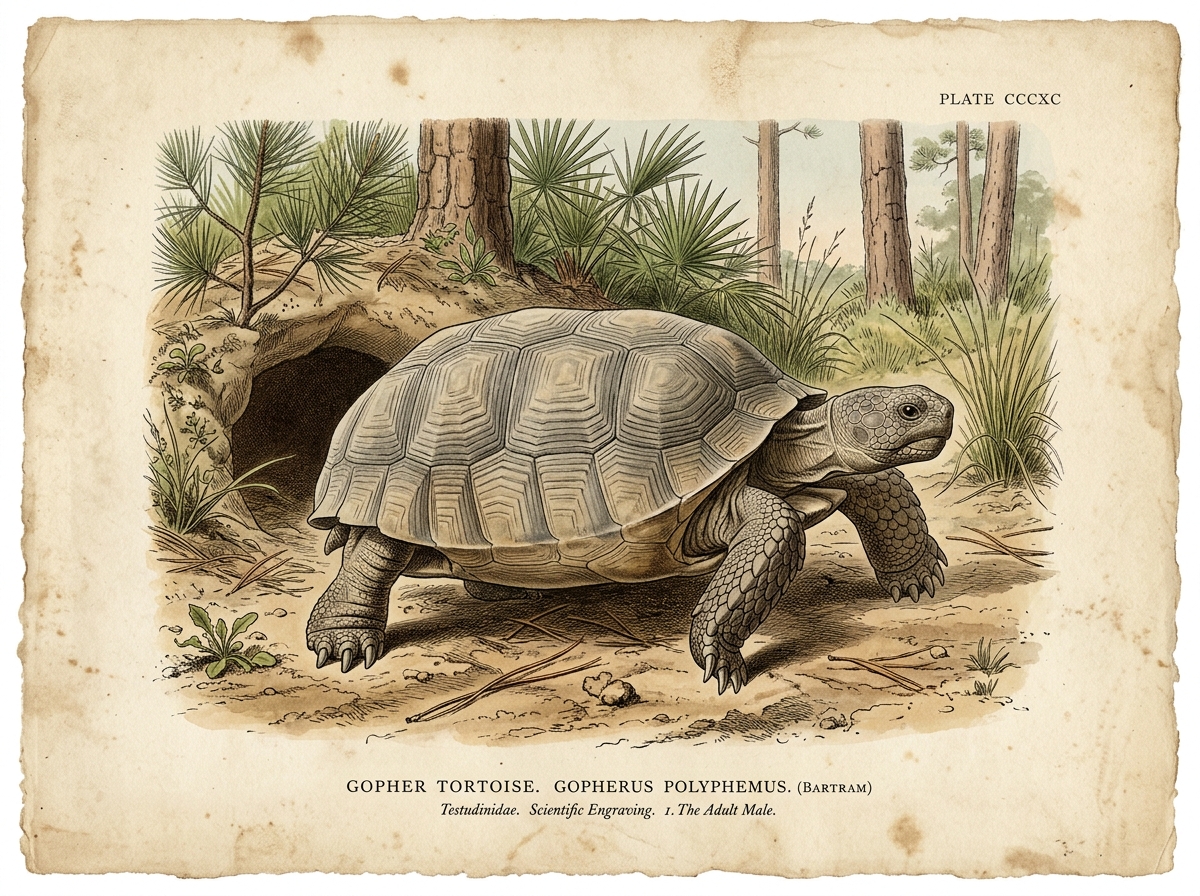
Gopher Tortoise
Gopherus polyphemus[Testudinidae]
Status:IUCN Vulnerable; Florida FWC State
Diet Role:Herbivore. Critical Keystone Engine
Mass / Length:Carapace: 20–30 cm (8–12 in). Mass: 4.
Habitat:High pine rocklands, sandy ridges, and
Stumpy elephantine hind feet; flattened spade-like front digging limbs; unwebbed claws; domed tan-brown shell. Pythons actively invade gopher tortoise burrows as subterranean thermal refugia during severe winter cold fronts, opportunistically preying on eggs or juvenile tortoises.
RANGE: High pine rocklands, sandy ridges, and scrub
Plate #10 • Apex & HerpetofaunaInvasive
4:3 Verified Plate
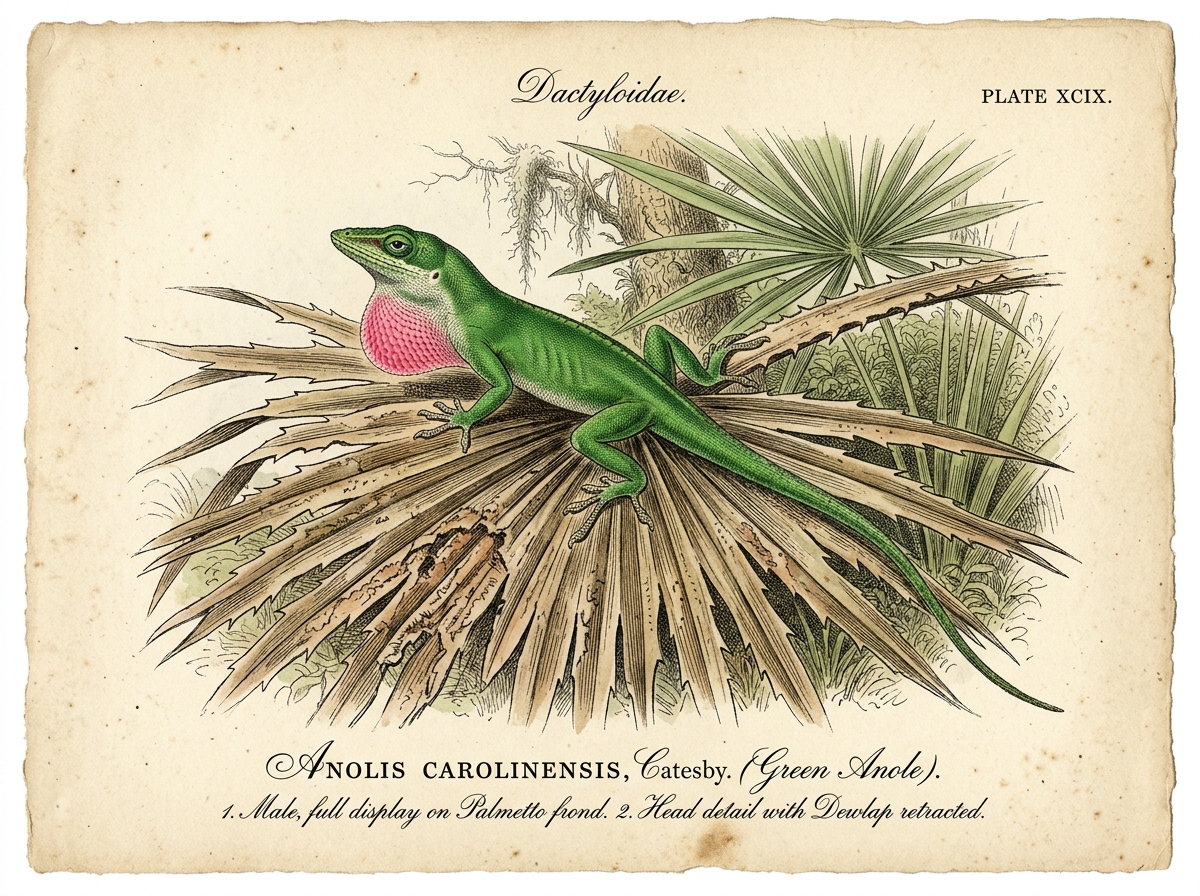
Green Anole
Anolis carolinensis[Dactyloidae]
Status:IUCN Least Concern; Declining local
Diet Role:Diurnal visual insectivore.
Mass / Length:Total length: 12–20 cm (5–8 in). Mass:
Habitat:Arboreal; tree canopy and upper shrub
Ability to shift color from vibrant emerald green to deep brown; slender elongated snout; males display bright pinkish-red throat dewlap. Insignificant due to miniature size.
RANGE: Arboreal; tree canopy and upper shrub layers
Plate #11 • Apex & HerpetofaunaInvasive
4:3 Verified Plate
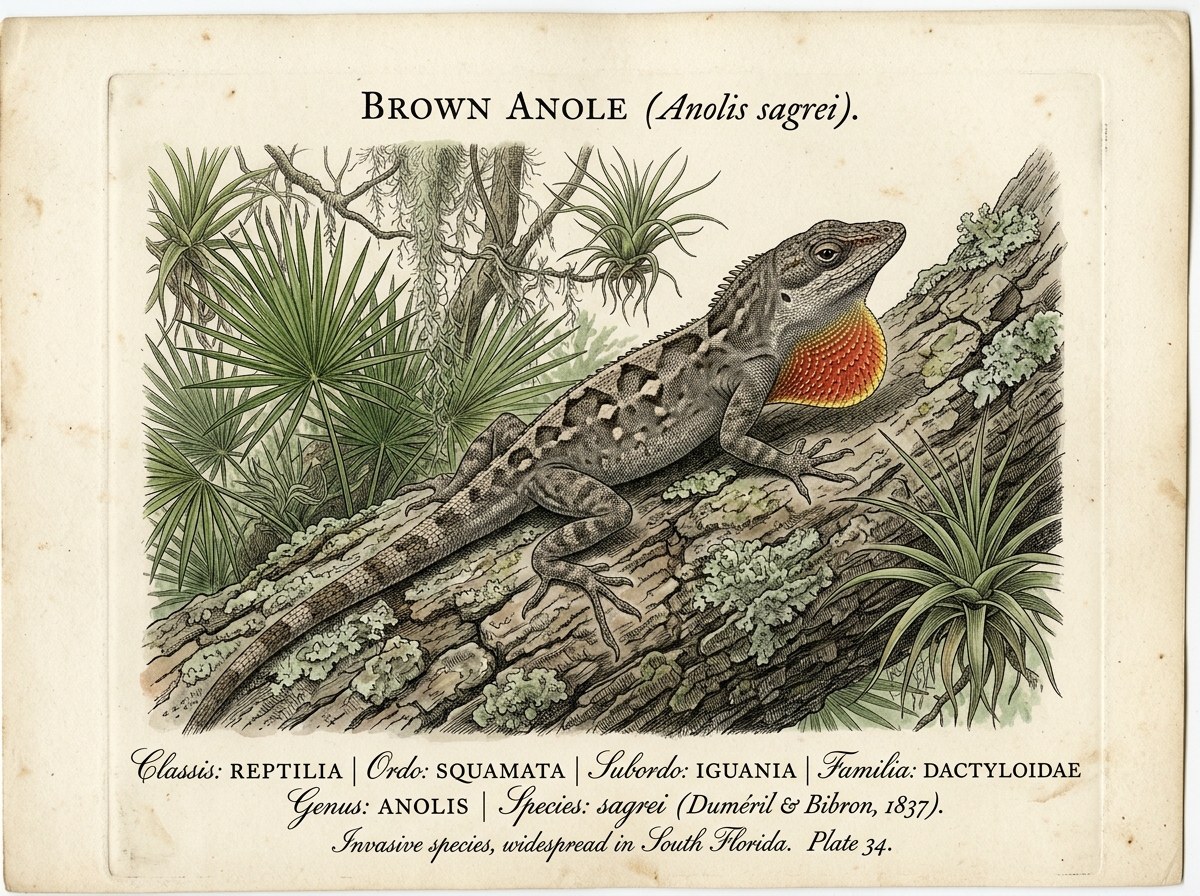
Brown Anole
Anolis sagrei[Dactyloidae]
Status:Non-Native Invasive Competitor (Est
Diet Role:Aggressive insectivore; outcompetes
Mass / Length:Total length: 12–21 cm (5.0–8.3 in). M
Habitat:Ground level, fallen logs, lower tree
Shorter blunt snout; gray-brown coloration with dorsal chevrons (never turns green); bright yellow-orange dewlap with white border.
RANGE: Ground level, fallen logs, lower tree trunks
Plate #12 • Apex & HerpetofaunaNative
4:3 Verified Plate
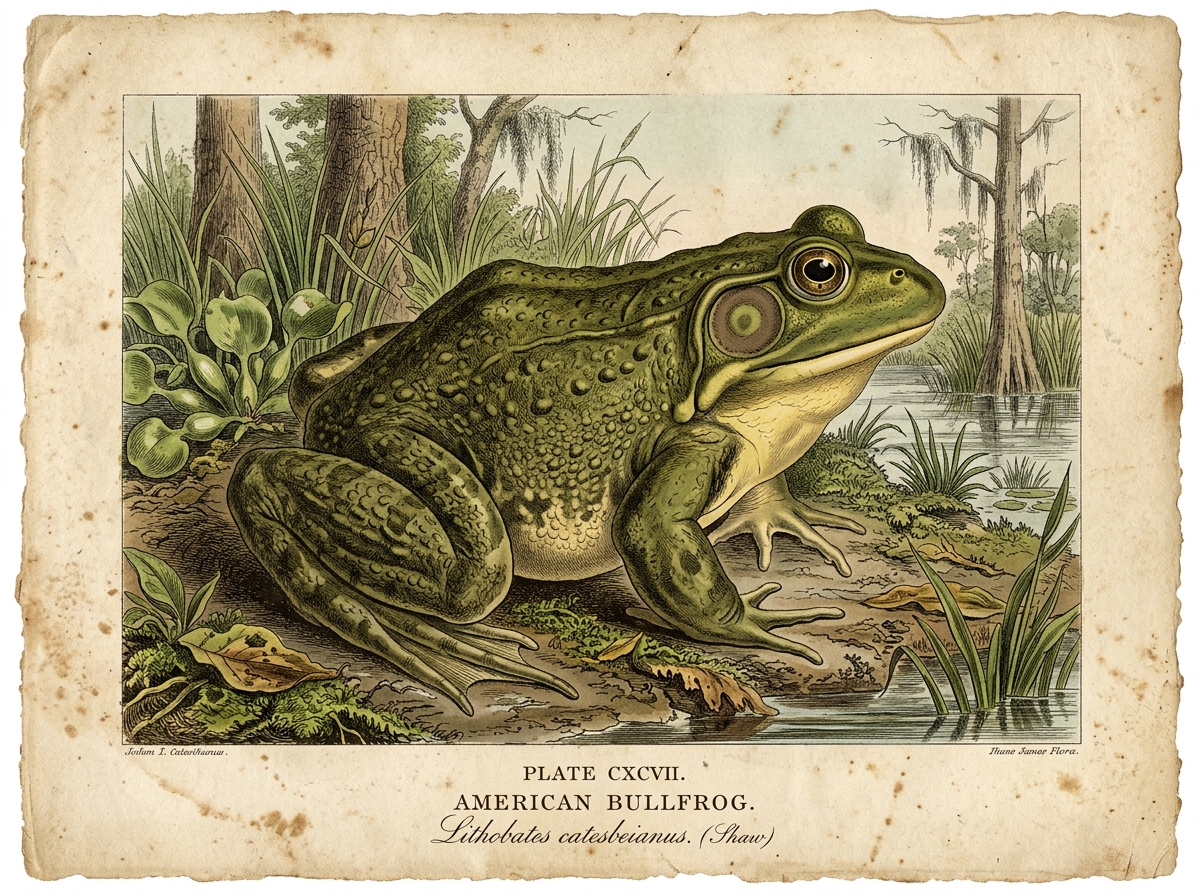
American Bullfrog
Lithobates catesbeianus[Ranidae]
Status:IUCN Least Concern
Diet Role:Voracious opportunistic gape-limite
Mass / Length:Body length: 9–15 cm (3.5–6.0 in). Mas
Habitat:Permanent deep sloughs, canals, and al
Lacks dorsolateral folds down the trunk; large prominent circular eardrum (tympanum) exceeding eye diameter in males. Consumed by neonate and juvenile pythons in wet sloughs.
RANGE: Permanent deep sloughs, canals, and alligator
Plate #13 • Apex & HerpetofaunaKeystone
4:3 Verified Plate
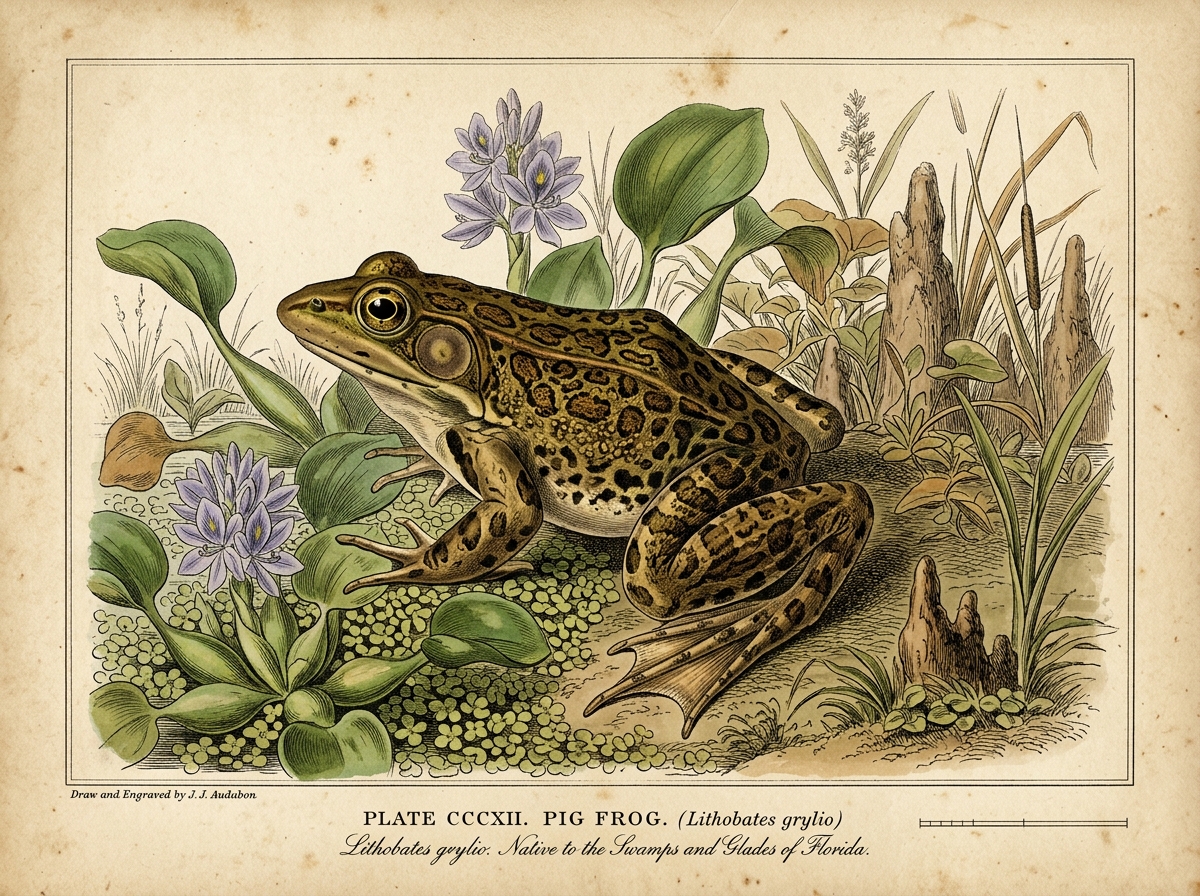
Pig Frog
Lithobates grylio[Ranidae]
Status:IUCN Least Concern; Keystone Wetlan
Diet Role:Aquatic carnivore specializing heav
Mass / Length:Body length: 8–14 cm (3.2–5.5 in). Mas
Habitat:Open sawgrass marshes and floating wat
Pointed snout; fully webbed hind feet extending to very tip of longest toe; narrow head profile. Core food item for young pythons during their first two years of development.
RANGE: Open sawgrass marshes and floating water lily
Plate #14 • Apex & HerpetofaunaNative
4:3 Verified Plate
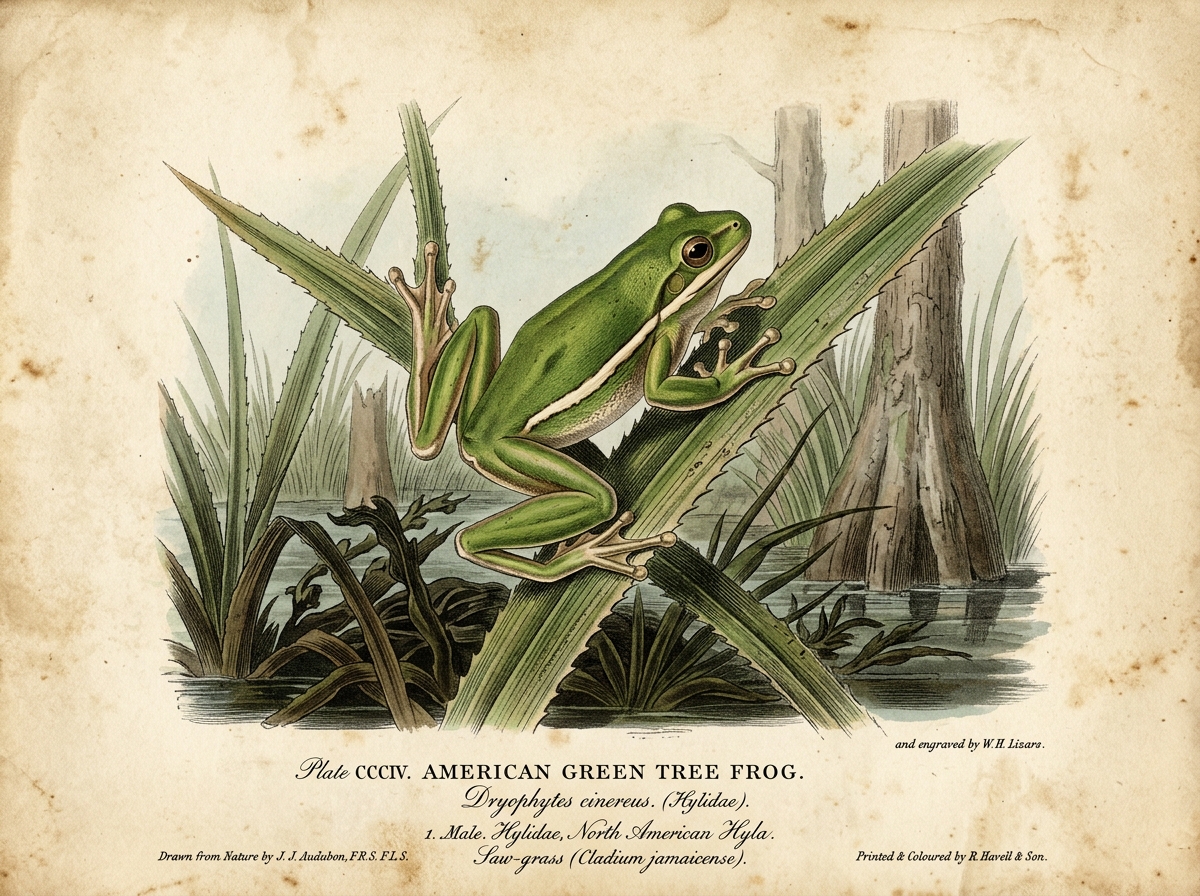
Green Tree Frog
Dryophytes cinereus[Hylidae]
Status:IUCN Least Concern
Diet Role:Nocturnal insectivore.
Mass / Length:Length: 3–6 cm (1.2–2.4 in). Mass: 4–1
Habitat:Emergent sawgrass stems, cattails, and
Smooth vibrant green skin with a distinct white or cream lateral stripe from jaw down flanks; expanded adhesive toe pads. Minor prey for emergent python hatchlings.
RANGE: Emergent sawgrass stems, cattails, and cypres
Plate #15 • Apex & HerpetofaunaInvasive
4:3 Verified Plate
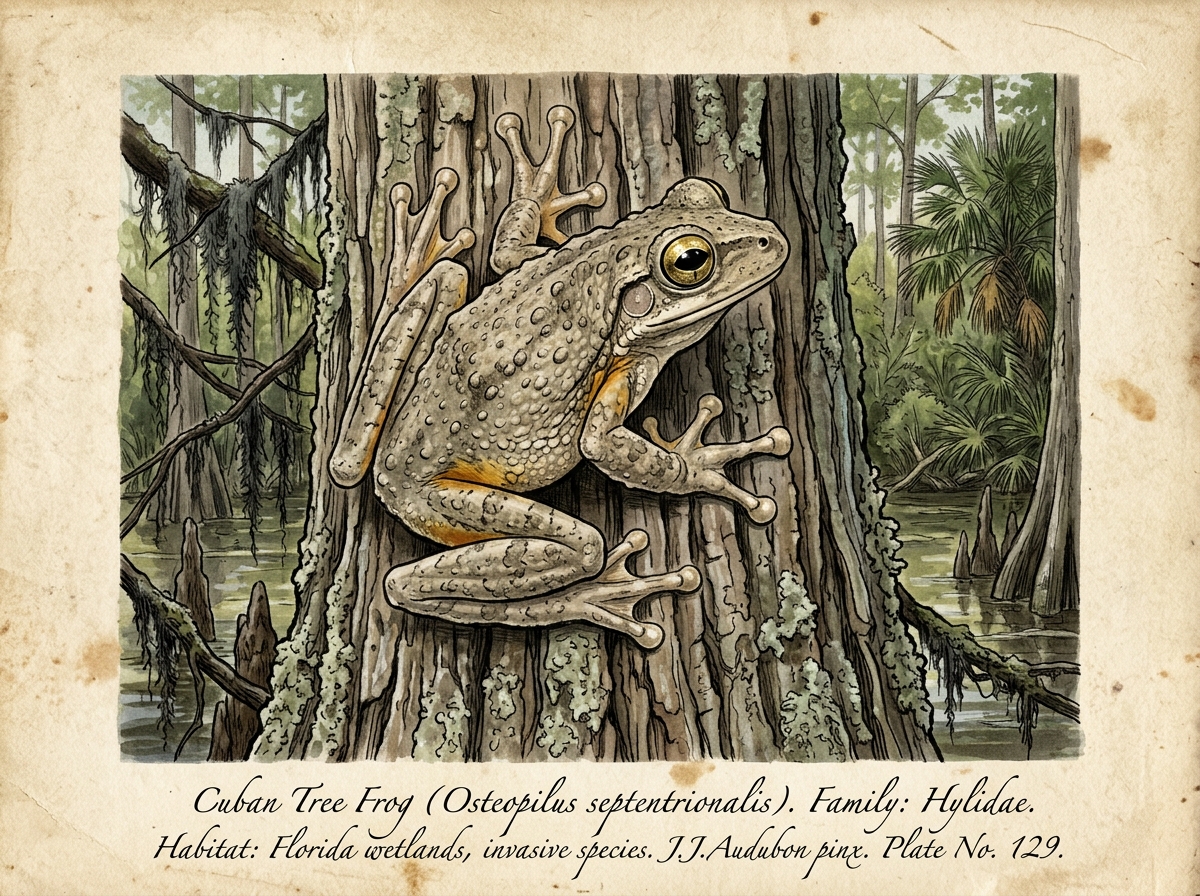
Cuban Tree Frog
Osteopilus septentrionalis[Hylidae]
Status:Non-Native Noxious Invasive
Diet Role:Dominant invasive predator devourin
Mass / Length:Length: 3.8–13.0 cm (1.5–5.1 in). Mass
Habitat:Hammocks, tree islands, and building i
Bumpy warty skin; massive toe discs; skin fused to skull bone; irritating toxic skin secretions.
RANGE: Hammocks, tree islands, and building infrastr
Plate #16 • MammalsEndangered
4:3 Verified Plate
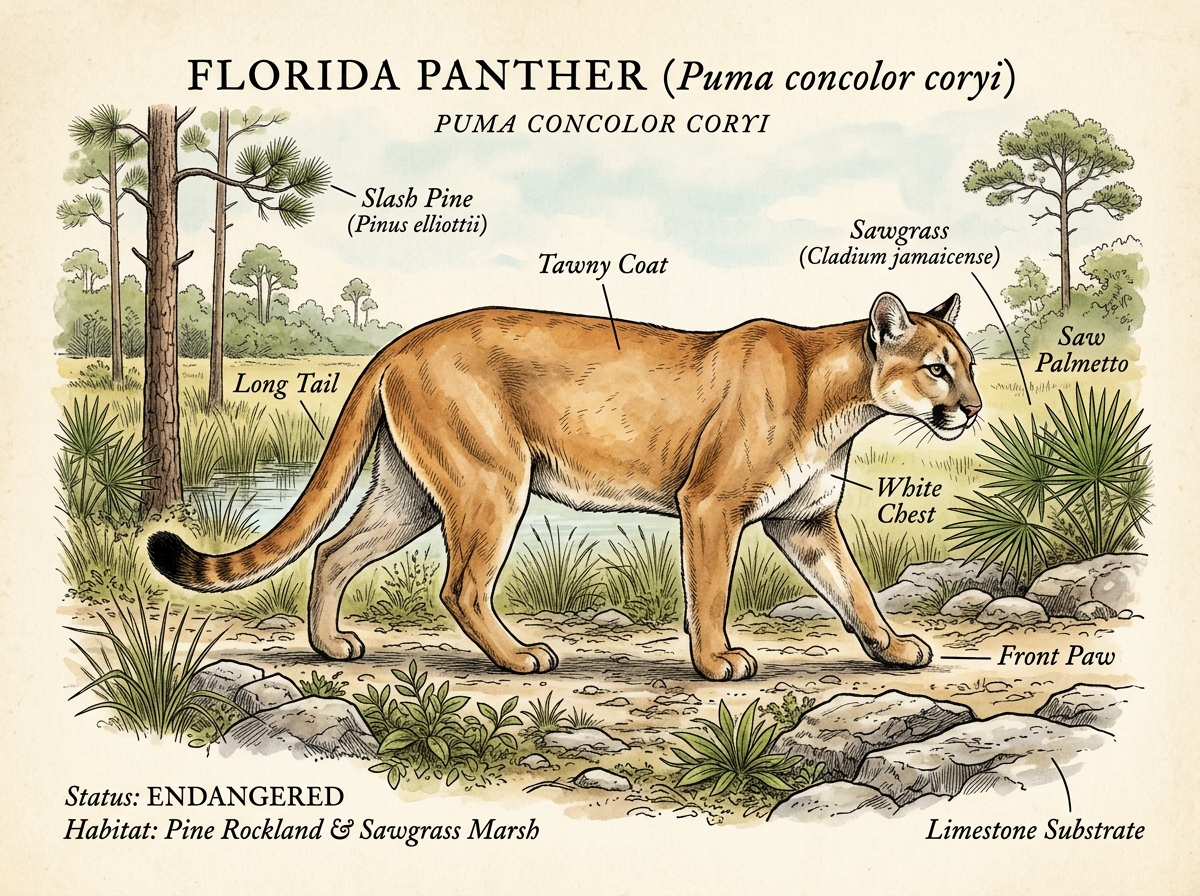
Florida Panther
Puma concolor coryi[Felidae]
Status:USFWS Endangered; Florida FWC Feder
Diet Role:Native apex hypercarnivore. Preys o
Mass / Length:Males: 45–73 kg (100–160 lbs), length
Habitat:Dense hardwood hammocks, pinelands, an
Tawny-buff dorsal coat with creamy white throat and chest; crook at tail tip and dorsal cowlick (classic genetic markers). Adult panthers occasionally kill and eat pythons; however, pythons have caused severe indirect harm by collapsing the small-to-medium mammal biomass (rabbits, raccoons), forcing panthers into extreme dietary reliance on deer and intensifying territorial stress.
RANGE: Dense hardwood hammocks, pinelands, and mixed
Plate #17 • MammalsNative
4:3 Verified Plate
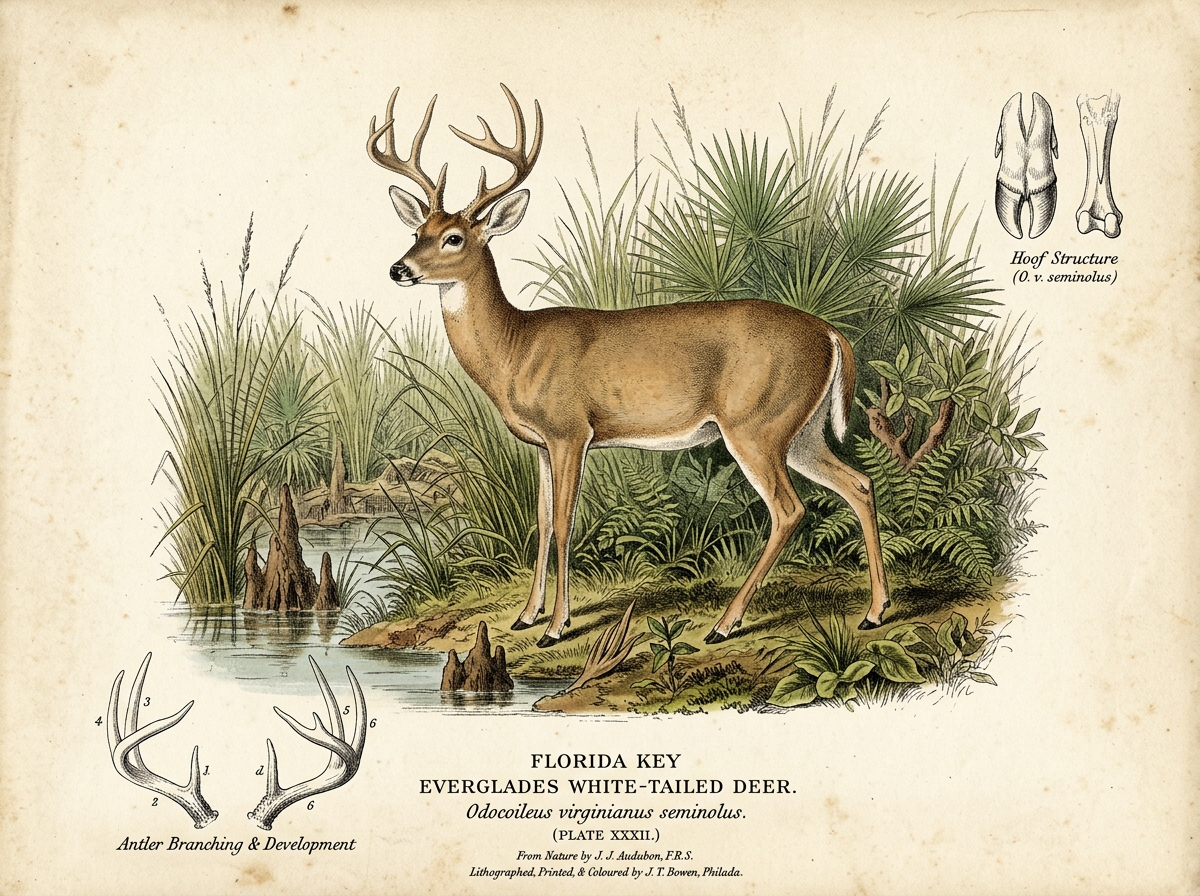
Florida White-tailed Deer
Odocoileus virginianus seminolus[Cervidae]
Status:IUCN Least Concern; Florida FWC Man
Diet Role:Primary herbivore browsing leaves,
Mass / Length:Bucks: 50–57 kg (110–125 lbs). Does: 4
Habitat:Wet marl prairies, hammock edges, and
Small stature; reddish-brown summer coat turning grayish in winter; broad white underside of tail flashing when fleeing. High Mortality Target. Pythons over 3.5 m (11.5 ft) regularly ambush, constrict, and consume adult deer, including antlered bucks. Python predation heavily impacts fawn recruitment, directly competing with the Florida panther.
RANGE: Wet marl prairies, hammock edges, and cypress
Plate #18 • MammalsNative
4:3 Verified Plate
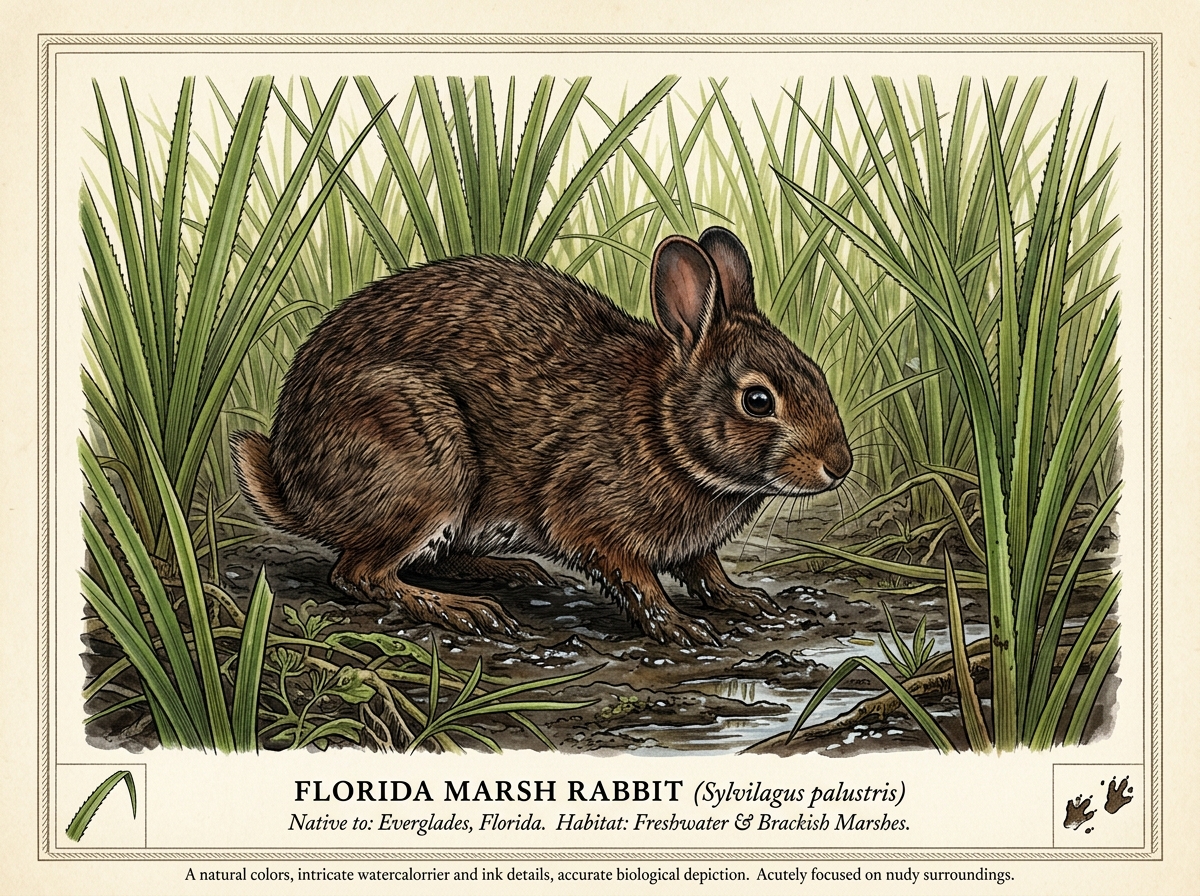
Marsh Rabbit
Sylvilagus palustris paludicola[Leporidae]
Status:IUCN Least Concern; Population Exti
Diet Role:Keystone primary consumer feeding o
Mass / Length:Length: 43–44 cm (17 in). Mass: 1.0–1.
Habitat:Freshwater sawgrass marshes, wet marl
Short rounded ears; dingy gray-brown underside of tail (lacks the white cotton tail of other rabbits); walks by alternating feet rather than hopping. Catastrophic Impact. Documented 100% decline in detection across Everglades National Park road surveys (Dorcas et al. 2012 PNAS). Pythons are the definitive primary mortality factor, wiping out the rabbit from central Everglades regions.
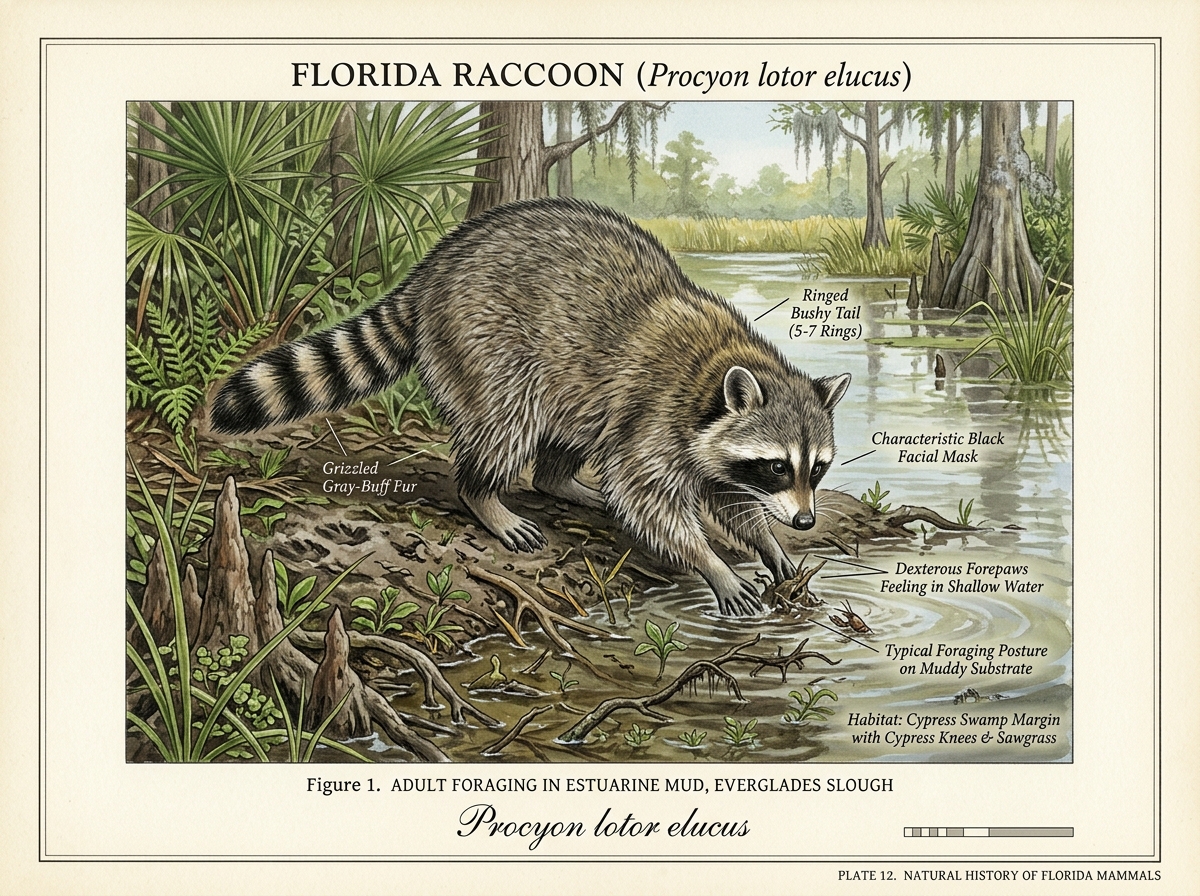
Mass / Length:Mass: 3.5–9.0 kg (7.7–20.0 lbs). Lengt
Habitat:Hammocks, tree islands, mangrove keys,
Prominent black facial bandit mask; bushy ringed tail; dexterous hand-like front paws. 99.3% Population Decline in Everglades National Park (Dorcas et al. 2012). Raccoons serve as preferred meals for medium-sized pythons (2–3 m). While raccoons occasionally raid python nests, their decimated density prevents effective population control.
RANGE: Hammocks, tree islands, mangrove keys, and ca
Plate #20 • MammalsNative
4:3 Verified Plate
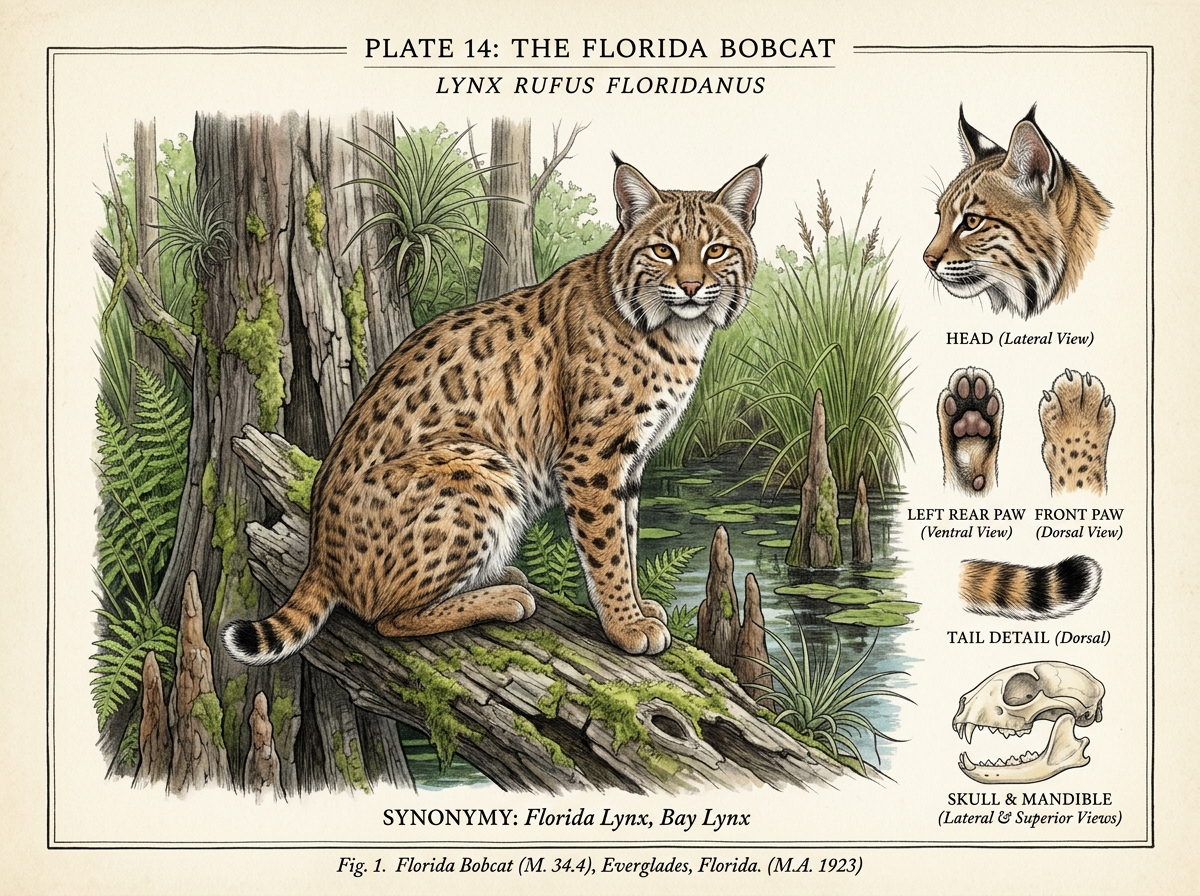
Bobcat
Lynx rufus floridanus[Felidae]
Status:IUCN Least Concern; Managed Native
Diet Role:Carnivorous mesopredator hunting ro
Mass / Length:Mass: 6–14 kg (13–31 lbs). Length: 70–
Habitat:Cypress swamps, sawgrass tree islands,
Short bobbed black-tipped tail with white underside; tufted ears; heavily spotted coat; facial ruff. 87.5% Decline in southern Everglades surveys. However, a landmark 2021 trail camera study in Big Cypress National Preserve documented a wild bobcat actively raiding a python nest, destroying and caching python eggs, and battling a 14-foot female python—the first confirmed native mammalian nest predation.
RANGE: Cypress swamps, sawgrass tree islands, and ha
Plate #21 • MammalsNative
4:3 Verified Plate
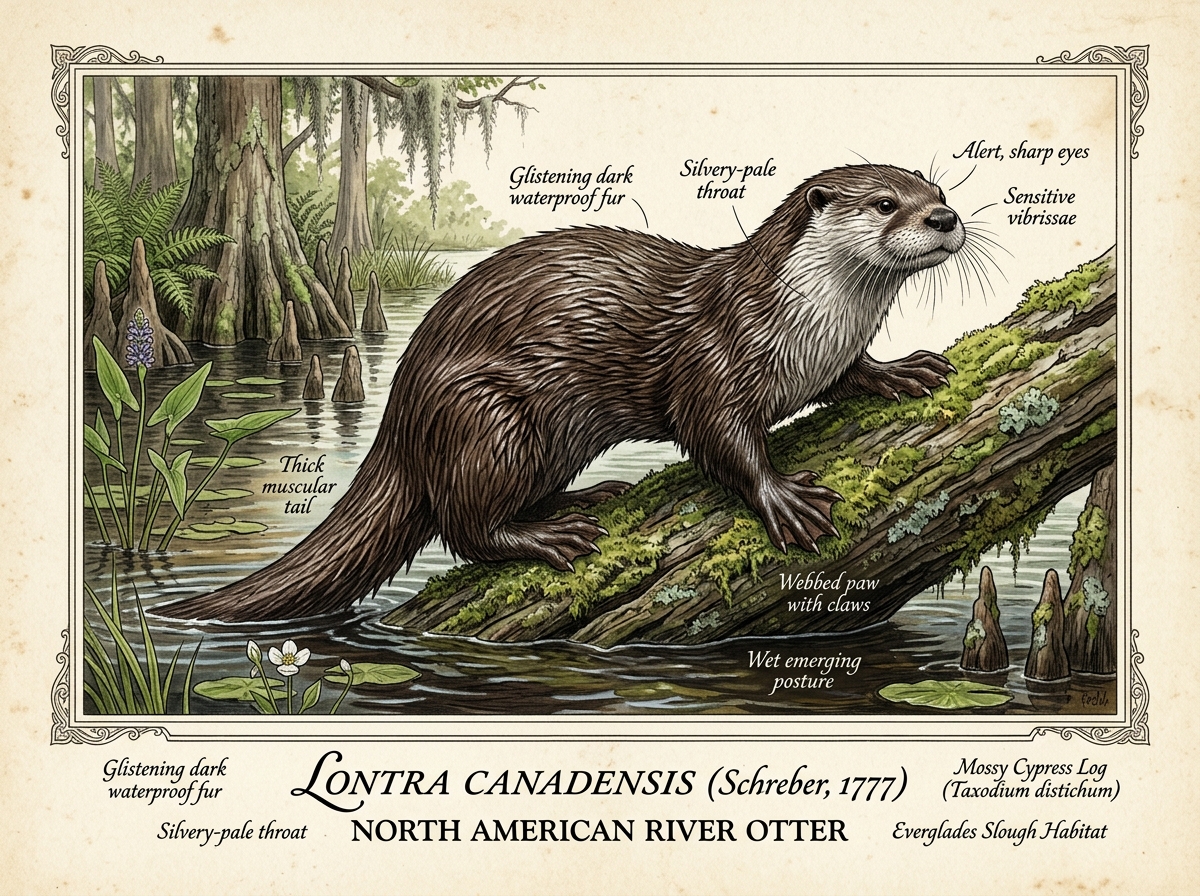
North American River Otter
Lontra canadensis[Mustelidae]
Status:IUCN Least Concern
Diet Role:Aquatic hyper-carnivore specializin
Mass / Length:Length: 90–130 cm (35–51 in). Mass: 5–
Habitat:Deep sloughs, river systems, cypress s
Torpedo-shaped streamlined body; lustrous waterproof chocolate-brown pelt with pale throat; broad tapered tail; fully webbed feet. Vulnerable to submerged aquatic ambush by pythons. Otters frequently appear in python necropsies.
RANGE: Deep sloughs, river systems, cypress strands,
Plate #22 • MammalsThreatened
4:3 Verified Plate
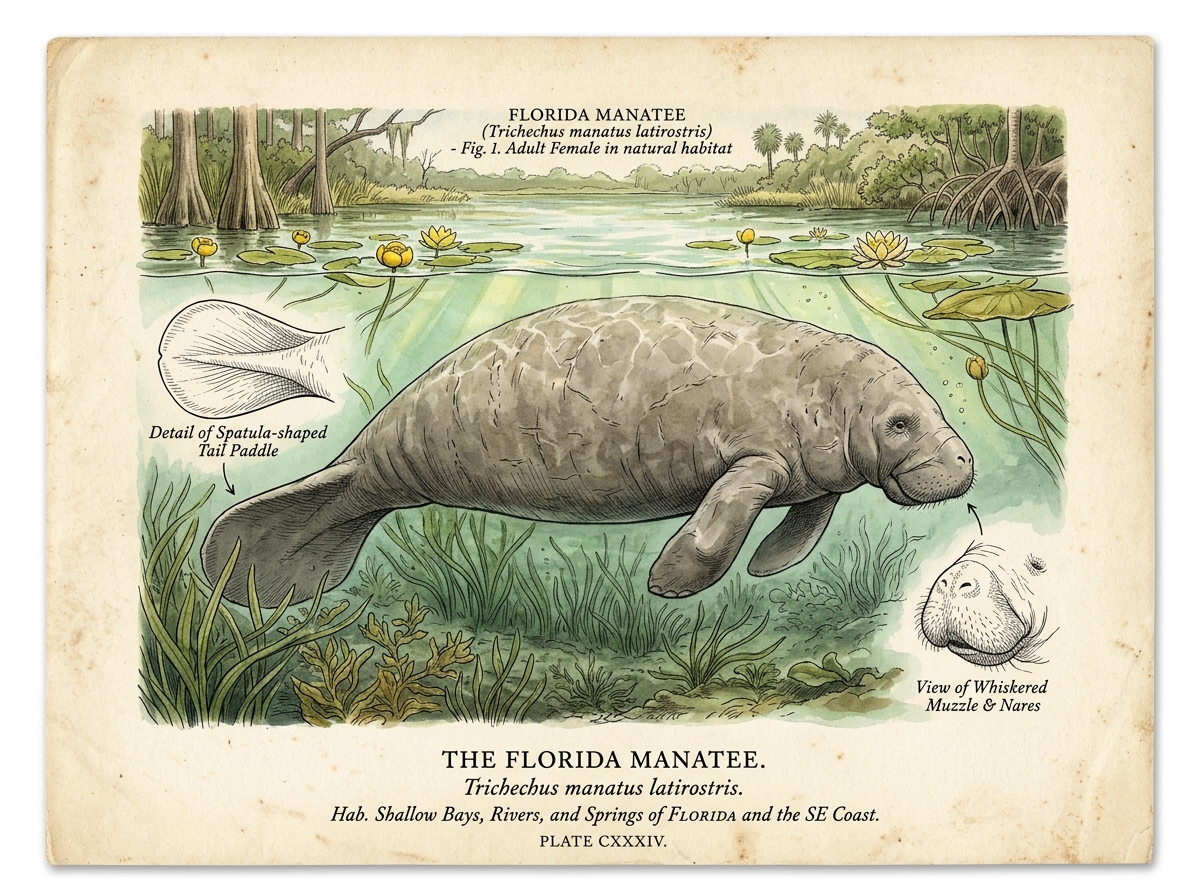
West Indian Manatee
Trichechus manatus latirostris[Trichechidae]
Status:IUCN Vulnerable; USFWS Threatened;
Diet Role:Fully herbivorous aquatic grazer co
Mass / Length:Length: 2.7–3.5 m (8.9–11.5 ft). Mass:
Habitat:Coastal mangrove bays, brackish canals
Massive rounded grayish body; horizontal paddle-shaped tail; flexible cleft prehensile snout. Zero Direct Interaction. Manatees are far too massive to be python prey and occupy deeper open channels where pythons do not establish hunting territory.
RANGE: Coastal mangrove bays, brackish canals, and w
Plate #23 • MammalsNative
4:3 Verified Plate
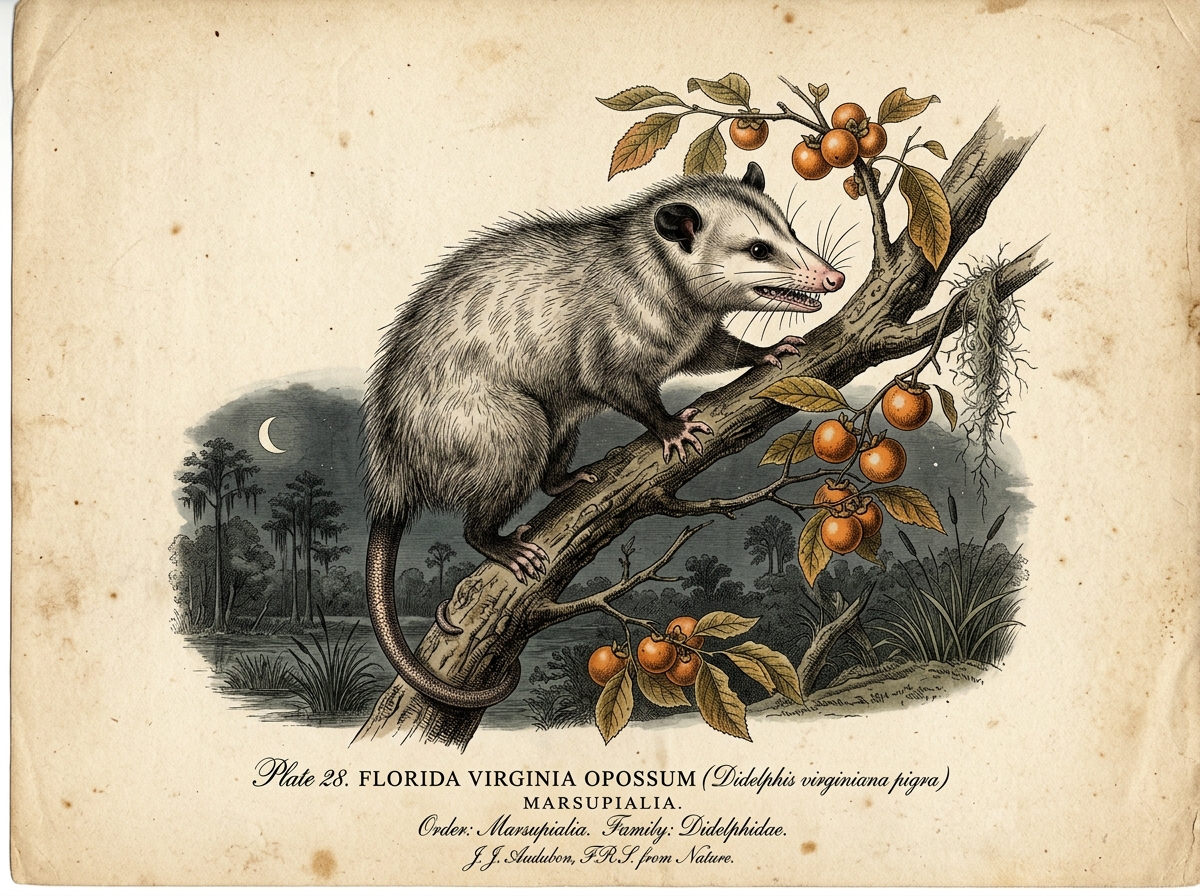
Virginia Opossum
Didelphis virginiana pigra[Didelphidae]
Status:IUCN Least Concern; Ecologically Co
Diet Role:Nocturnal scavenger and omnivore; r
Mass / Length:Mass: 1.8–4.0 kg (4.0–8.8 lbs). Length
Habitat:Tree islands, hammocks, and canal spoi
White pointed snout; hairless prehensile tail; black ears; solitary marsupial pouch. 98.9% Population Decline in Everglades National Park (Dorcas et al. 2012). Extremely vulnerable to python scent-tracking and ambush due to slow terrestrial pace.
RANGE: Tree islands, hammocks, and canal spoil banks
Plate #24 • MammalsNative
4:3 Verified Plate
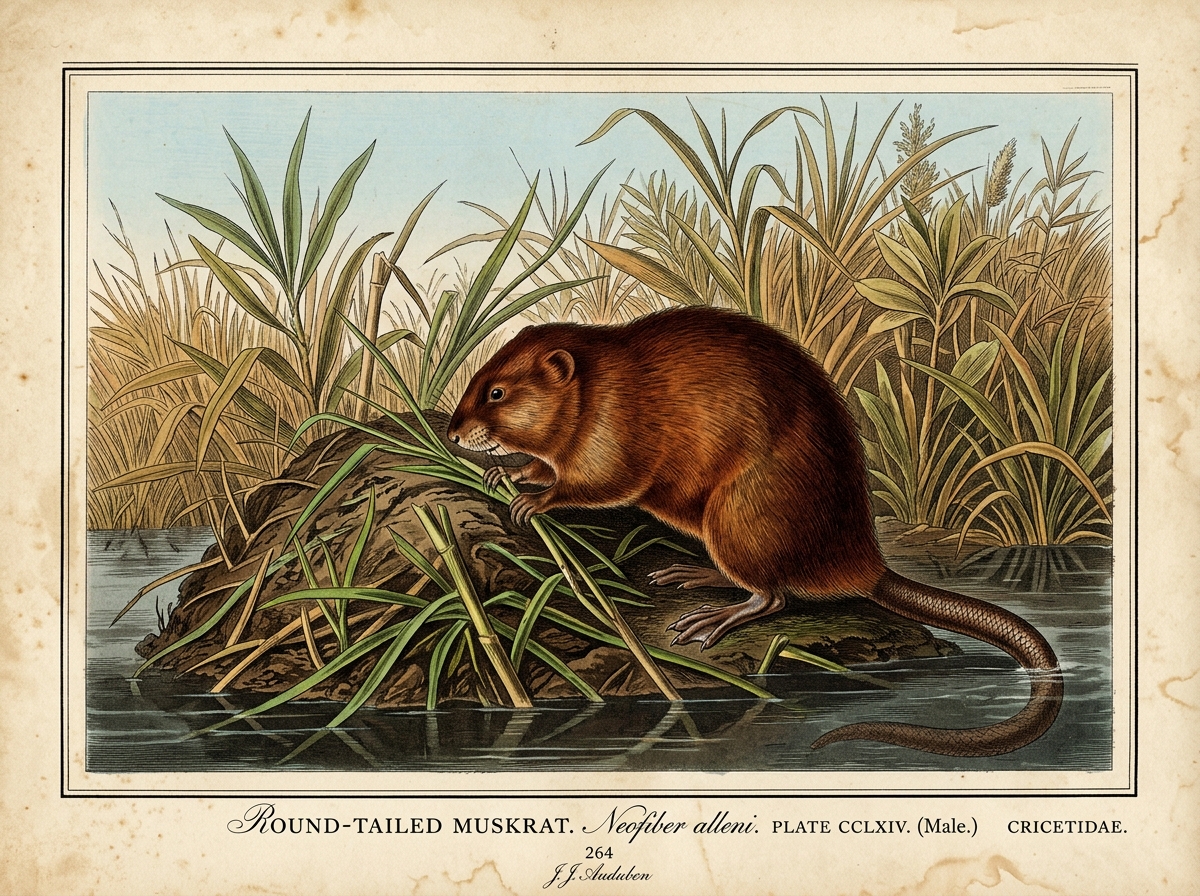
Round-tailed Muskrat
Neofiber alleni[Cricetidae]
Status:IUCN Least Concern; Florida FWC Spe
Diet Role:Herbivore building woven grass lodg
Mass / Length:Total length: 28–38 cm (11–15 in). Mas
Habitat:Shallow sawgrass marshes, wet marl pra
Round hairy tail (not laterally flattened like common muskrat); reddish-brown dense underfur; prominent emergent grass dome nests. Core caloric prey for subadult pythons (1–2 m) operating in shallow marsh systems.
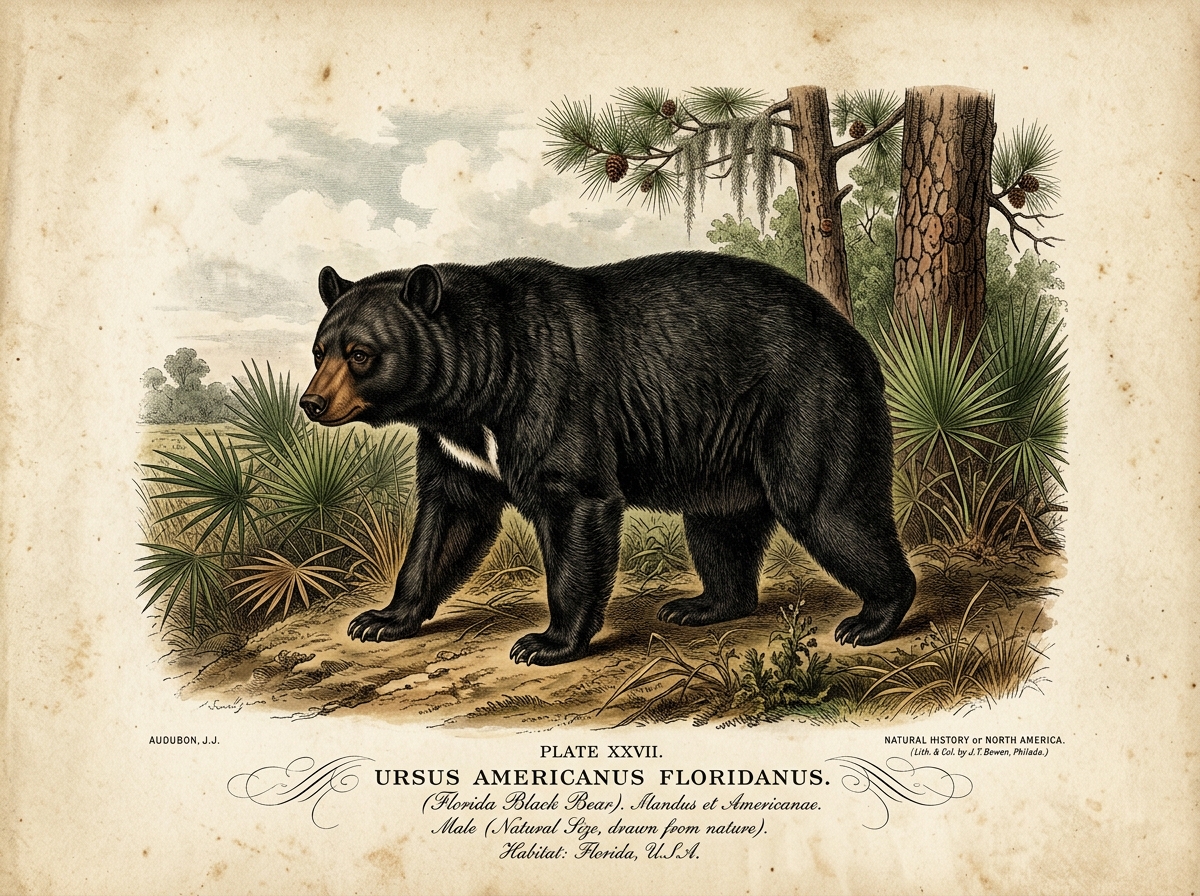
Mass / Length:Males: 113–204 kg (250–450 lbs). Femal
Habitat:Dense forested wetlands, cypress stran
Uniform glossy black fur; tan muzzle; straight nasal profile; five-toed plantigrade tracks. Minimal direct predation. Adult bears are too formidable for pythons. Bears may opportunistically scavenge python carcasses or raid nests.
RANGE: Dense forested wetlands, cypress strands, and
Plate #26 • MammalsNative
4:3 Verified Plate
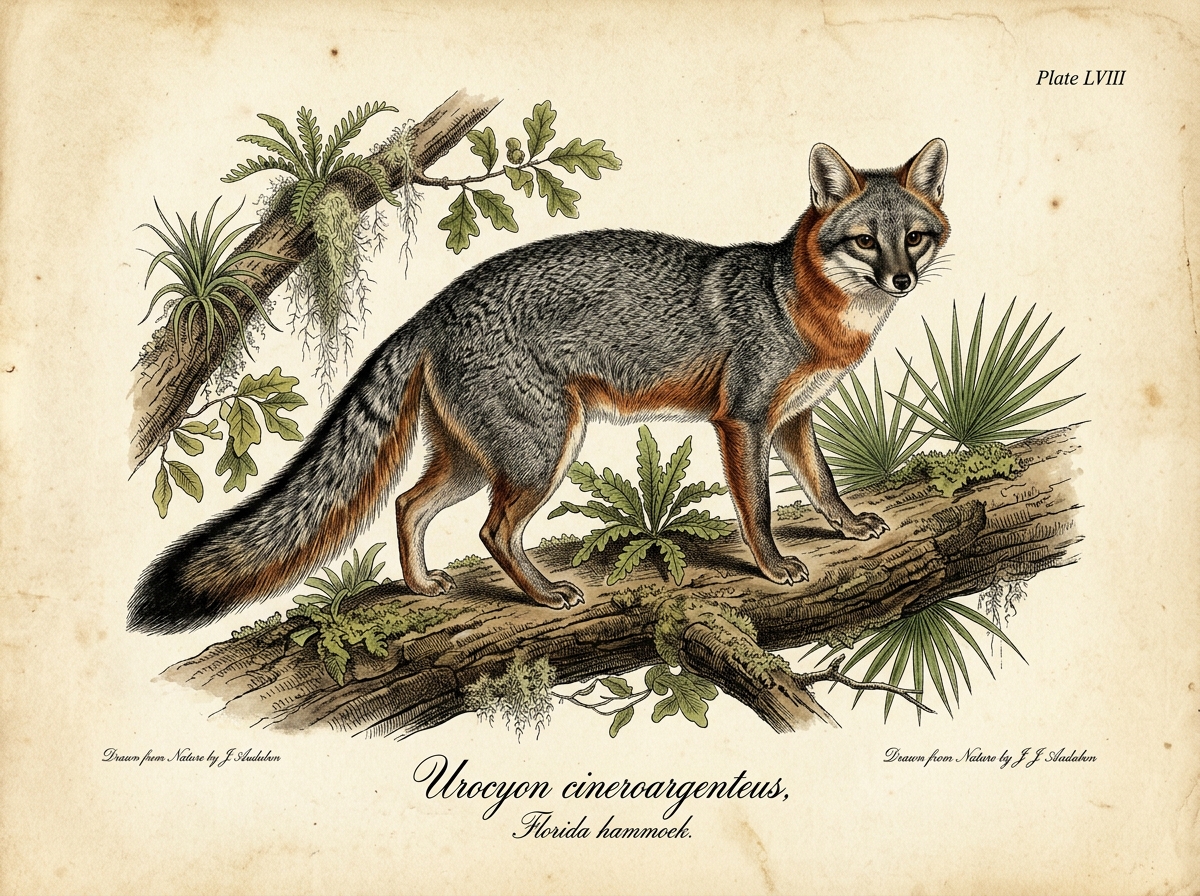
Gray Fox
Urocyon cinereoargenteus[Canidae]
Status:IUCN Least Concern
Diet Role:Omnivorous mesopredator hunting sma
Mass / Length:Mass: 3–5 kg (6.6–11.0 lbs). Length: 8
Habitat:Hardwood hammocks, pinelands, and tran
Salt-and-pepper grizzled gray coat with reddish flanks and neck; black dorsal stripe ending in black tail tip; hooked semi-retractable claws. Severe population decline across southern Florida; vulnerable on the ground and in trees to large climbing pythons.
RANGE: Hardwood hammocks, pinelands, and transitiona
Plate #27 • MammalsThreatened
4:3 Verified Plate
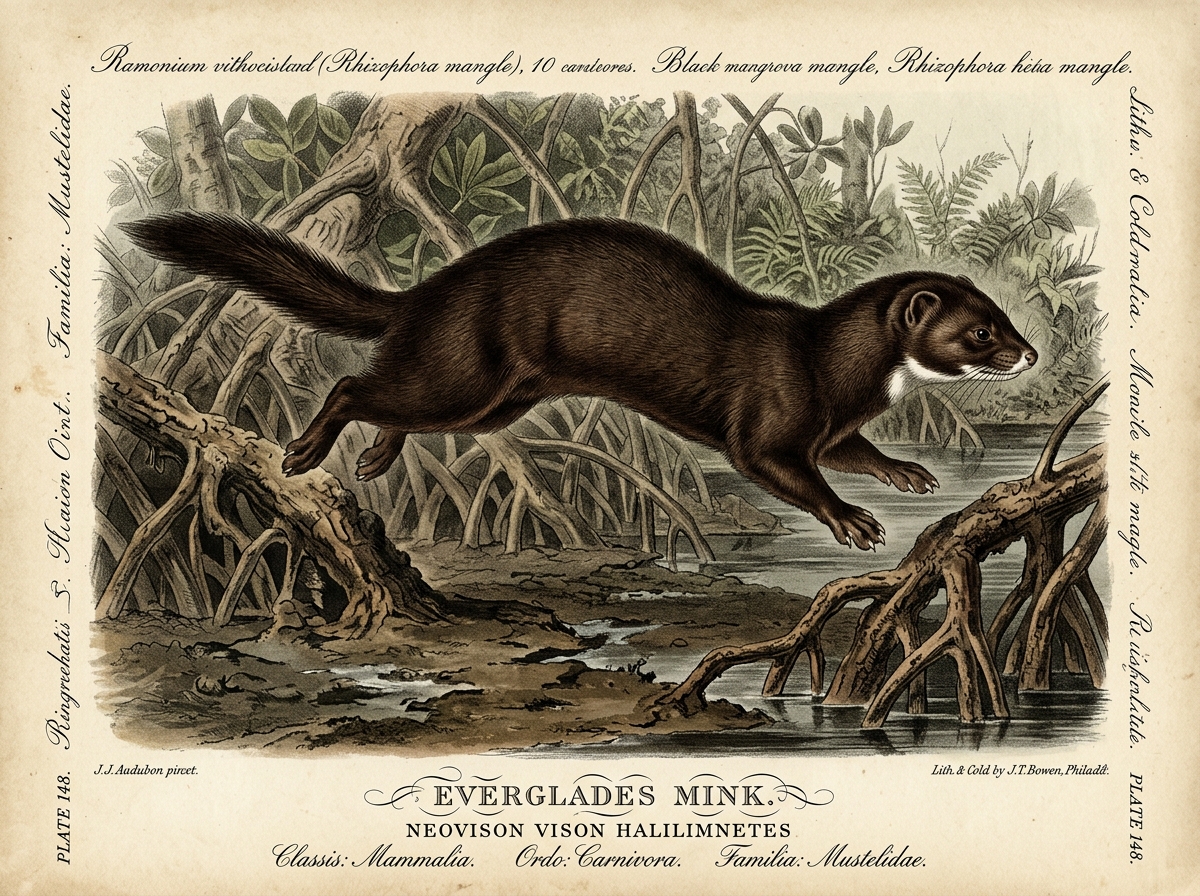
Everglades Mink
Neovison vison halilimnetes[Mustelidae]
Status:Florida FWC State Threatened; USFWS
Diet Role:Semi-aquatic carnivore hunting smal
Mass / Length:Length: 40–70 cm (16–28 in). Mass: 0.5
Habitat:Shallow freshwater marshes, wet marl f
Sleek dark chocolate-brown body with small white chin/throat patch; slightly bushy tail. Extreme habitat overlap with juvenile and subadult pythons; populations heavily suppressed by constrictor proliferation.
RANGE: Shallow freshwater marshes, wet marl flats, a
Plate #28 • AvifaunaEndangered
4:3 Verified Plate
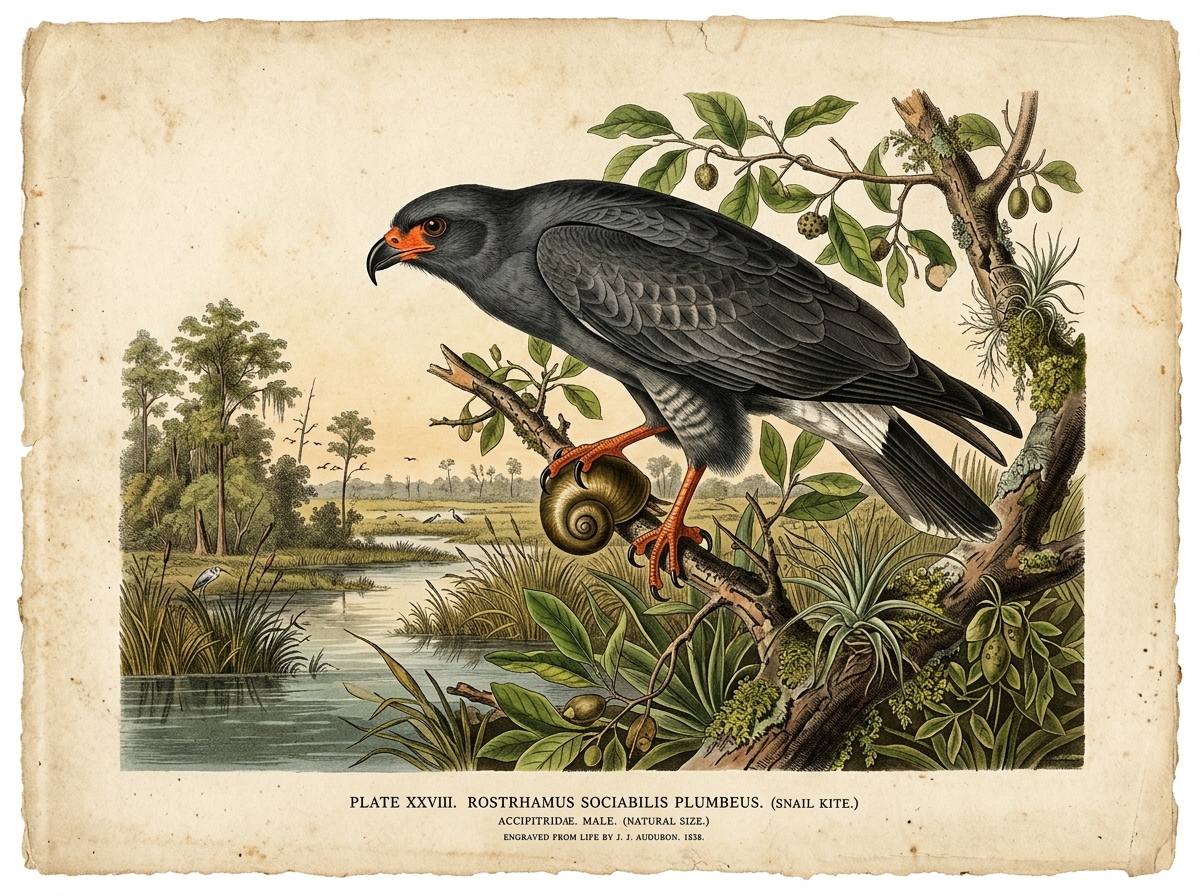
Everglades Snail Kite
Rostrhamus sociabilis plumbeus[Accipitridae]
Status:IUCN Least Concern (species); USFWS
Diet Role:Extreme Specialist Malacivore. Diet
Mass / Length:Length: 36–40 cm (14–16 in). Wingspan:
Habitat:Expansive shallow sloughs, open marshe
Deeply hooked, decurved sickle beak; square white rump patch in flight; males slate gray with red cere and legs; females streaked brown. Pythons raid low-hanging willow nests over water, preying on eggs, chicks, and brooding adults.
RANGE: Expansive shallow sloughs, open marshes, and
Plate #29 • AvifaunaThreatened
4:3 Verified Plate
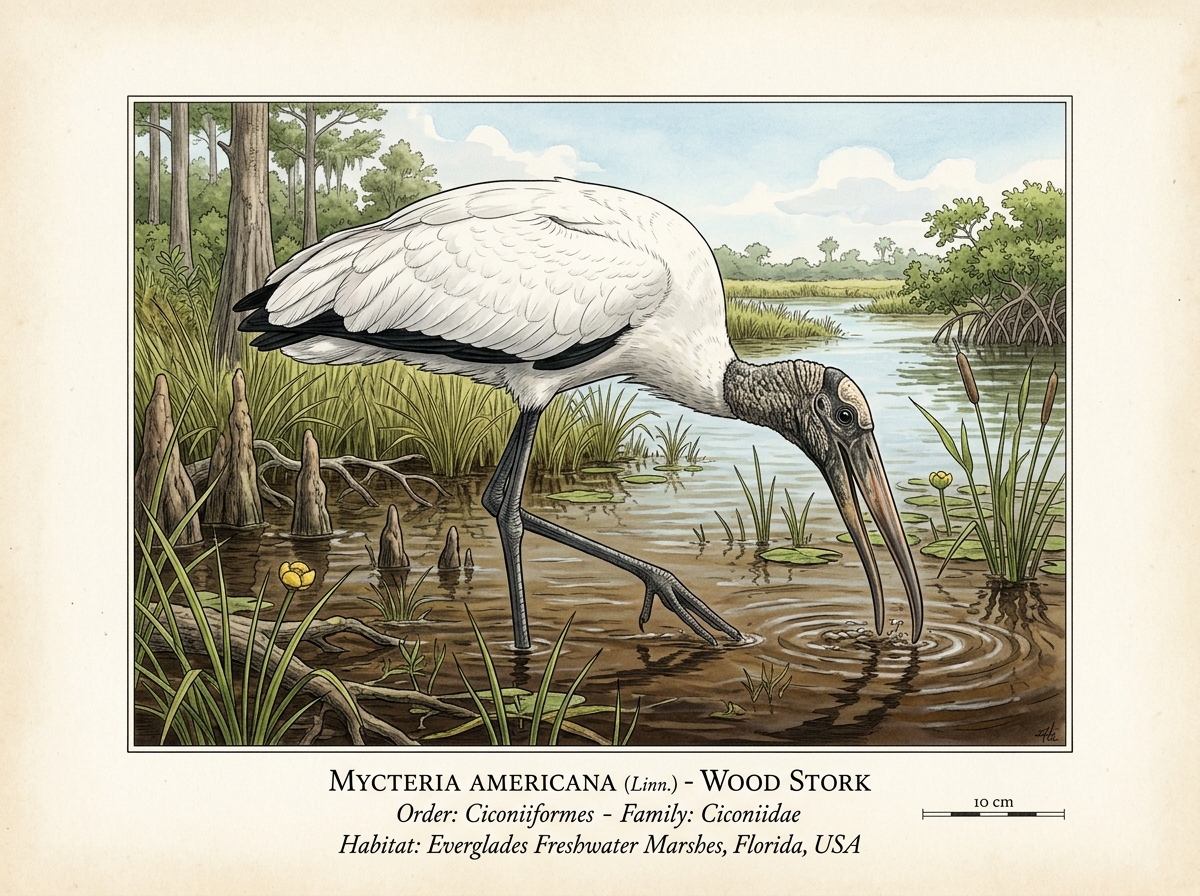
Wood Stork
Mycteria americana[Ciconiidae]
Status:IUCN Least Concern; USFWS Threatene
Diet Role:Tactile groping specialist. Bill sn
Mass / Length:Standing height: 85–115 cm (33–45 in).
Habitat:Cypress swamps, mangrove rookeries, an
Huge white body with black flight feathers; naked dark gray scaly head and neck; thick curved beak; flies with neck outstretched. Rookeries in mangroves and cypresses are vulnerable to climbing pythons that consume fledglings. Foraging adults are ambushed at drying pools.
RANGE: Cypress swamps, mangrove rookeries, and falli
Plate #30 • AvifaunaThreatened
4:3 Verified Plate
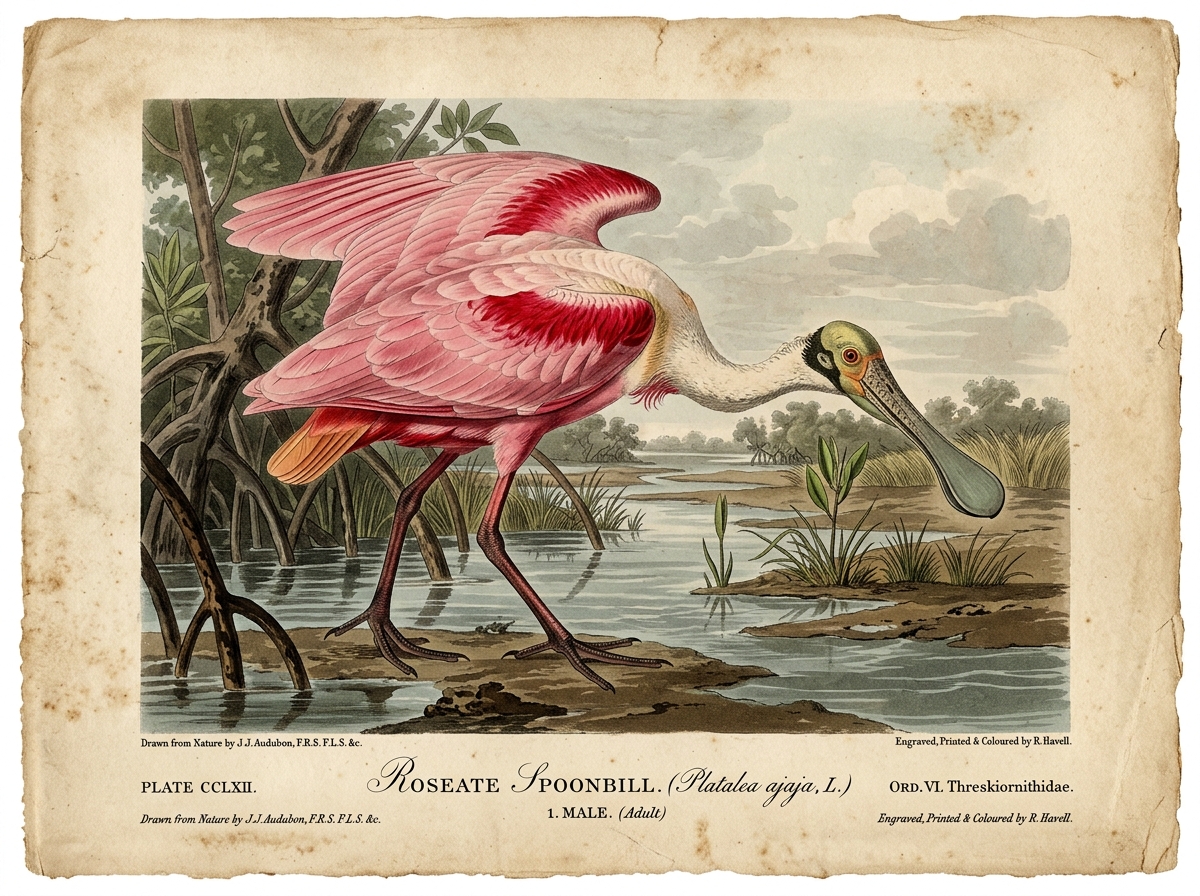
Roseate Spoonbill
Platalea ajaja[Threskiornithidae]
Status:IUCN Least Concern; Florida FWC Sta
Diet Role:Tactile filter carnivore sweeping i
Mass / Length:Standing height: 71–86 cm (28–34 in).
Habitat:Coastal mangrove keys, shallow estuari
Unmistakable bright pink plumage with ruby-carmine wing coverts; bare greenish head; broad flattened spoon-shaped bill. Heavy nest predation by swimming and climbing pythons in southern mangrove rookeries.
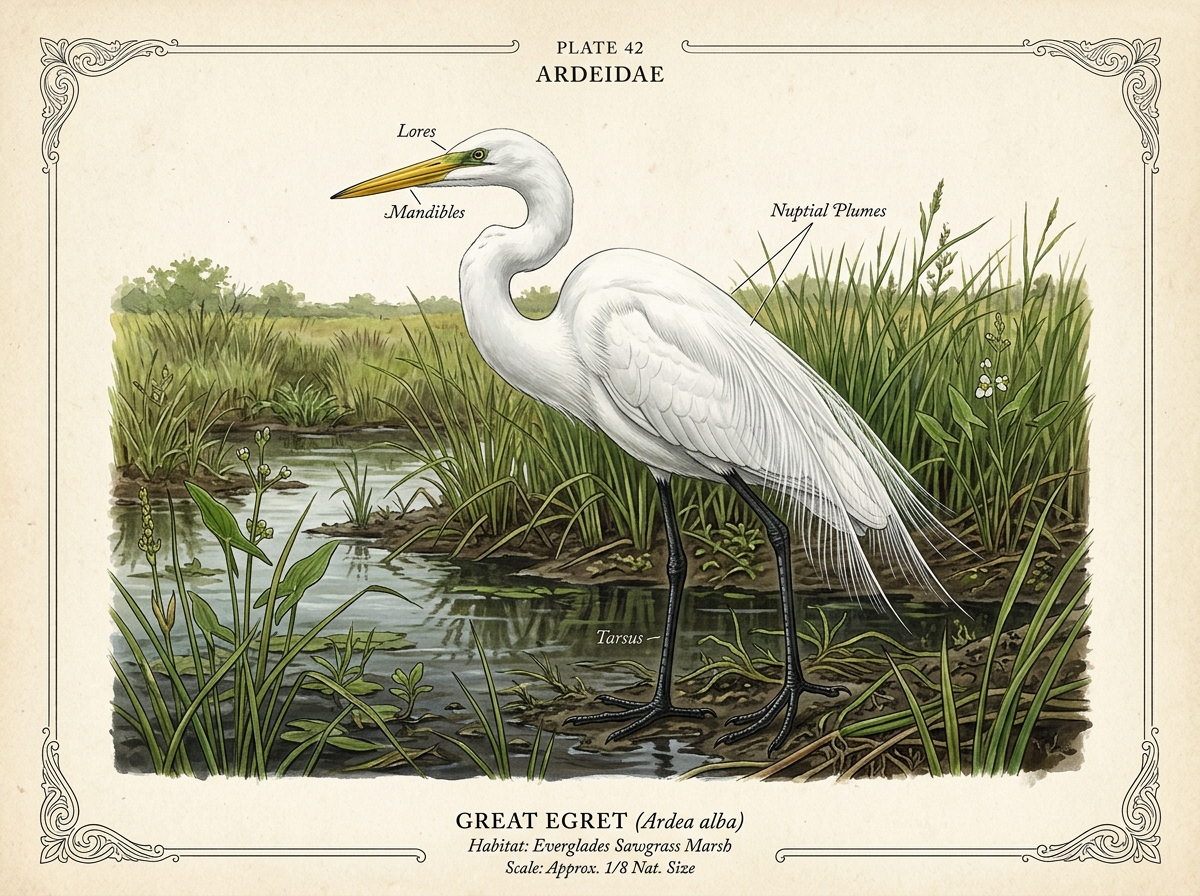
Mass / Length:Standing height: 80–104 cm (31–41 in).
Habitat:Wet prairies, sloughs, mangrove swamps
Pristine white plumage; sharp yellow dagger-like beak; solid black legs and feet; delicate nuptial plumes (aigrettes) during breeding. Bidirectional Interaction. Adult egrets are ambushed and eaten by large pythons; however, egrets actively hunt and consume hatchling pythons (< 60 cm) in shallow marshes.
RANGE: Wet prairies, sloughs, mangrove swamps, and c
Plate #32 • AvifaunaKeystone
4:3 Verified Plate
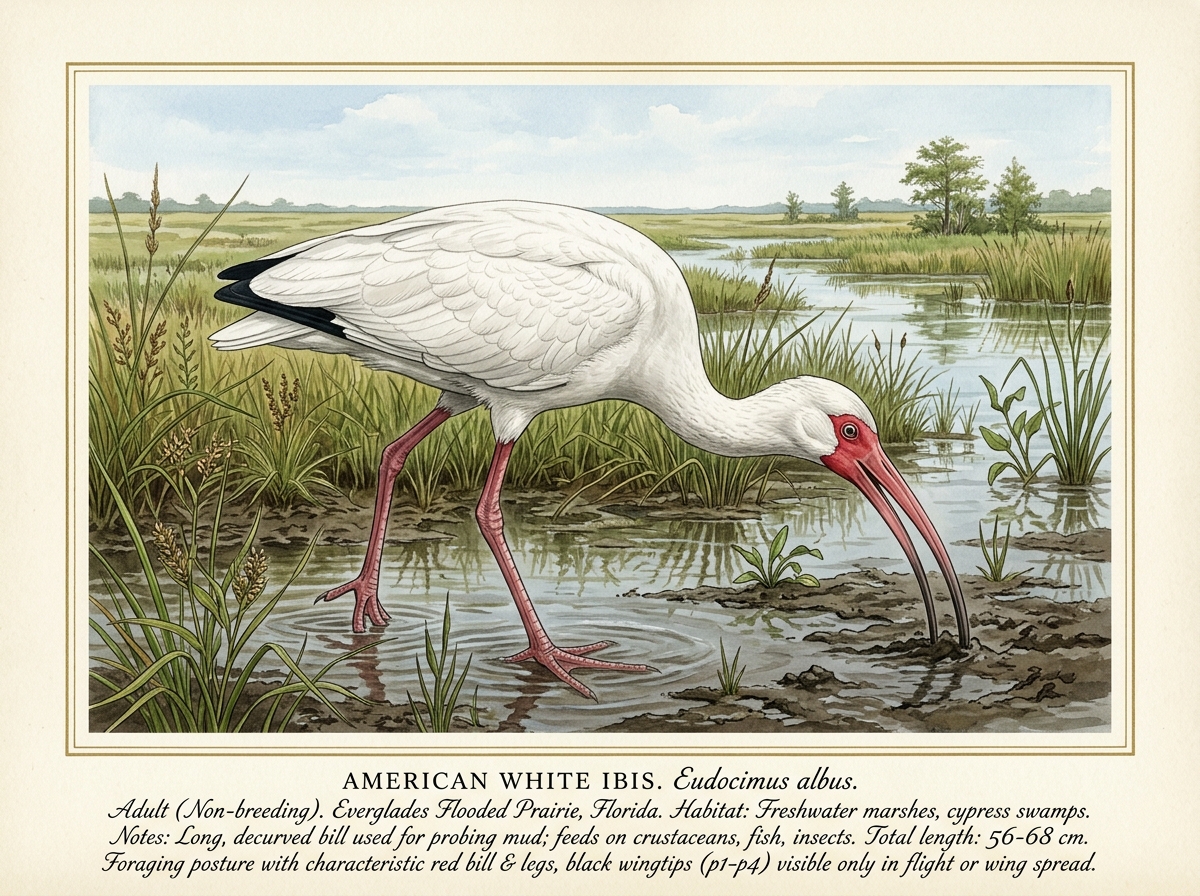
White Ibis
Eudocimus albus[Threskiornithidae]
Status:IUCN Least Concern; Keystone Wetlan
Diet Role:Non-visual tactile prober inserting
Mass / Length:Height: 56–68 cm (22–27 in). Wingspan:
Habitat:Marl prairies, wet pastures, and shall
Pure white plumage with bold black wingtips; long decurved red-pink bill; bright pink facial skin and legs. High colonial nesting density makes tree island rookeries magnet targets for foraging adult pythons.
RANGE: Marl prairies, wet pastures, and shallow floo
Plate #33 • AvifaunaKeystone
4:3 Verified Plate
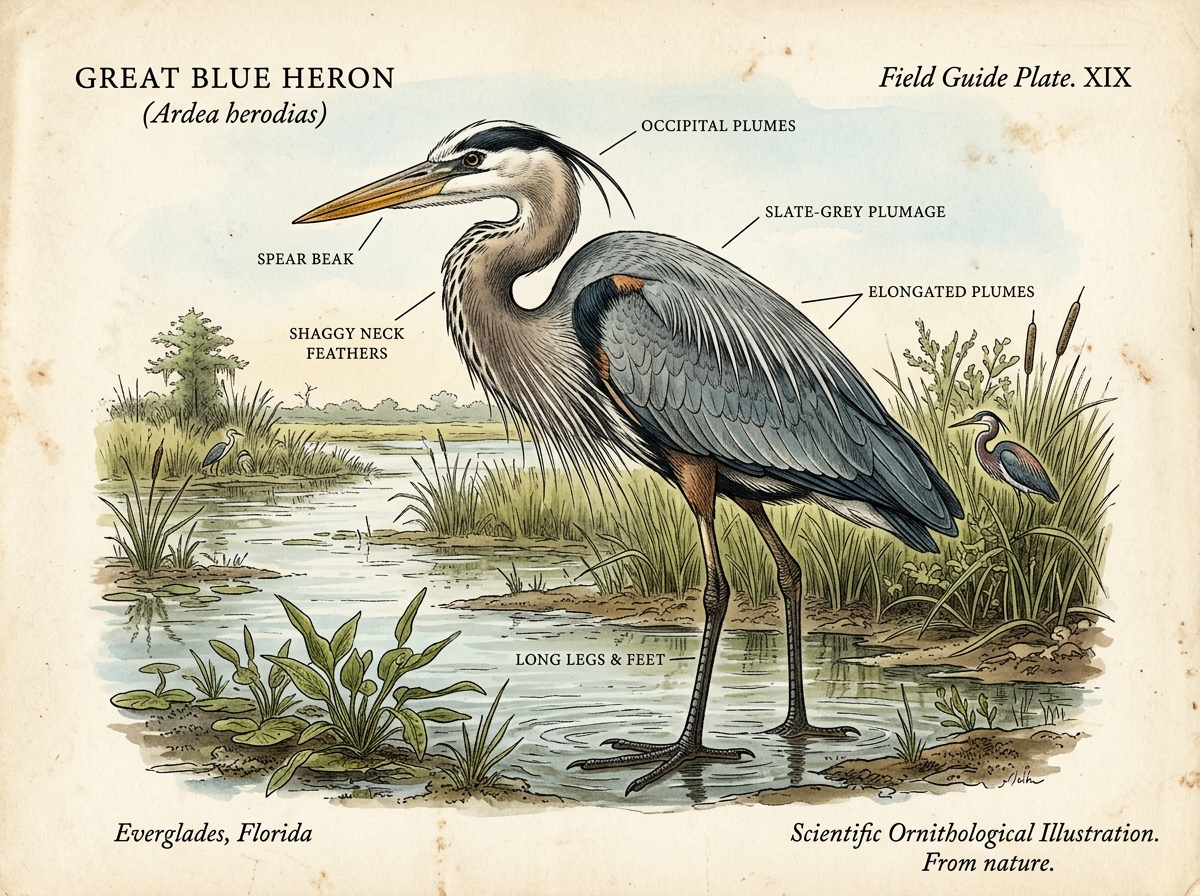
Great Blue Heron
Ardea herodias[Ardeidae]
Status:IUCN Least Concern; Protected Nativ
Diet Role:Top avian predator spearing large f
Mass / Length:Standing height: 97–137 cm (38–54 in).
Habitat:Deep slough margins, canals, sawgrass
Tall slate blue-gray body; black plumes above eye; heavy yellowish dagger bill; slow deep wingbeats with neck tucked in tight "S". Readily spears and swallows neonate and young juvenile pythons. Large adult pythons ambush full-grown herons in tall marsh vegetation.
RANGE: Deep slough margins, canals, sawgrass waterwa
Plate #34 • AvifaunaNative
4:3 Verified Plate
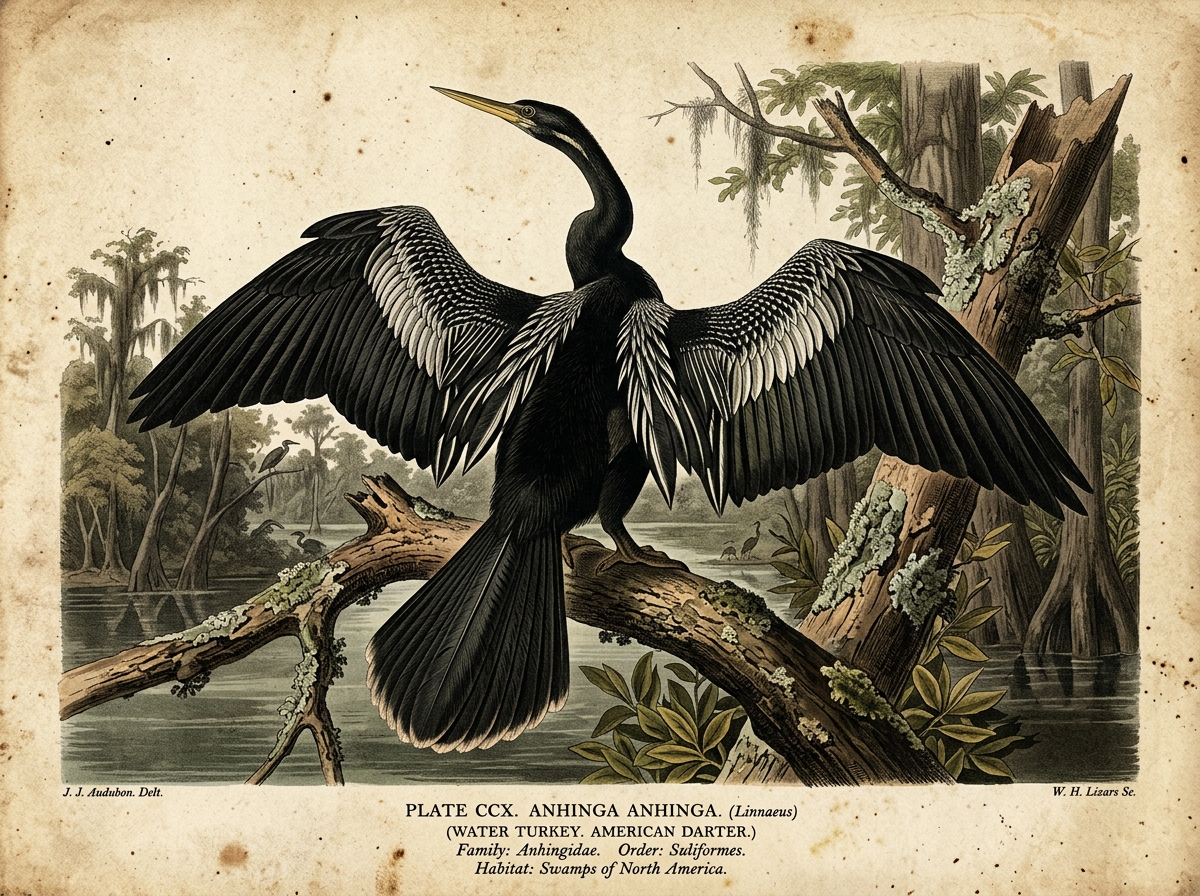
Anhinga
Anhinga anhinga[Anhingidae]
Status:IUCN Least Concern; Common Native
Diet Role:Subsurface pursuit predator spearin
Mass / Length:Length: 75–95 cm (30–37 in). Wingspan:
Habitat:Permanent canals, sloughs, and cypress
Long serpentine neck; sharp pointed yellow spear bill; fan-shaped tail; silver-white streaks on black wings; spreads wings open to dry. Vulnerable to terrestrial/arboreal ambush while drying waterlogged wings on low branches over canals.
RANGE: Permanent canals, sloughs, and cypress ponds.
Plate #35 • AvifaunaNative
4:3 Verified Plate
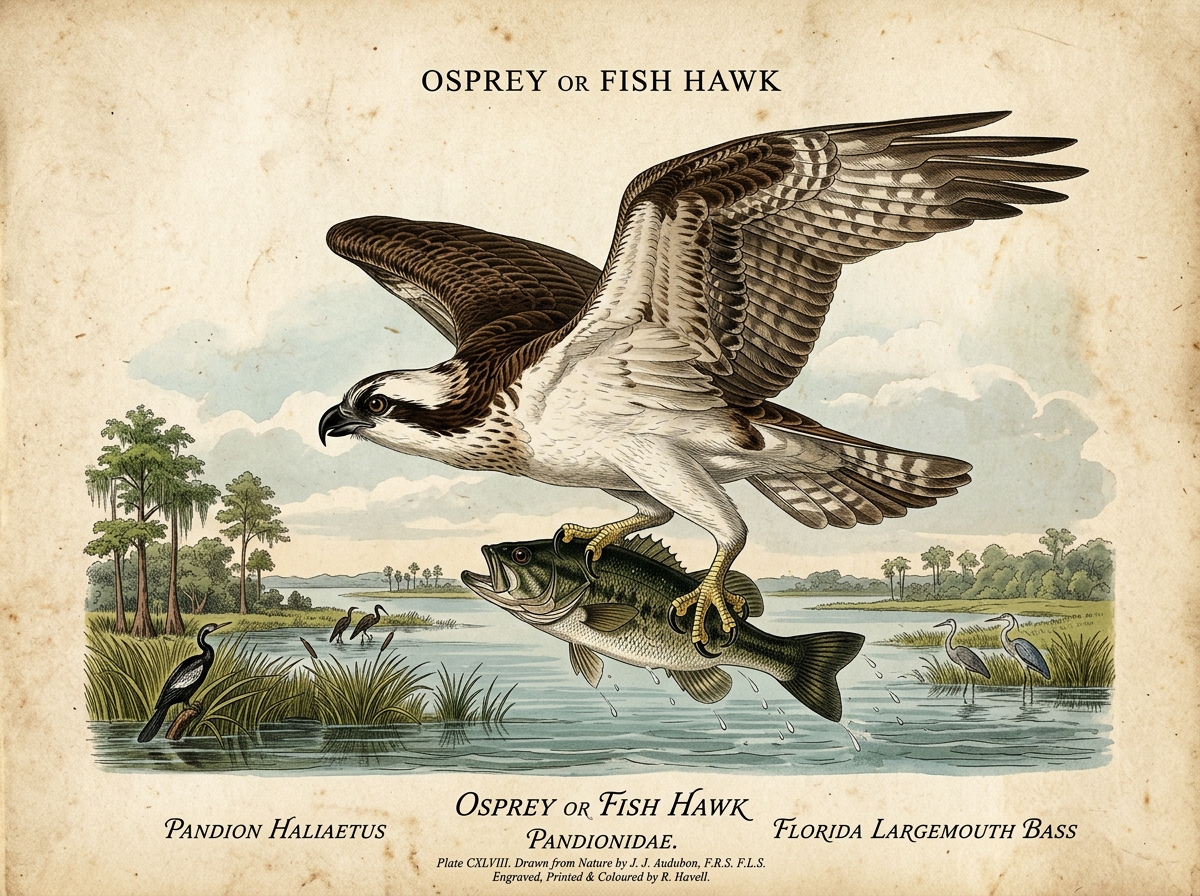
Osprey
Pandion haliaetus[Pandionidae]
Status:IUCN Least Concern
Diet Role:Obligate aerial piscivore (>99% liv
Mass / Length:Length: 54–58 cm (21–23 in). Wingspan:
Habitat:Estuaries, coastal bays, and large lak
Dark brown dorsal plumage, clean white chest; white head with bold dark eye stripe; gull-like kinked wing profile in flight. Minimal direct overlap; nests atop high snags and power poles outside python foraging zones.
RANGE: Estuaries, coastal bays, and large lakes with
Plate #36 • AvifaunaKeystone
4:3 Verified Plate
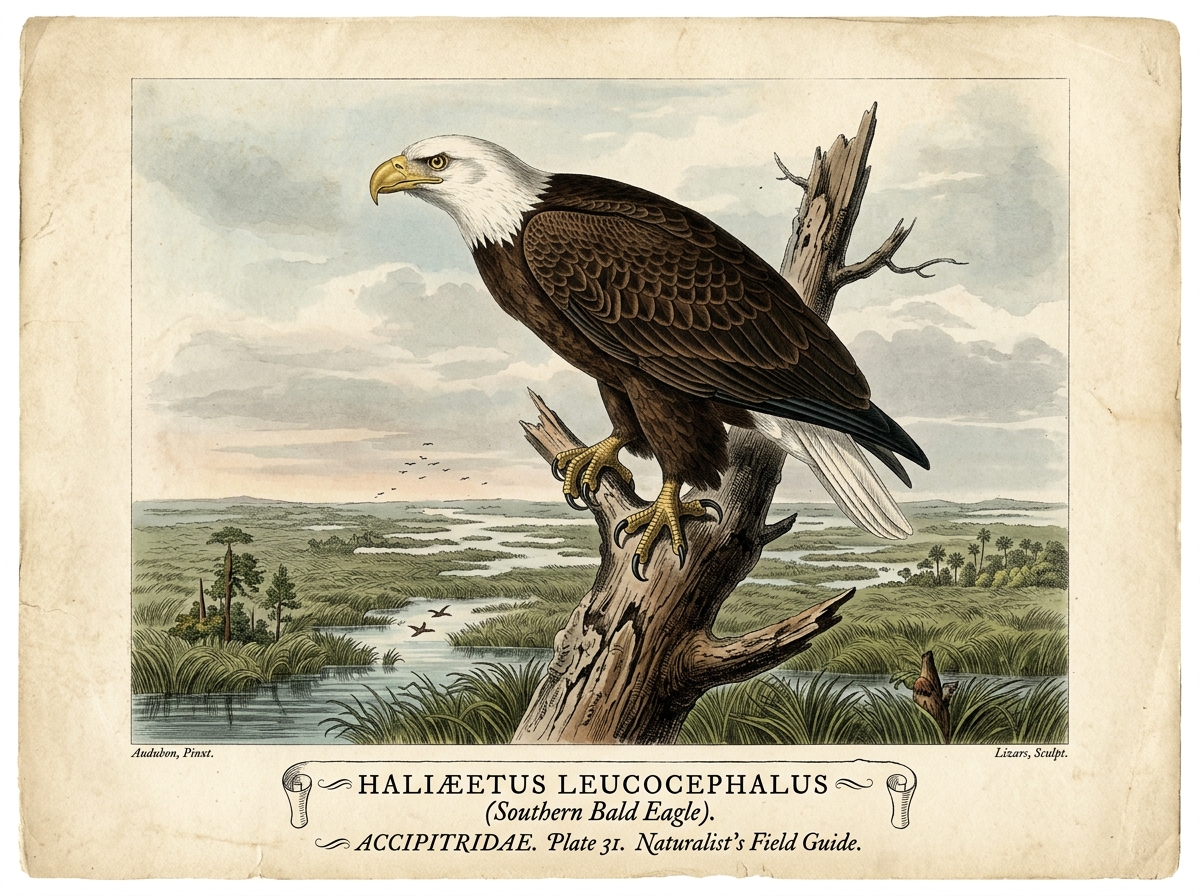
Bald Eagle
Haliaeetus leucocephalus[Accipitridae]
Status:IUCN Least Concern; Bald and Golden
Diet Role:Apex raptor and kleptoparasite taki
Mass / Length:Length: 70–90 cm (28–35 in). Wingspan:
Habitat:Pine rocklands and large cypress trees
Striking snow-white head and tail on dark brown body; massive yellow hooked beak and talons; flat plank-like wing glide. Known to scavenge python roadkill; adult eagles are immune to python predation.
RANGE: Pine rocklands and large cypress trees border
Plate #37 • AvifaunaNative
4:3 Verified Plate
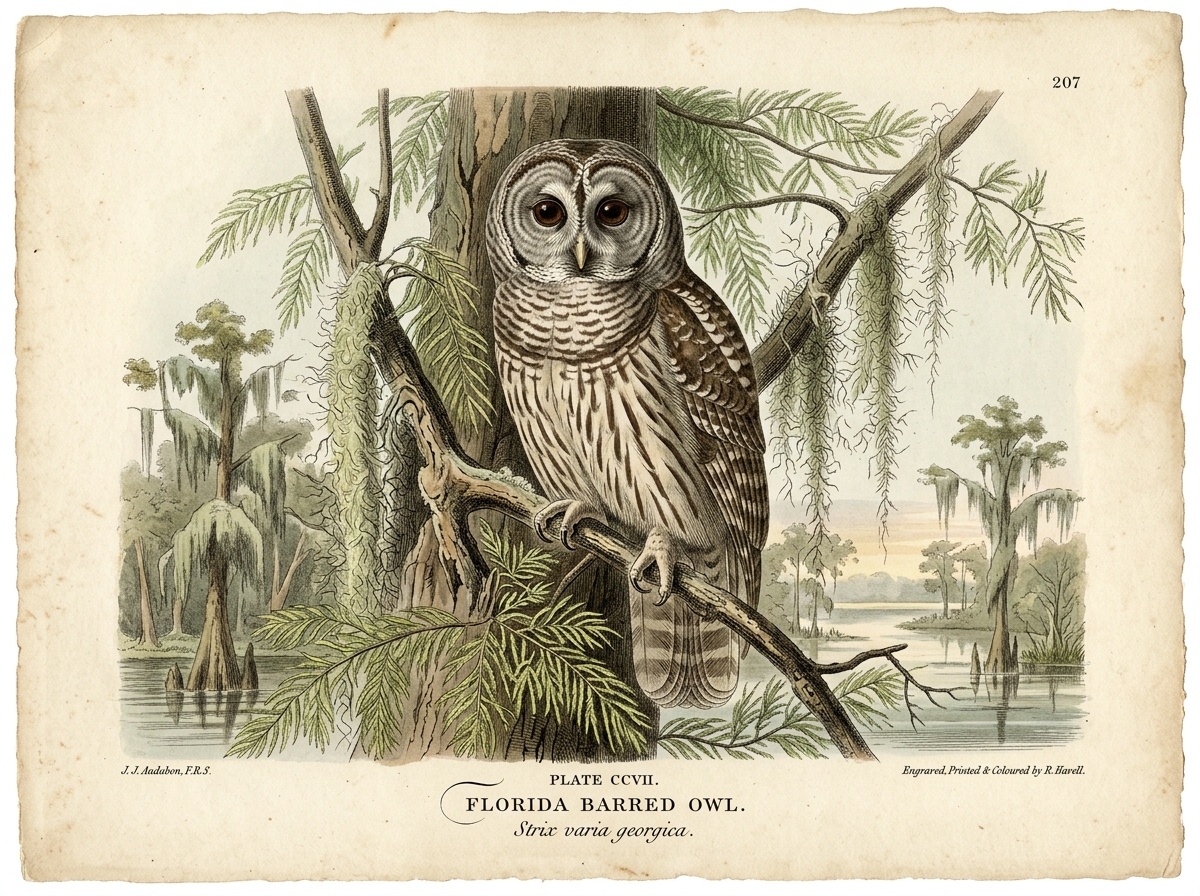
Barred Owl
Strix varia[Strigidae]
Status:IUCN Least Concern
Diet Role:Nocturnal ambush predator hunting c
Mass / Length:Length: 43–50 cm (17–20 in). Wingspan:
Habitat:Shaded cypress strands, deep hardwood
Rounded head with no ear tufts; dark brown/black eyes; horizontal breast barring and vertical belly streaking; distinctive 8-note call: "Who cooks for you, who cooks for you all?" Pythons readily enter tree cavities to predate eggs and nestlings; roosting owls may be ambushed in dense hammock foliage.
RANGE: Shaded cypress strands, deep hardwood hammock
Plate #38 • AvifaunaNative
4:3 Verified Plate
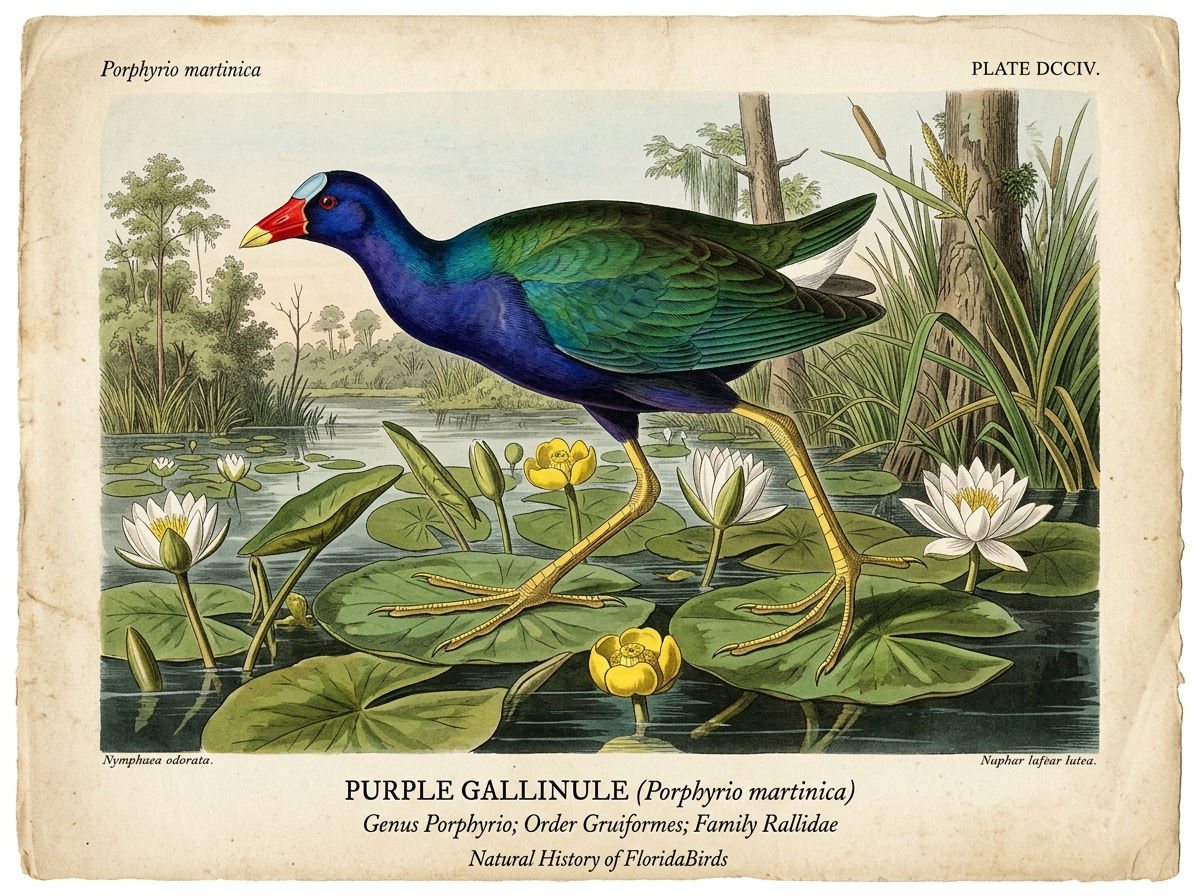
Purple Gallinule
Porphyrio martinica[Rallidae]
Status:IUCN Least Concern
Diet Role:Omnivorous marsh grazer feeding on
Mass / Length:Length: 26–37 cm (10–15 in). Wingspan:
Habitat:Deep sloughs with abundant floating wa
Brilliant iridescent purple-blue head and chest; green back; scarlet-red bill with yellow tip; sky-blue forehead shield; enormously long yellow toes. High Vulnerability. Lives directly on top of the floating vegetation mats where pythons lie in wait with submerged bodies.
RANGE: Deep sloughs with abundant floating water lil
Plate #39 • AvifaunaKeystone
4:3 Verified Plate
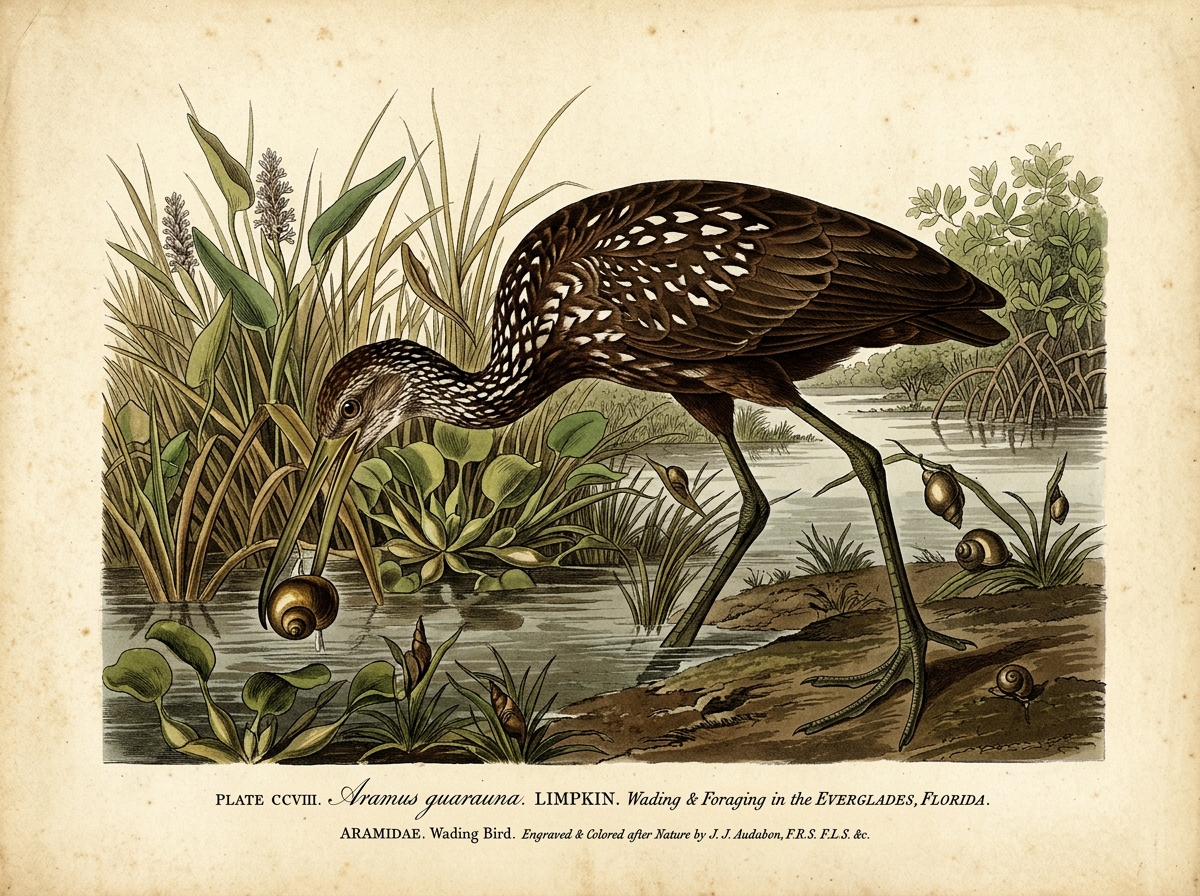
Limpkin
Aramus guarauna[Aramidae]
Status:IUCN Least Concern; Keystone Malaci
Diet Role:Specialized apple snail predator. B
Mass / Length:Length: 64–73 cm (25–29 in). Wingspan:
Habitat:Shaded cypress sloughs, tree island ma
Dark brown plumage with distinct white triangular streaks; long decurved bill; loud piercing wailing cry echoing through swamps. Extremely vulnerable due to slow foraging on marsh floors and low shrub nests.
RANGE: Shaded cypress sloughs, tree island margins,
Plate #40 • AvifaunaNative
4:3 Verified Plate
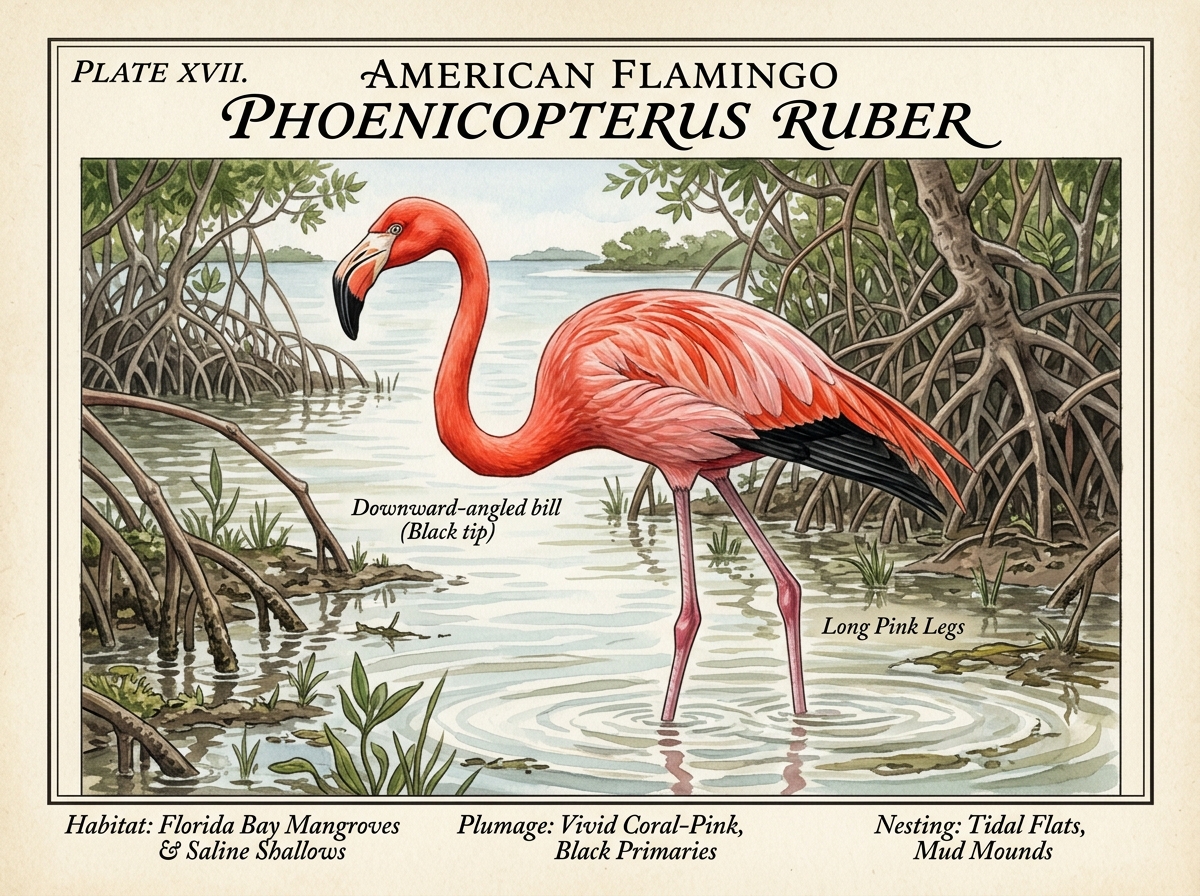
American Flamingo
Phoenicopterus ruber[Phoenicopteridae]
Status:IUCN Least Concern; Florida FWC Sta
Diet Role:Inverted filter feeder extracting b
Mass / Length:Standing height: 120–145 cm (47–57 in)
Habitat:Hypersaline coastal lagoons, mudflats,
Unmistakable deep crimson/salmon-pink plumage; enormously long legs and neck; down-bent black-tipped pink bill; flies with neck and legs straight. Negligible; restricted to open hypersaline flats where pythons do not maintain permanent territories.
RANGE: Hypersaline coastal lagoons, mudflats, and op
Plate #41 • Aquatics & InvertebratesKeystone
► Living Plate (Hybrig LTX 2.5)
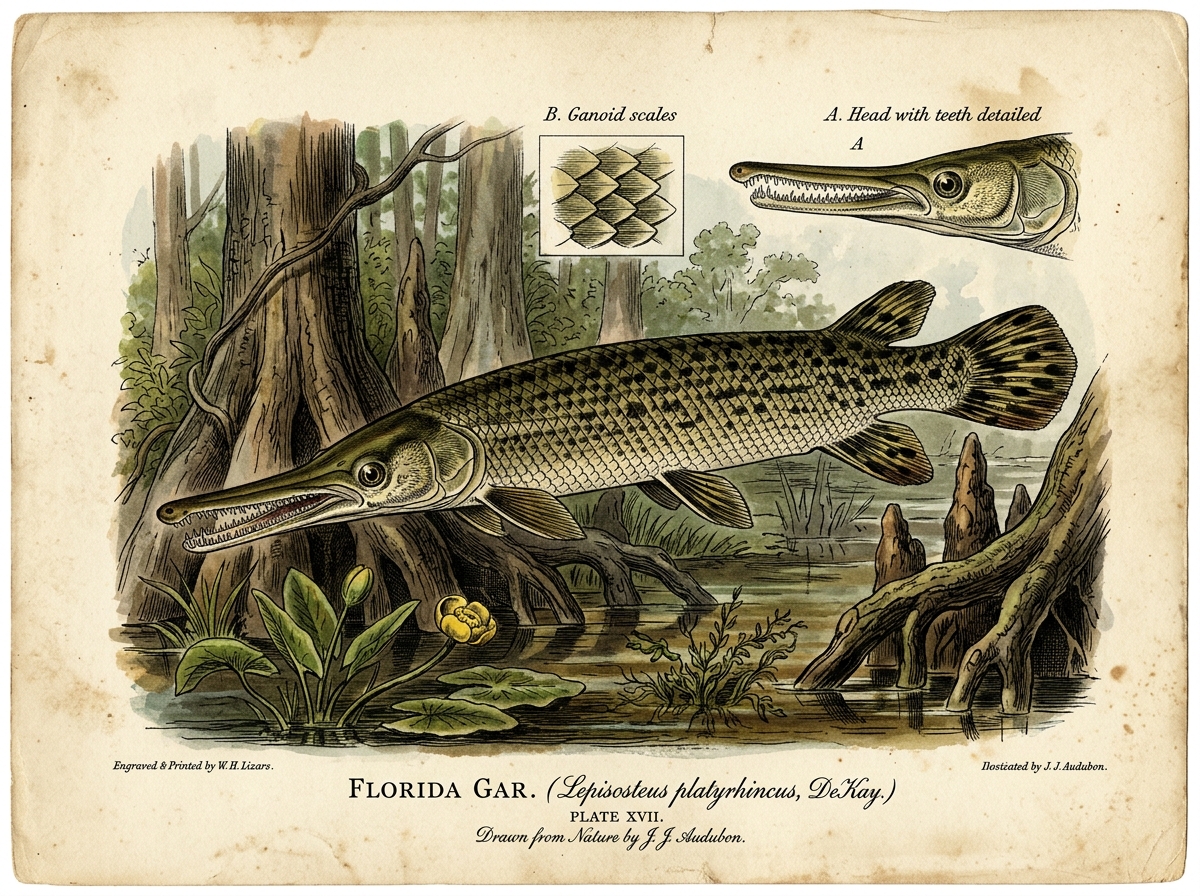
Florida Gar
Lepisosteus platyrhincus[Lepisosteidae]
Status:Native Keystone Indicator
Diet Role:Ambush predator utilizing vasculari
Mass / Length:Length: 33–86 cm (13–34 in). Mass: 0.8
Habitat:Deep sloughs, canals, and alligator ho
Broad, short snout; irregular rounded dark spots across body and fins; diamond-shaped ganoid armor. Heavily armored interlocking ganoid scales deter small pythons; large pythons occasionally consume them in drying marsh pools.
RANGE: Deep sloughs, canals, and alligator holes.
Plate #42 • Aquatics & InvertebratesNative
4:3 Verified Plate
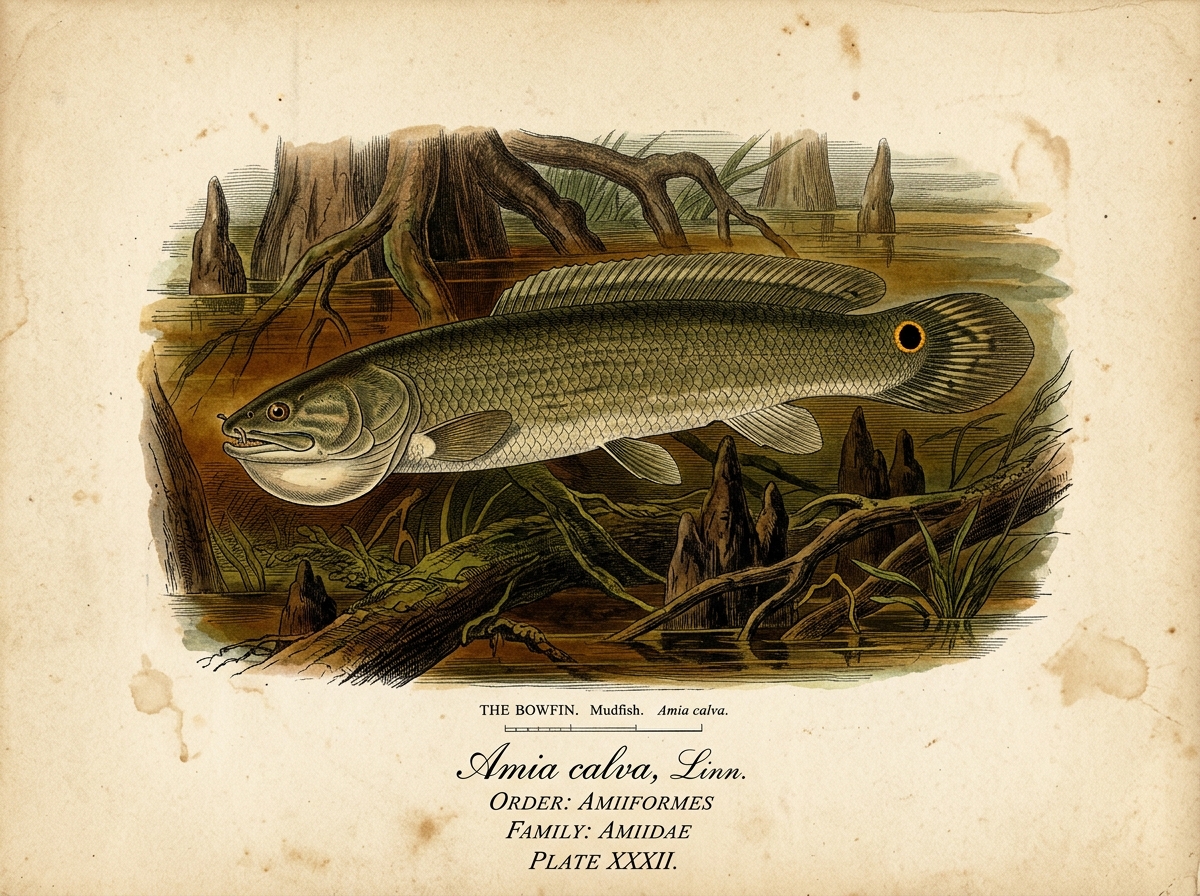
Bowfin
Amia calva[Amiidae]
Status:Ancient Native Survivor
Diet Role:Benthic apex fish hunting crayfish
Mass / Length:Length: 50–109 cm (20–43 in). Mass: 1.
Habitat:Vegetated sloughs, muddy swamps, and c
Undulating continuous dorsal fin spanning half the back; prominent dark eyespot (ocellus) on upper tail base in males; large bony gular throat plate. Consumed by subadult pythons when concentrated in drying sloughs.
RANGE: Vegetated sloughs, muddy swamps, and canals.
Plate #43 • Aquatics & InvertebratesNative
► Living Plate (Hybrig LTX 2.5)
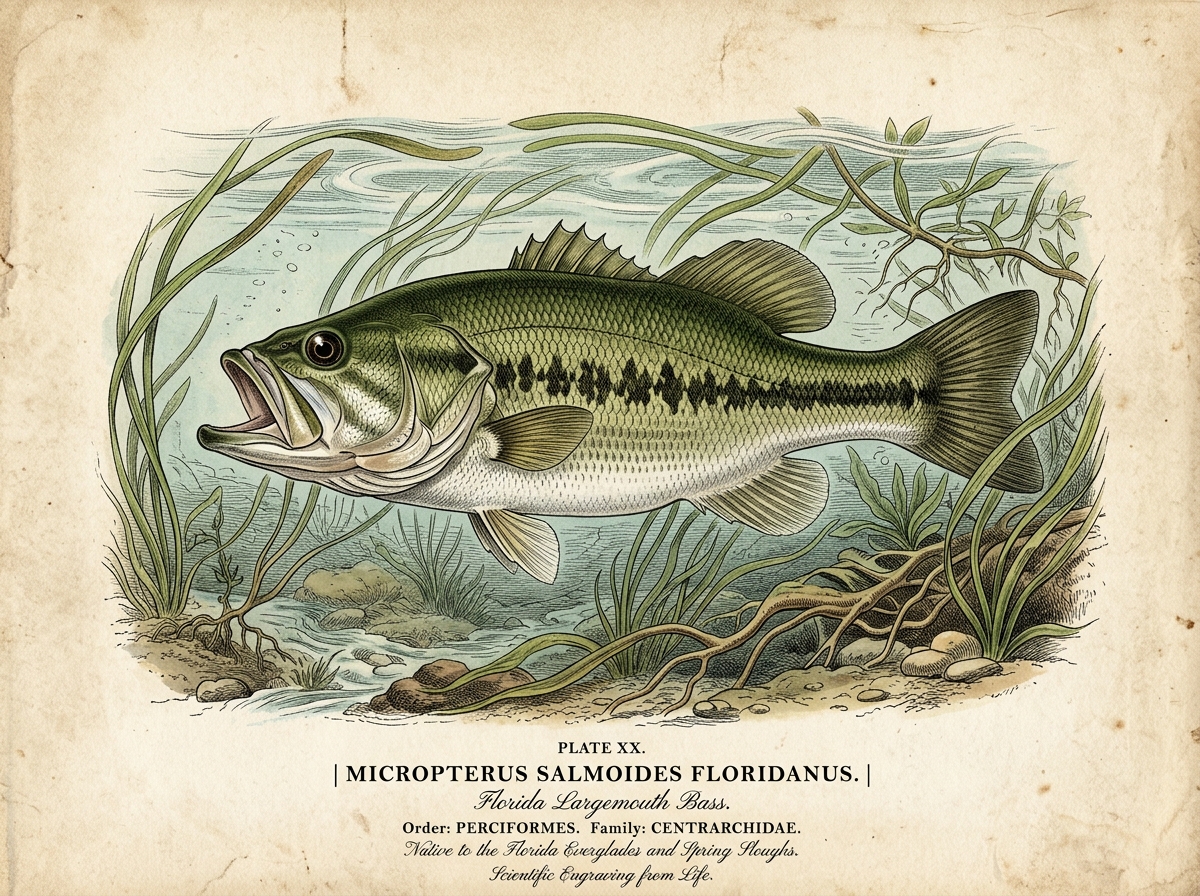
Florida Largemouth Bass
Micropterus salmoides floridanus[Centrarchidae]
Status:Native Apex Game Fish
Diet Role:Apex aquatic predator consuming pan
Mass / Length:Length: 30–75 cm (12–30 in). Mass: 1.0
Habitat:Clear deep-water sloughs and tree isla
Massive jaw extending past posterior margin of eye; broad jagged dark horizontal lateral stripe. Sustains the wading bird populations (herons/egrets) that pythons target.
RANGE: Clear deep-water sloughs and tree island moat
Plate #44 • Aquatics & InvertebratesNative
4:3 Verified Plate
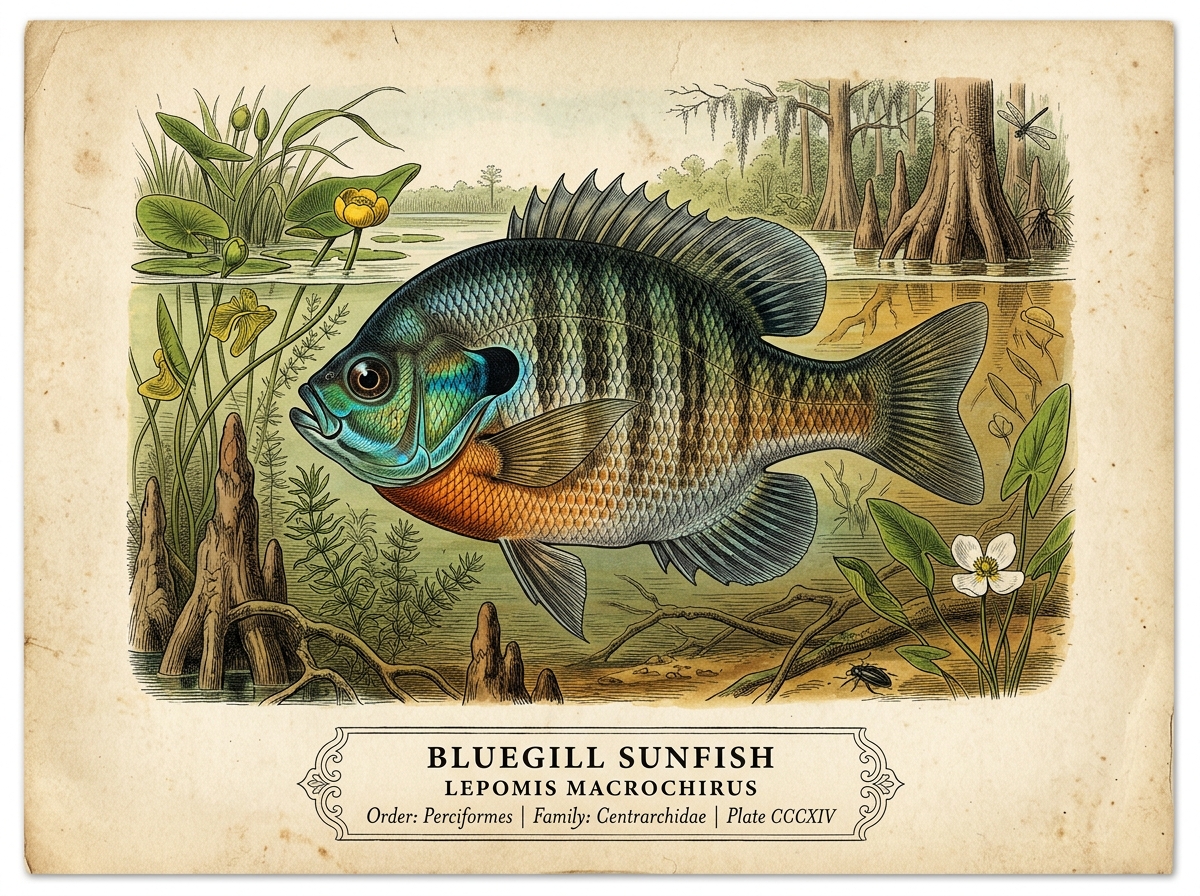
Bluegill Sunfish
Lepomis macrochirus[Centrarchidae]
Status:Native Foundation Forage
Diet Role:Omnivorous grazer and secondary con
Mass / Length:Length: 10–30 cm (4–12 in). Mass: 150–
Habitat:Slough edges, periphyton beds, and lil
Saucer-like compressed body; dark blue/black flexible opercular ear flap; dark vertical flank bars.
RANGE: Slough edges, periphyton beds, and lily pad c
Plate #45 • Aquatics & InvertebratesNative
4:3 Verified Plate
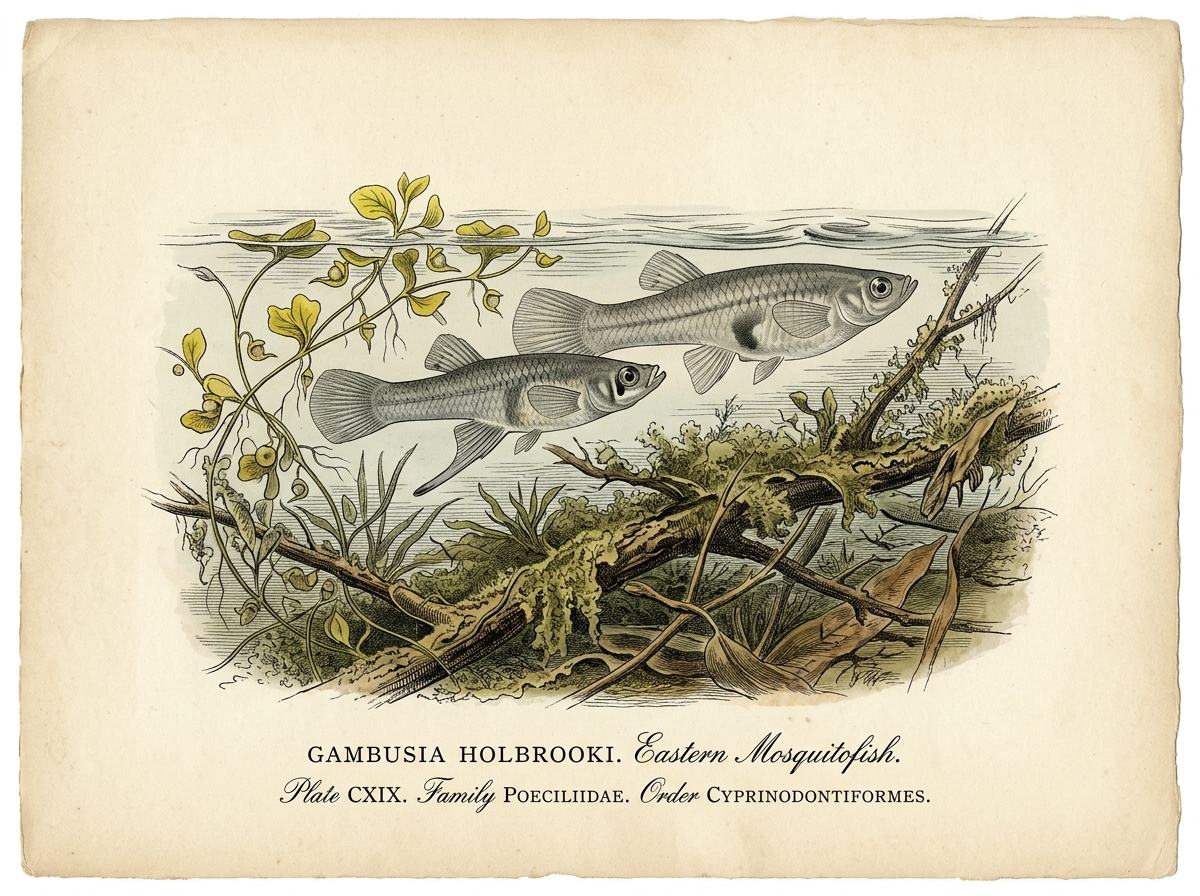
Eastern Mosquitofish
Gambusia holbrooki[Poeciliidae]
Status:Native Foundation Producer / Vector
Diet Role:Prolific consumer of mosquito larva
Mass / Length:Length: 2–6 cm (0.8–2.4 in). Mass: 1–3
Habitat:Ubiquitous in shallow marsh margins, p
Upturned surface-feeding mouth; teardrop marking below eye; rounded tail fin; gravid spot on females. Critical Hatchling Food Source. Neonate pythons forage in shallow sawgrass margins, ambushing dense schools of mosquitofish during their first weeks of life.
RANGE: Ubiquitous in shallow marsh margins, periphyt
Plate #46 • Aquatics & InvertebratesNative
4:3 Verified Plate
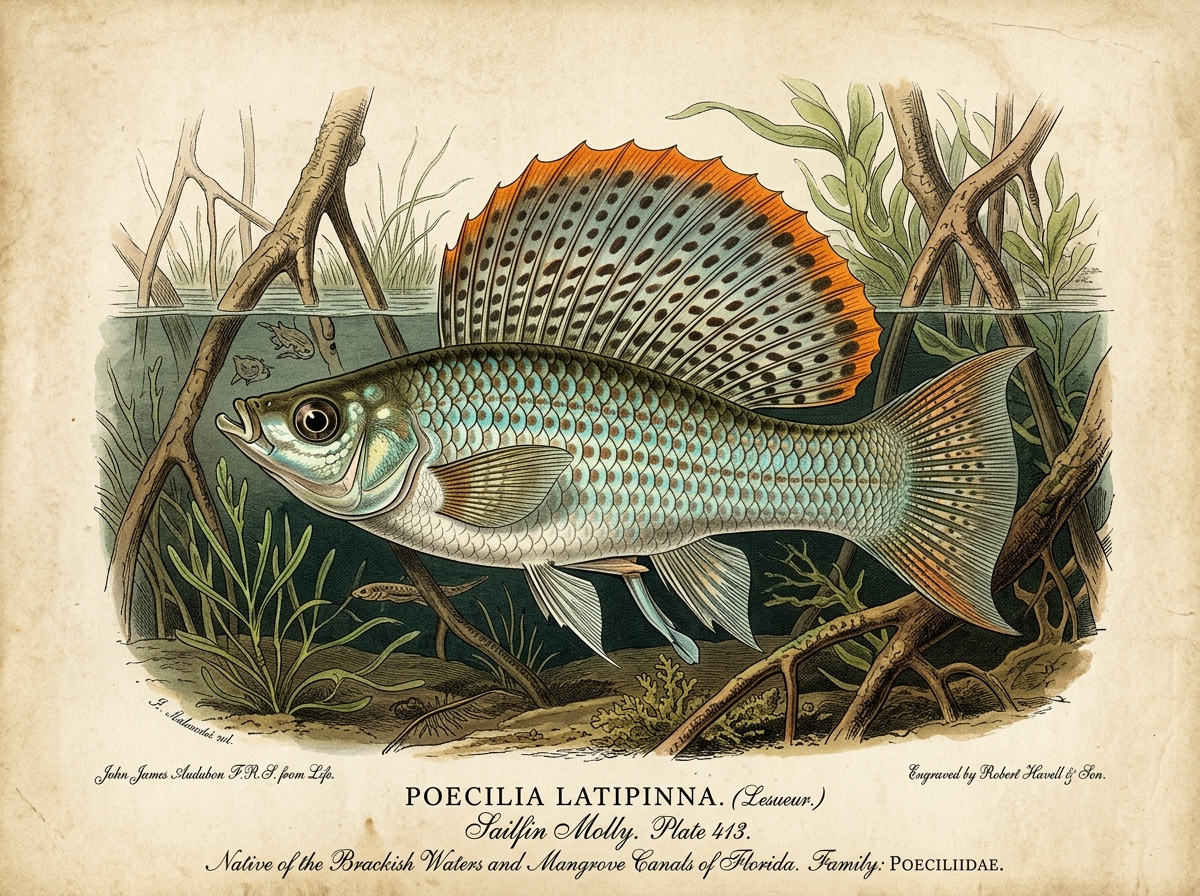
Sailfin Molly
Poecilia latipinna[Poeciliidae]
Status:Euryhaline Native
Diet Role:Herbivore and algivore grazing on p
Mass / Length:Length: 5–10 cm (2–4 in). Mass: 5–15 g
Habitat:Brackish mangrove fringes, tidal salt
Males bear a magnificent high dorsal fin with spotted rows; longitudinal rows of spots along flanks. Direct food base for juvenile pythons in southern coastal ecotones.
RANGE: Brackish mangrove fringes, tidal salt marshes
Plate #47 • Aquatics & InvertebratesInvasive
4:3 Verified Plate
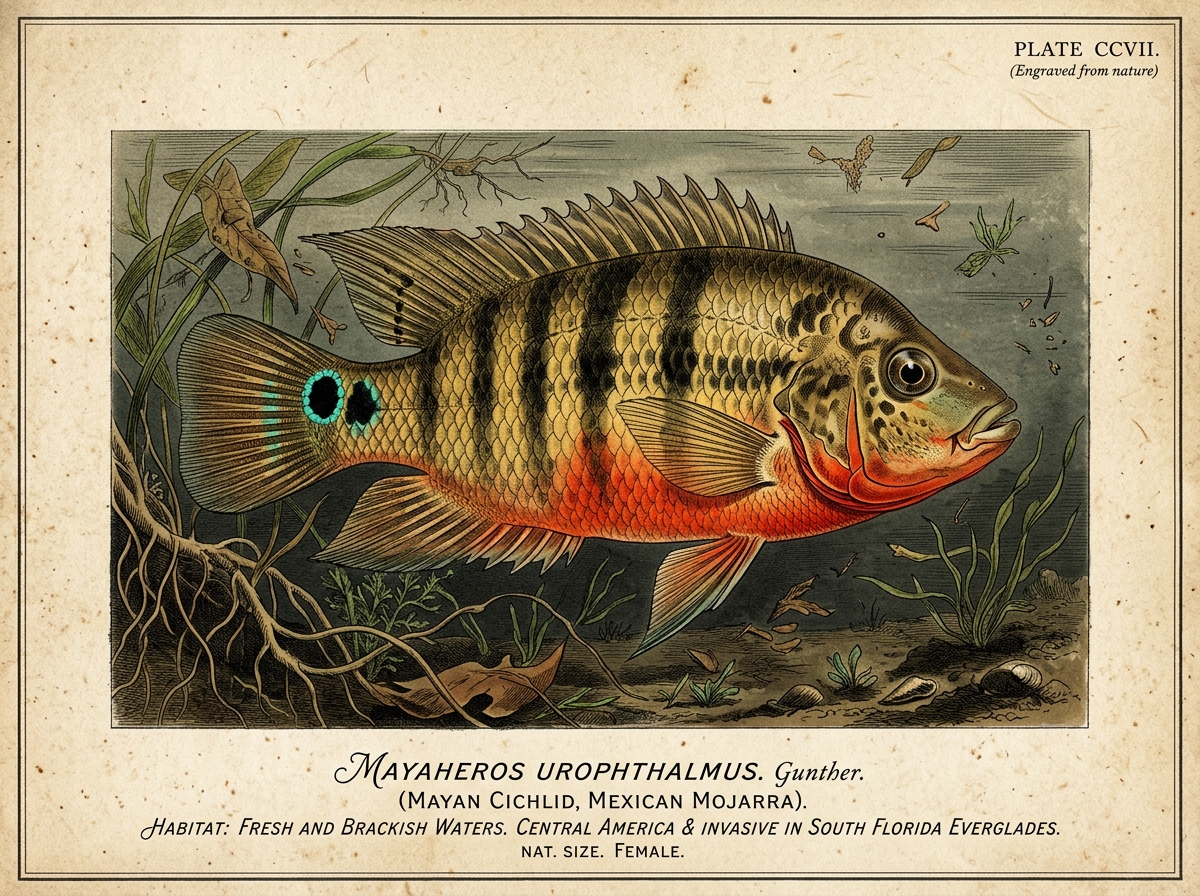
Mayan Cichlid
Mayaheros urophthalmus[Cichlidae]
Status:Non-Native Invasive Competitor
Diet Role:Aggressive carnivore displacing nat
Mass / Length:Length: 15–25 cm (6–10 in). Mass: 200–
Habitat:Canals, mangrove creeks, and sloughs.
5–7 bold vertical black bars; distinct black eyespot encircled with turquoise at tail base; reddish chin. Abundant novel food source for subadult pythons; supports wading birds targeted by pythons.
RANGE: Canals, mangrove creeks, and sloughs. High sa
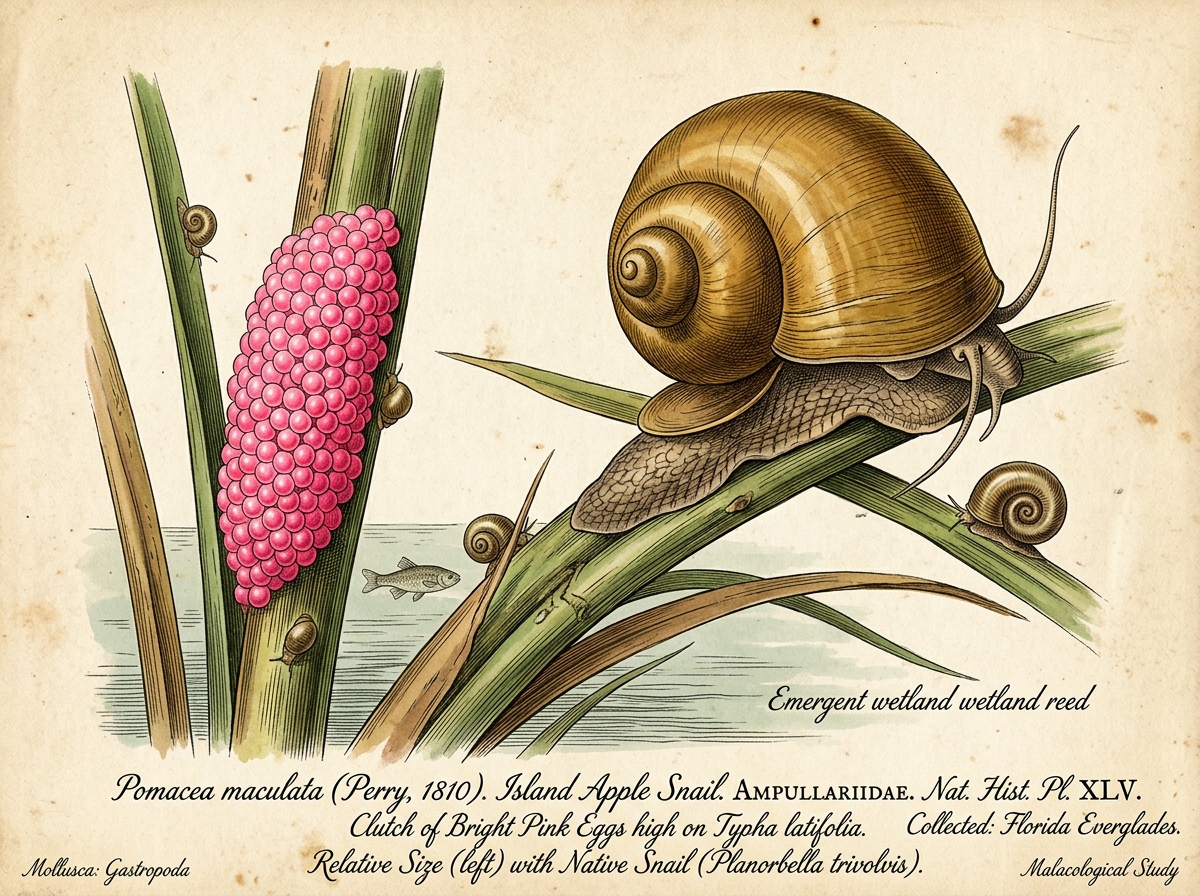
Mass / Size:Shell: 4–6 cm (1.6–2.4 in). Compact native shell.
Egg Clutches:Small clutches of 20–80 creamy white spherical eggs.
[NATIVE] Right-handed (dextral) globose golden-amber/olive shell. Lays modest clutches of 20–80 creamy white-to-pale pink spherical eggs on emergent plant stems near the waterline. Ecological Link: The sole evolutionary obligate prey of the federally endangered Everglades Snail Kite (Rostrhamus sociabilis), whose slender hooked sickle beak is precisely shaped to extract this native snail without crushing the shell.
RANGE: Clean emergent marshes, sloughs, and sawgrass prairies with 10–12 month hydroperiod.
Mass / Size:Shell: 7–15 cm (3–6 in). Up to 4× mass of native snail.
Egg Clutches:Massive clutches of 500–2,000 neon bubblegum-pink eggs.
[INVASIVE] South American invader introduced via aquarium trade. Massive, round, thick-walled globose shell up to tennis-ball size (up to 4× larger than native snail). Lays massive, unmistakable clusters of 500–2,000 toxic neon bubblegum-pink eggs high on emergent vegetation out of water. Ecological Link: Now heavily hunted by the Everglades Snail Kite, boosting adult kite population numbers but creating handling challenges for smaller hatchling and juvenile kites dealing with the gigantic shells.
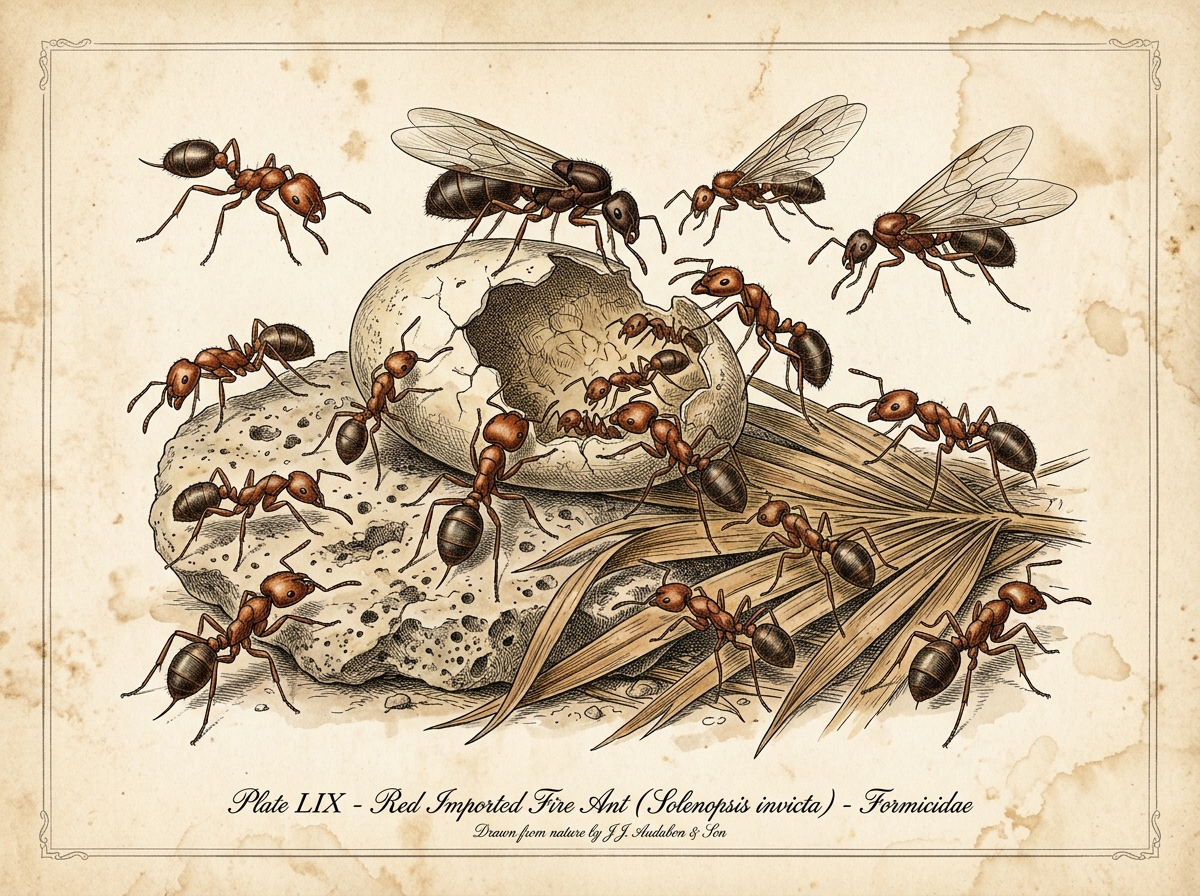
Diet Role:Omnivorous predator; scavenges and swarms
Mass / Length:2–6 mm (polymorphic workers)
Habitat:Prairies, levees, pine rocklands, hammocks
Lethal swarm hazard to reptile nests, eggs, and neonates. Aggressive stinging behavior with necrotizing solenopsin alkaloid venom. Forms living floating rafts during wet-season Everglades floods.
RANGE: Terrestrial mounds and floating colonies throughout all South Florida biomes
Plate #53 • Flora & BotanyFlora
4:3 Verified Plate
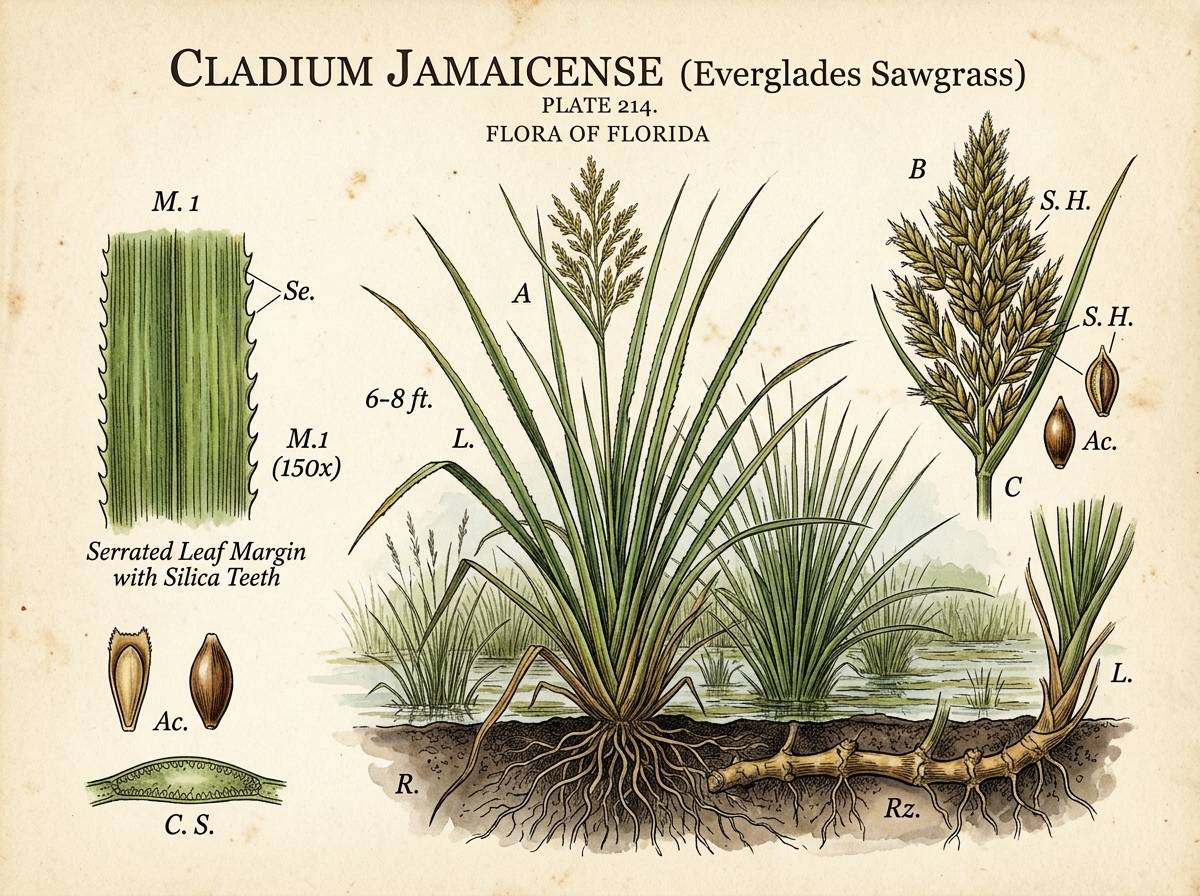
Sawgrass
Cladium jamaicense[Cyperaceae]
Status:Foundation Ecological Architect (De
Diet Role:Builds the peat soils that create E
Mass / Length:Height: 1–3 m (3–10 ft). Forms continu
Habitat:Freshwater peat ridges and sloughs; re
Coarse, V-folded tough leaf blades armed with razor-sharp forward-pointing silica serrations along margins and midrib. Primary Terrestrial Cover. Dense serrated sawgrass beds provide pythons with supreme camouflage, thermal shading, and concealment from aerial survey spotters and hunters.
RANGE: Freshwater peat ridges and sloughs; requires
Plate #54 • Flora & BotanyKeystone
4:3 Verified Plate
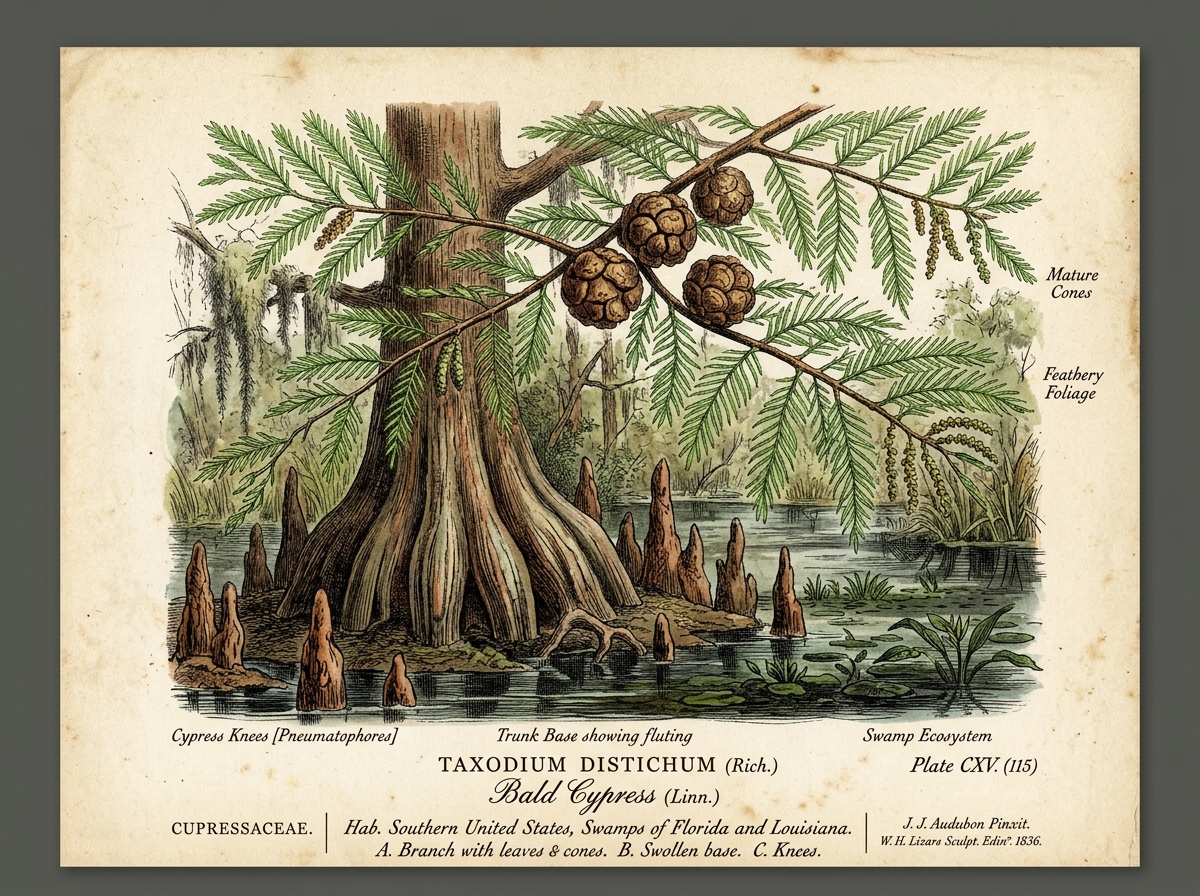
Bald Cypress
Taxodium distichum[Cupressaceae]
Status:Keystone Wetland Tree
Diet Role:Creates depression habitats that retain dry season water.
Mass / Length:Height: 20–35 m (65–115 ft). Trunks broadly buttressed.
Habitat:Depressional limestone cypress domes and strands.
Deciduous feathery green needle-like leaves shedding golden-red in autumn; extensive fluted trunk bases; vertical conical root outgrowths ("cypress knees"). Cypress domes are winter thermal sanctuaries for pythons; hollow trunks provide brooding cavities.
RANGE: Depressional limestone cypress domes and strands
Plate #55 • Flora & BotanyKeystone
4:3 Verified Plate
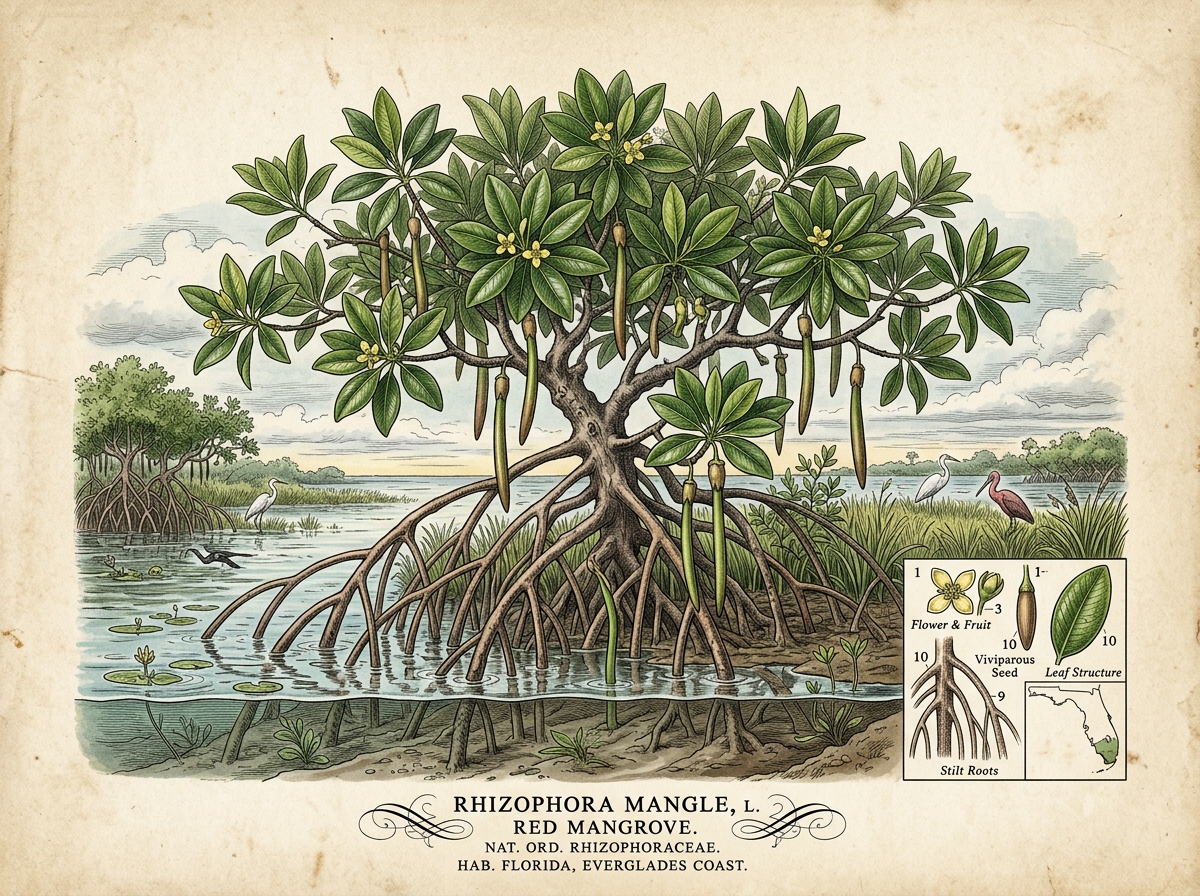
Red Mangrove
Rhizophora mangle[Rhizophoraceae]
Status:Keystone Estuarine Shoreline Builder
Diet Role:Builds coastlines by trapping sediment and organic debris.
Mass / Length:Height: 10–25 m (33–82 ft).
Habitat:Coastal intertidal fringes, salt marshes, and tidal creeks.
Arching aerial "walking" stilt roots; thick waxy opposite leaves; long pencil-like viviparous floating propagules. Pythons use prop root labyrinths to swim through tidal waterways, resting in branches above high tide.
RANGE: Coastal intertidal fringes, salt marshes, and tidal creeks
Plate #56 • Flora & BotanyFlora
4:3 Verified Plate
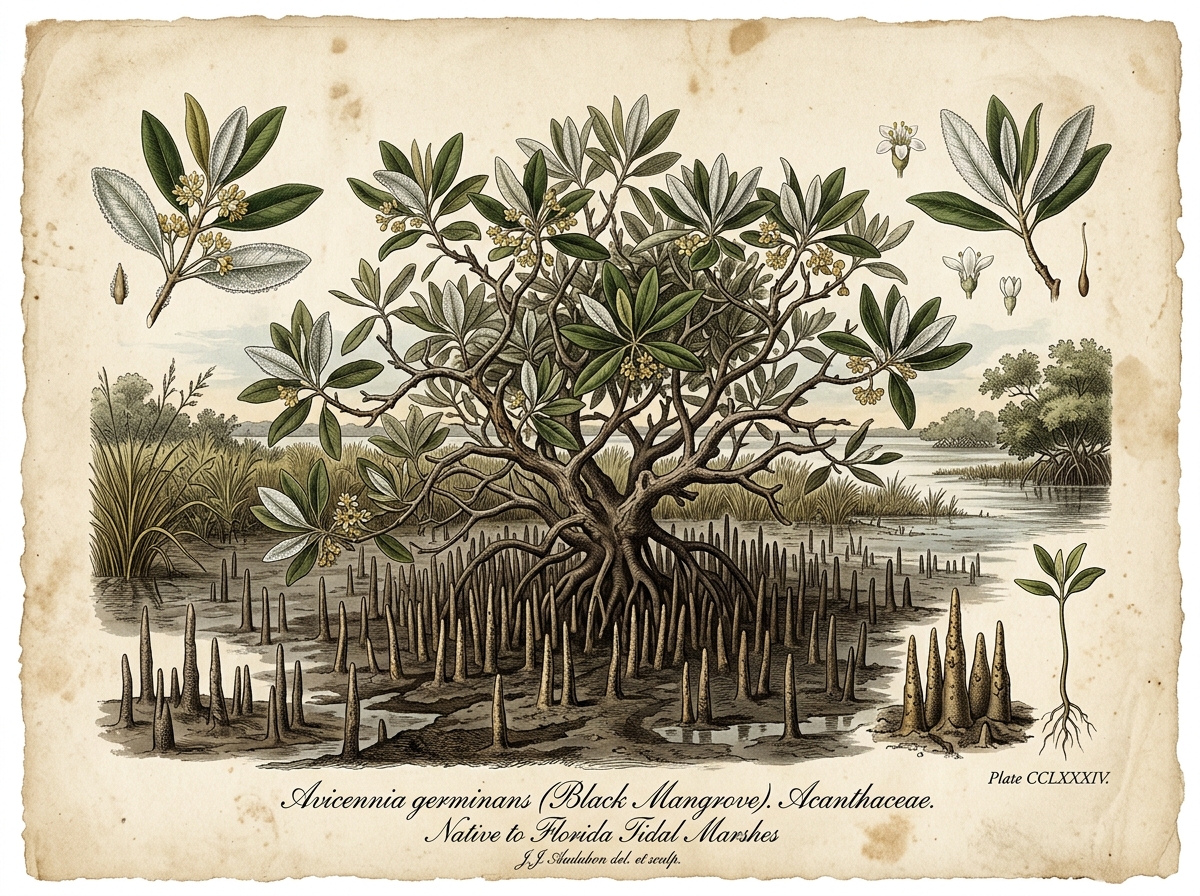
Black Mangrove
Avicennia germinans[Acanthaceae]
Status:Foundation Coastal Producer
Diet Role:Stabilizes hypersaline tidal soils.
Mass / Length:Height: 10–20 m (33–65 ft).
Habitat:Basin mangrove zones inland of red mangroves.
Thousands of erect pencil-like breathing tubes (pneumatophores) rising from mud; undersides of leaves excrete crystalline salt.
RANGE: Basin mangrove zones inland of red mangroves
Plate #57 • Flora & BotanyEndangered
4:3 Verified Plate
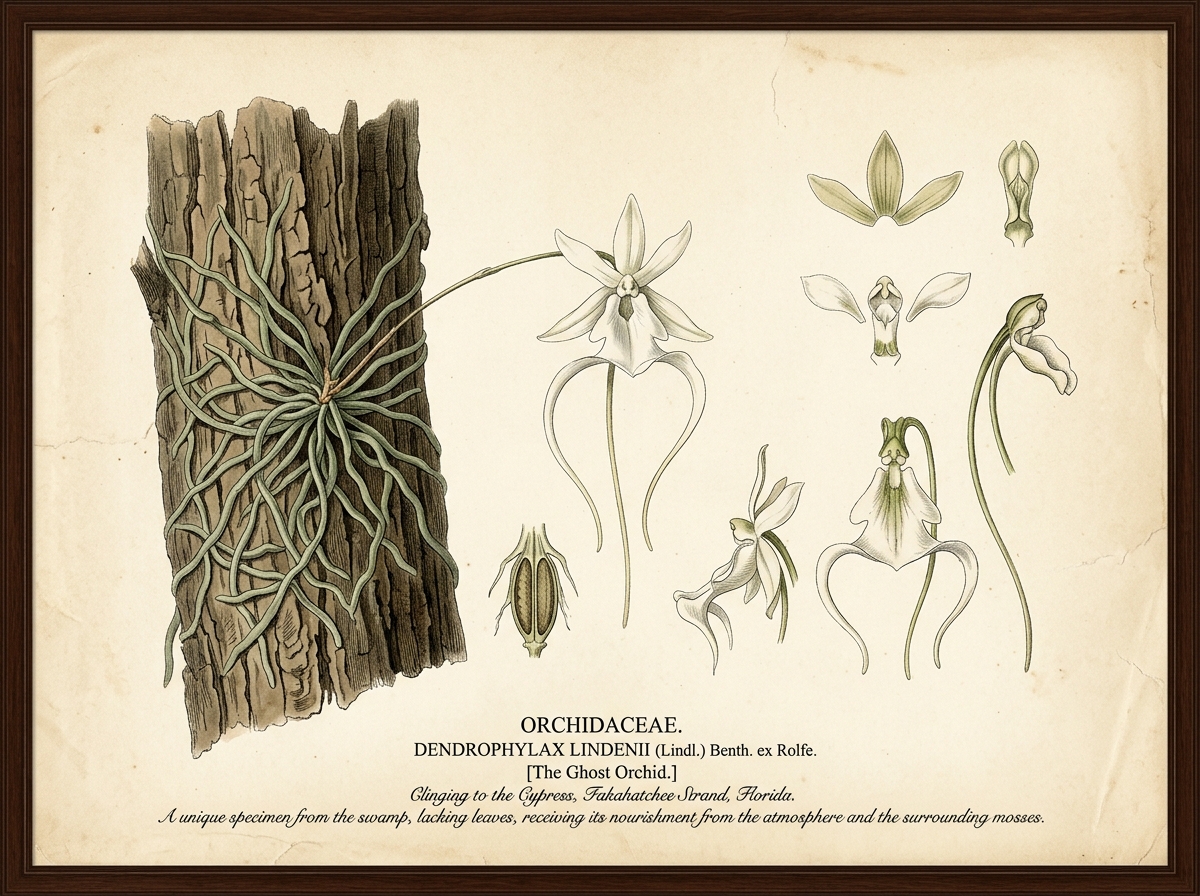
Ghost Orchid
Dendrophylax lindenii[Orchidaceae]
Status:Critically Endangered; USFWS Listed
Diet Role:Extreme habitat specialist requiring high humidity.
Mass / Length:Photosynthetic root span: 10–30 cm (4–12 in).
Habitat:Deep sloughs and mature cypress domes (e.g. Fakahatchee Strand).
Completely leafless; consists of gray-green photosynthetic roots radiating across host bark; blooms a solitary, pristine white flower with two long twisting tendrils resembling frog legs.
RANGE: Deep sloughs and mature cypress domes (e.g. Fakahatchee Strand)
Plate #58 • Flora & BotanyKeystone
4:3 Verified Plate
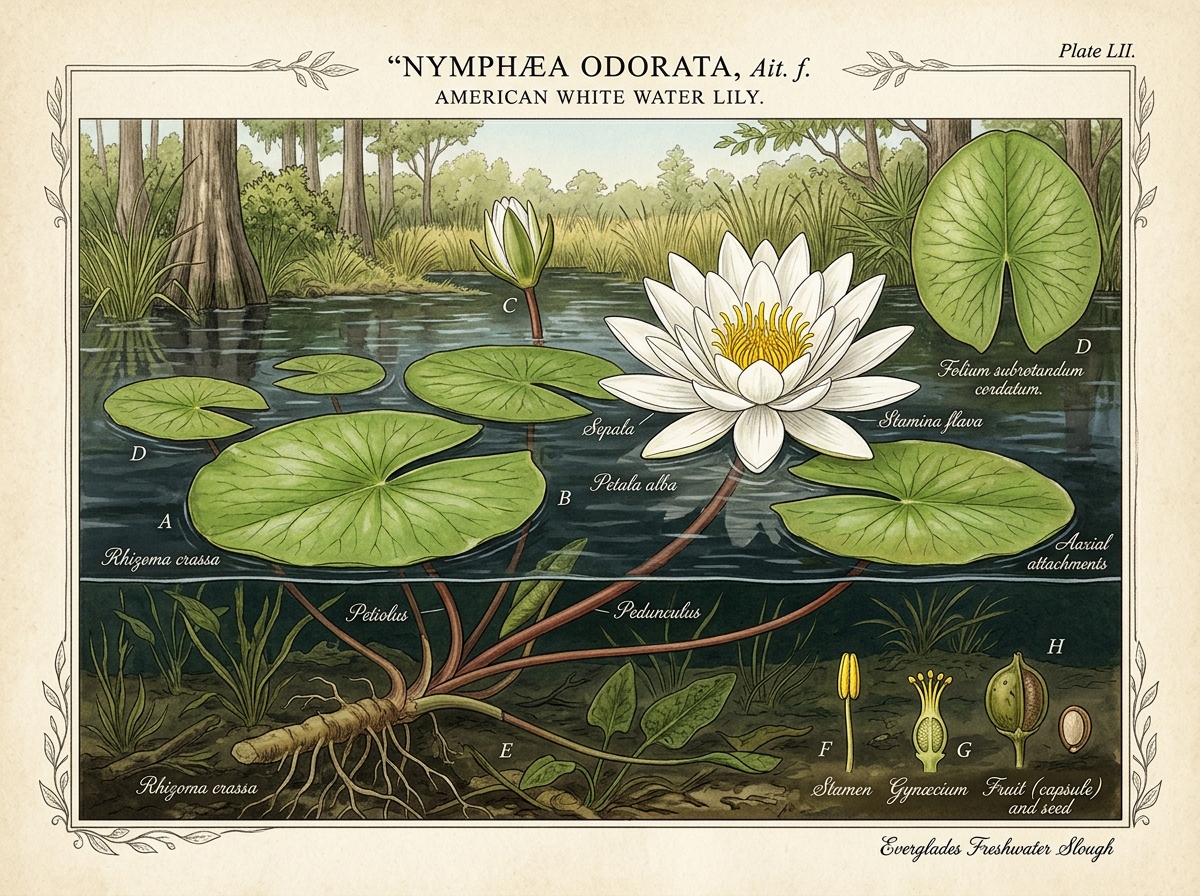
Fragrant Water Lily
Nymphaea odorata[Nymphaeaceae]
Status:Native Aquatic Keystone
Diet Role:Shields water column from solar heating; supports invertebrate fauna.
Mass / Length:Floating leaf diameter: 15–30 cm (6–12 in).
Habitat:Open deep-water sloughs, canals, and alligator holes.
Circular floating leaves with deep heart-shaped notch; intensely fragrant multi-petaled white flowers opening in morning sun. Python ambush staging platform. Pythons position themselves under lily pads with only eyes and nostrils exposed above water.
RANGE: Open deep-water sloughs, canals, and alligator holes
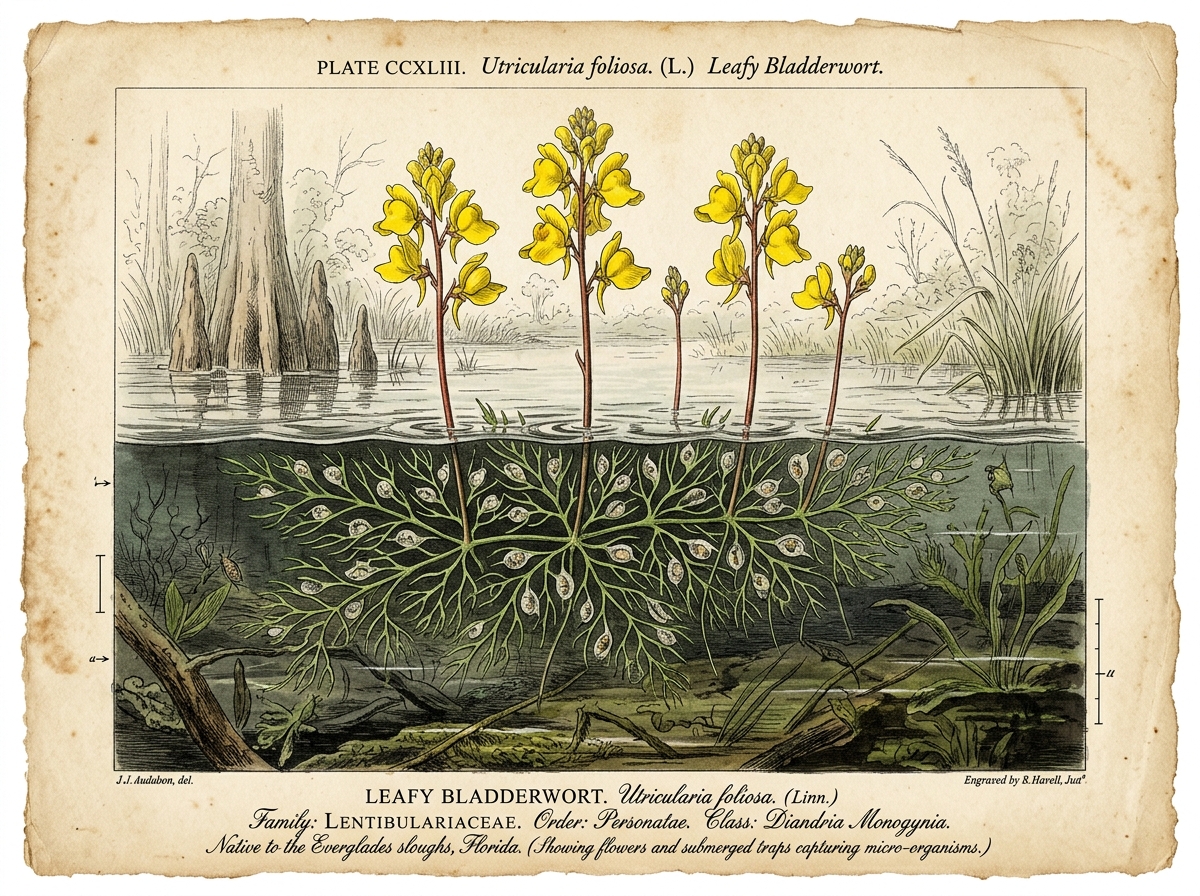
RANGE: Limnetic zones of clear, nutrient-poor freshwater sloughs
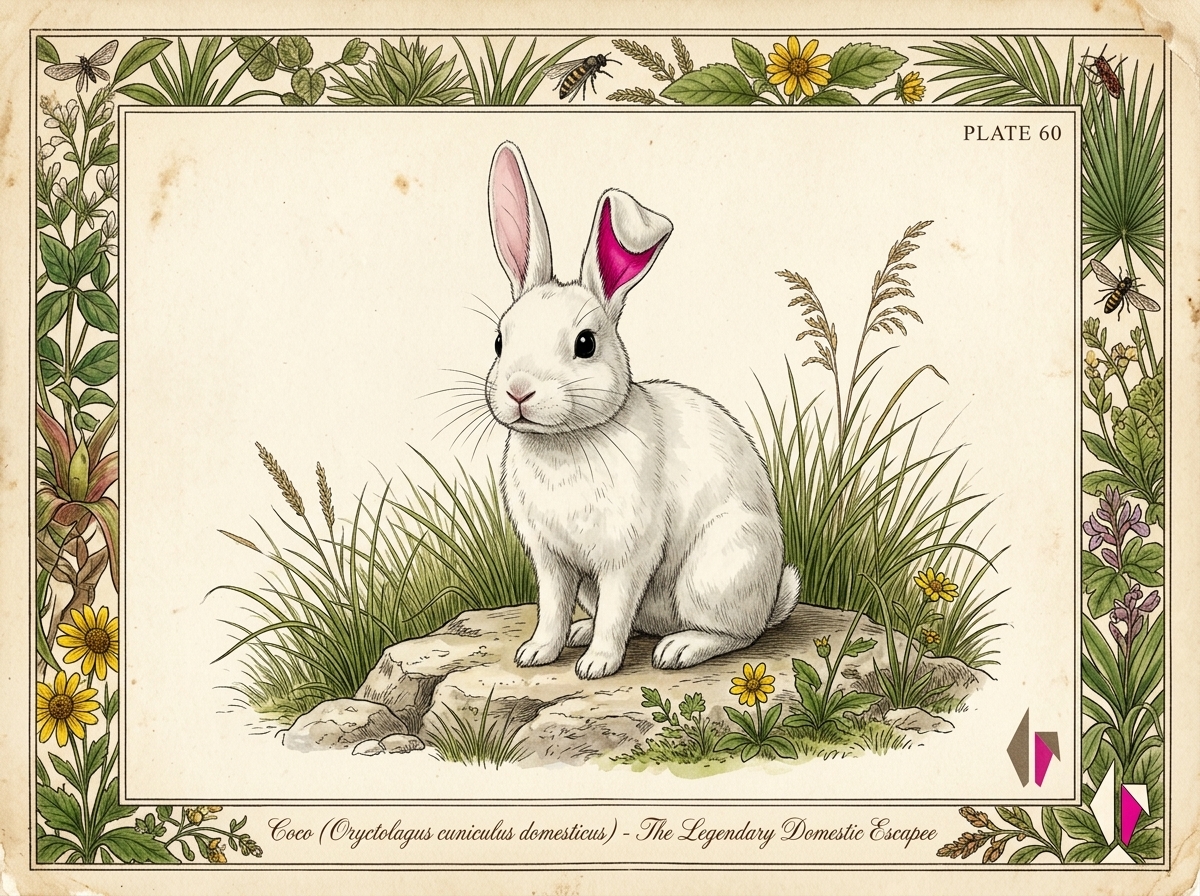
Plate #60 • Mammals & Studio LegendLegendary Escapee
► Living Plate (Hybrig LTX 2.5)
Coco the Rabbit
Oryctolagus cuniculus domesticus[Leporidae]
Status:Legendary Mascot • Uncatchable Easter Egg
Ecology:Elusive domestic escapee; thrives on pond rim
Mass / Length:Length: 38 cm (15 in) • Mass: 1.8 kg (4.0 lbs)
Biome:Shark Valley • North Rim of Pond Refugium
Pure white fluffy coat, dark glossy eyes, and a trademark bent left ear displaying a vivid magenta interior corresponding to Bigglesworth Studios' emblem. Unlike native marsh rabbits, Coco avoids open water, preferring dry grassy limestone banks. Possesses lightning-fast reflexes and instantaneous evasive side-leaps (Reaction 0.05s) — utterly impossible for pythons or alligators to capture.
RANGE: Shark Valley Freshwater Pond • Grassy Limestone Rim
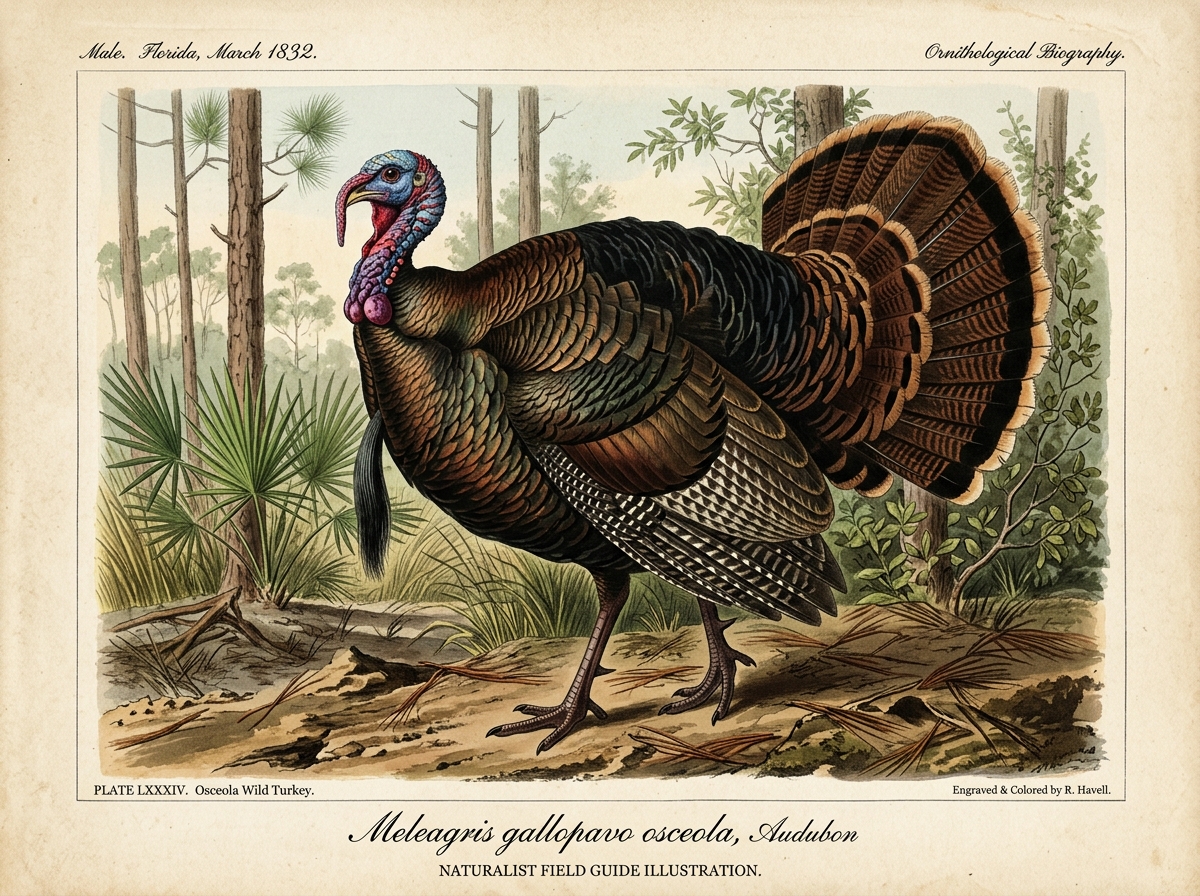
Mass / Length:Mass: 5–11 kg (11–24 lbs) • Height: 100–125 cm
Biome:Pine Flatwoods • Hardwood Hammocks
Dark bronze iridescent plumage with distinctive narrow white wing feather bars and bare blue/red head. Substantial prey for mid-to-late life stage pythons (5–11 kg). Extremely alert and evasive, executing explosive vertical flush escapes when ambushed in the saw palmetto understory.
RANGE: Pine Flatwoods, Oak Hammocks • Dry Prairie Glades
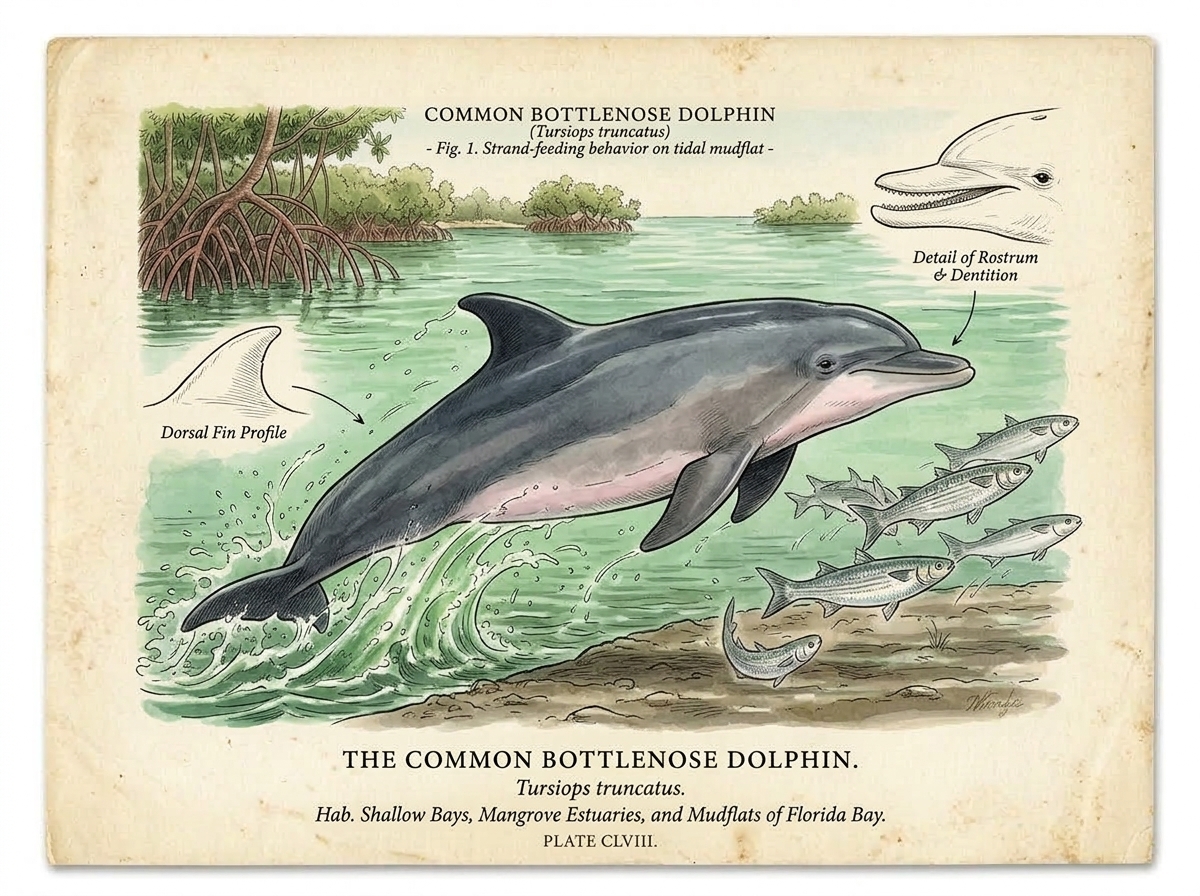
Plate #62 • Marine MammalsProtected
4:3 Verified Plate
Bottlenose Dolphin
Tursiops truncatus[Delphinidae]
Status:Marine Mammal Protection Act • Native
Diet Role:Apex marine carnivore (mullet, pinfish)
Mass / Length:Length: 2.0–3.8 m • Mass: 150–650 kg
Biome:Florida Bay Shallow Estuary • Tidal Passes
Non-prey apex marine mammal reinforcing South Florida ecosystem authenticity. Renowned for specialized Florida Bay strand-feeding behavior, hydroplaning onto shallow mud banks to trap shoals of mullet. Highly social, streamlined, and acoustically intelligent marine presence.
RANGE: Florida Bay, Ten Thousand Islands • Gulf Coastal Waters
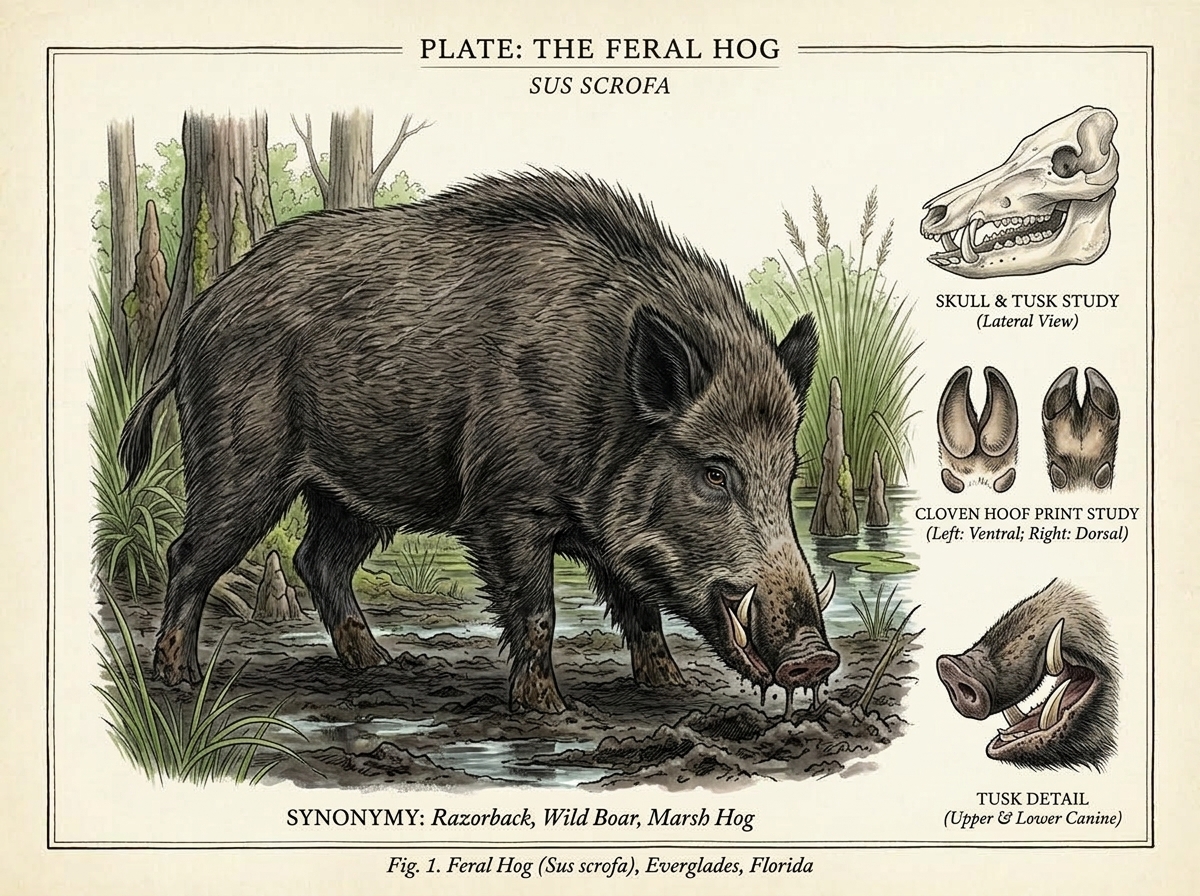
Mass / Length:Mass: 40–130 kg (90–285 lbs) • Length: 1.2–1.8 m
Biome:Pine Flatwoods, Marshes • Hammock Edges
Major high-value python prey species (40–130 kg) and ecological competitor. Features a coarse bristly coat and wedge-shaped head; mature boars wield razor-sharp tusks and retaliate aggressively during constriction, inflicting severe lacerations if not pinned securely.
RANGE: Pine Flatwoods, Wetland Margins • Disturbed Canal Levees
Plate #64 • Aquatic Apex PredatorNative
4:3 Verified Plate
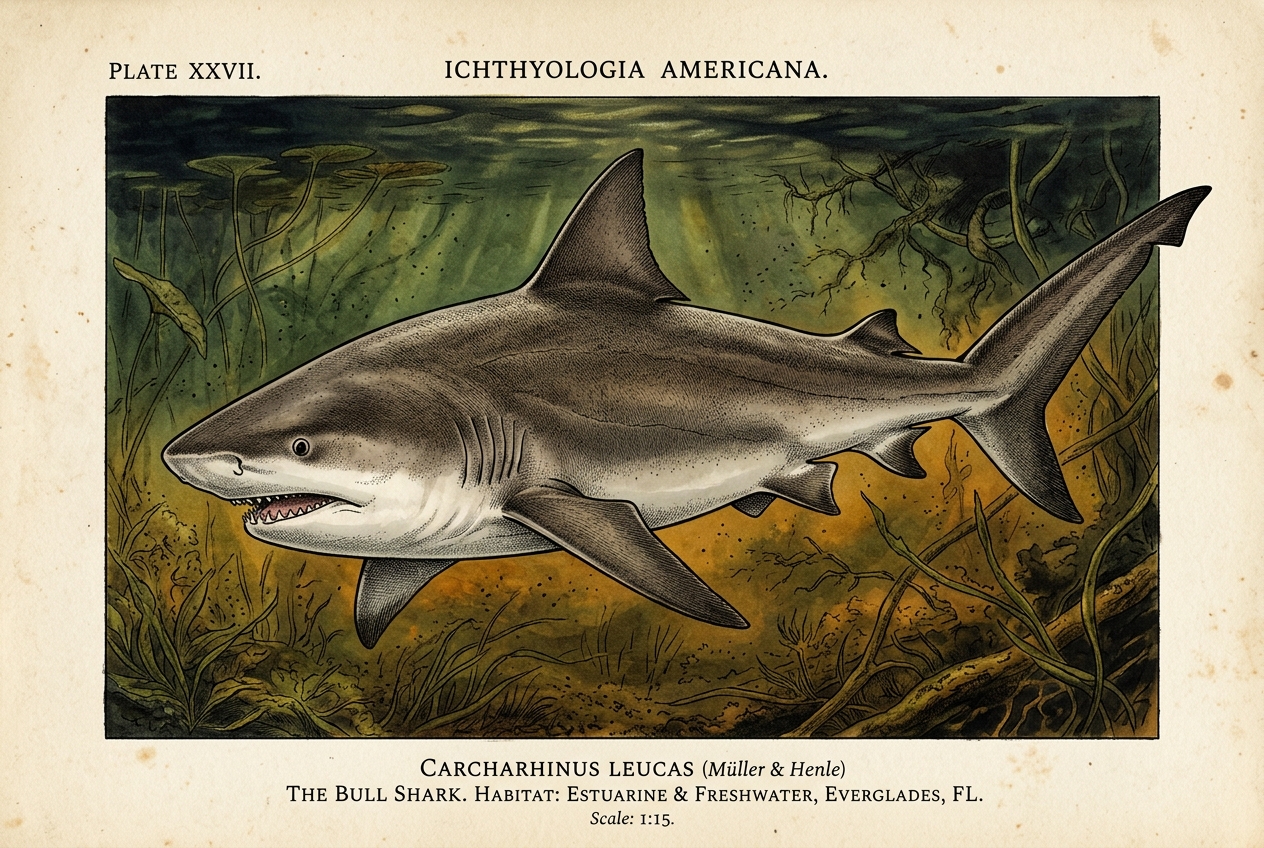
Bull Shark
Carcharhinus leucas[Carcharhinidae]
Status:IUCN Vulnerable • Native Euryhaline Apex
Diet Role:Apex aquatic carnivore (fish, rays, small herps)
Mass / Length:Mass: 90–230 kg (200–500 lbs) • Length: 2.1–3.4 m
Biome:Shark Valley Canals • Mangrove Tidal Rivers
Lethal aquatic threat capable of osmoregulating in completely fresh Everglades water. Possesses a stocky grey body, blunt snout, and terrifying circle-bump-strike ambush tactic. Poses an extreme danger to swimming pythons crossing deep canal cuts and estuarine channels.
RANGE: Deep Drainage Canals, Shark Valley Sloughs • Coastal Passes
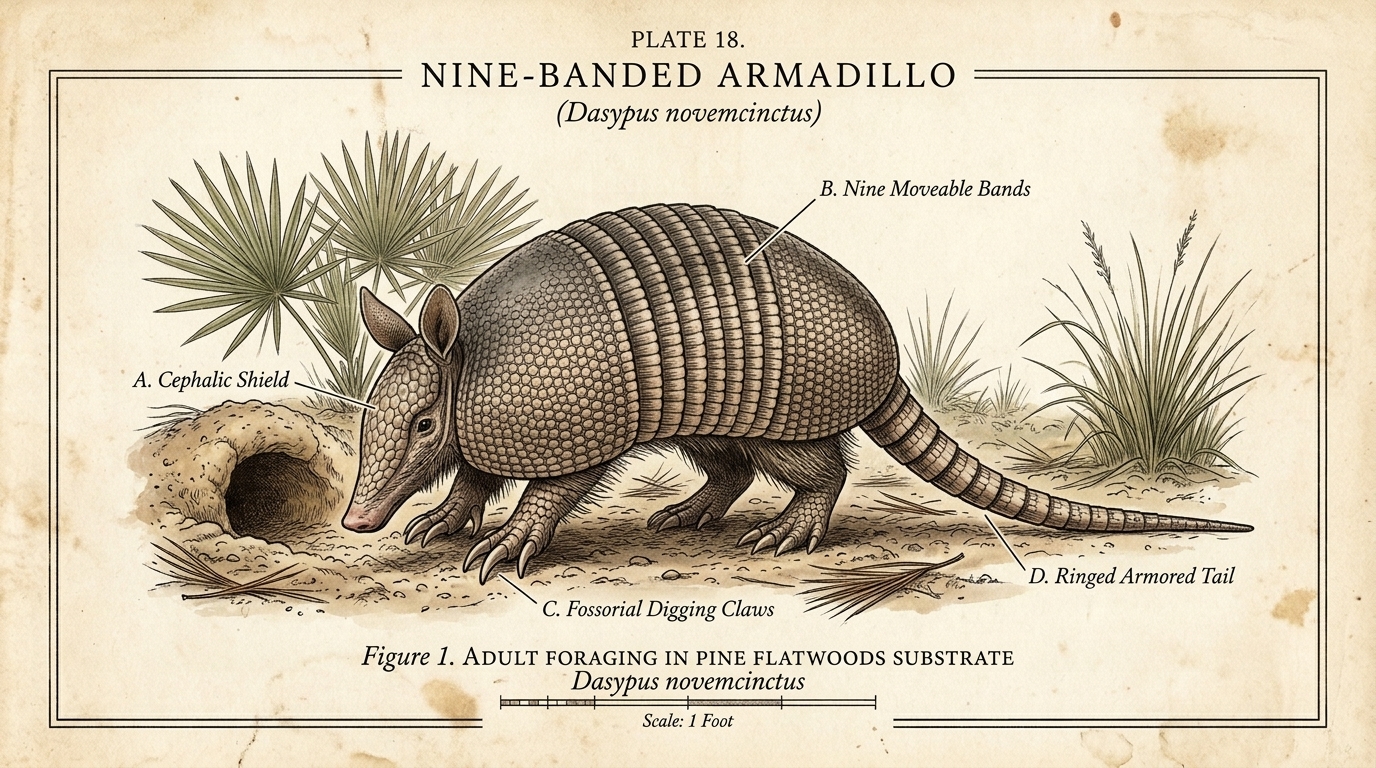
Mass / Length:Mass: 3.6–7.7 kg (8–17 lbs) • Length: 66–100 cm
Biome:Hardwood Hammocks, Canal Levees & Pinelands
Armored terrestrial mammal characterized by an ossified carapace with 9 flexible hinged bands, pig-like snout, and acute olfaction used to locate grubs 20 cm underground. Possesses an explosive vertical jump reflex (up to 1 m) when startled and excavates extensive burrow networks (up to 5 m long). While invulnerable to smaller predators, subadult and adult pythons successfully constrict and consume them, routinely claiming their deep burrows as critical thermal refugia during cold snaps.
RANGE: Hardwood Hammocks, Levee Embankments • Upland Pine Flatwoods
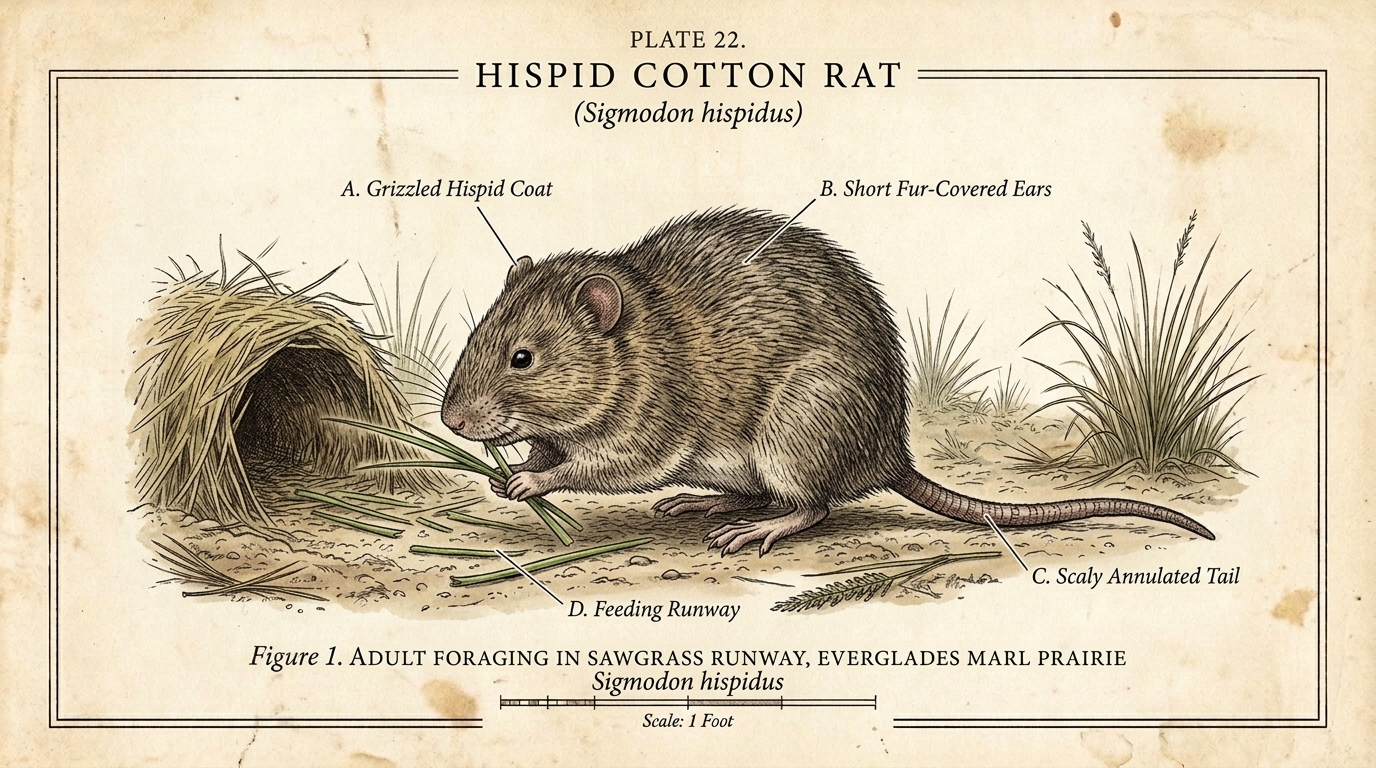
Coarse, grizzled olive-brown coat interspersed with dark bristly guard hairs, small rounded ears, and a scaly tail. Represents the single most numerically abundant mammalian prey item documented in Florida Burmese python diet studies (528+ records; 45% of diet when paired with black rats). Weaves dense 8–10 cm runway networks through sawgrass thatch. Serves as the quintessential primary sustenance for growing hatchling pythons, though large aggressive individuals will bite back fiercely with orange incisors.
RANGE: Sawgrass Prairies, Levee Embankments • Tree Island Margins
Plate #67 • MammalsNative
4:3 Verified Plate
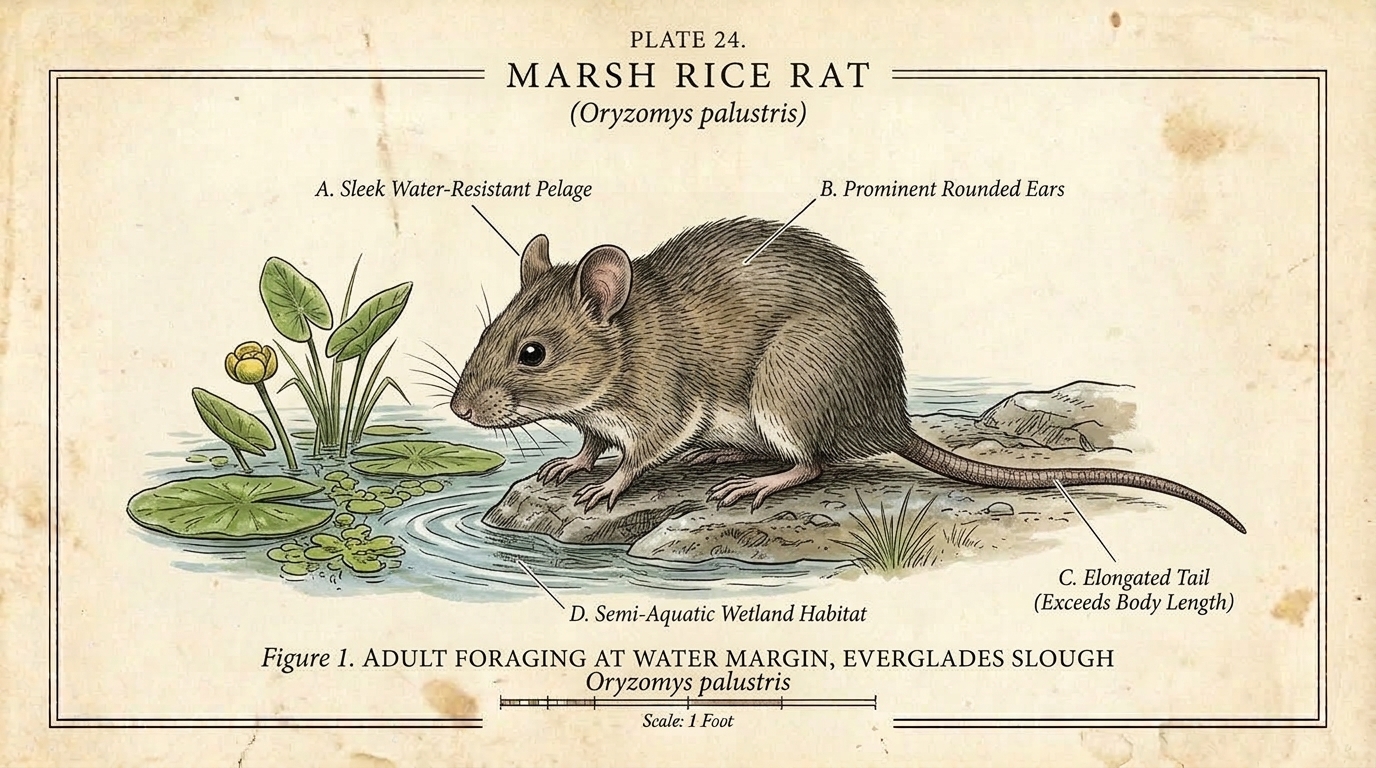
Marsh Rice Rat
Oryzomys palustris[Cricetidae]
Status:IUCN Least Concern • Semiaquatic Native
Diet Role:Semiaquatic omnivore (sedges, insects, small crabs)
Mass / Length:Mass: 40–80 g (0.09–0.18 lbs) • Length: 22–30 cm
Graceful, semi-aquatic rodent with silky tawny to grey-brown pelage, white underparts, long whiskers, and an elongated tail equal to body length. An accomplished swimmer capable of underwater dives exceeding 10 meters, nesting in woven grass spheres suspended above the fluctuating water line. Provides an essential, manageable entry prey for young neonate and hatchling pythons navigating inundated sawgrass marshes and culverts.
Diet Role:Aquatic omnivore (algae, duckweed, water bugs, mollusks)
Mass / Length:Mass: 550–800 g (1.2–1.8 lbs) • Length: 38–43 cm • Wingspan: 58–71 cm
Biome:Open Sloughs, Marsh Lakes • Canal Edges
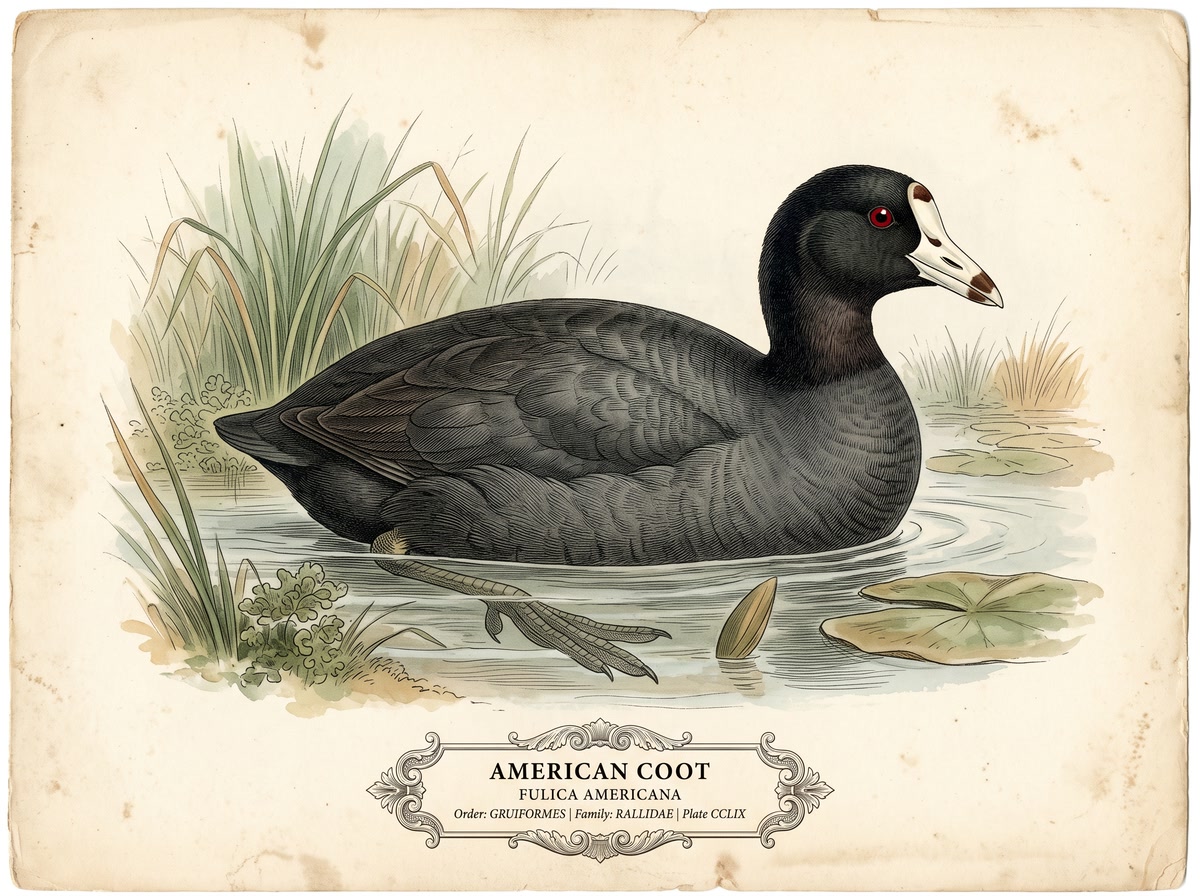
Plump, dark slate-grey waterbird with a stark white frontal shield and bill ending in a faint brownish ring. Lacks webbed feet, possessing instead distinctive lobed toes that enable powerful propulsion across open sloughs and agile walking on floating water-hyacinth mats. Gathers in rafted winter flocks numbering hundreds of individuals, pattering across the water surface with rapid wing-flaps to achieve flight when ambushed from beneath by patrolling subadult pythons.
RANGE: Deep Freshwater Sloughs, Marl Basins • Water Conservation Areas
Plate #69 • AvifaunaProtected Native
4:3 Verified Plate
American White Pelican
Pelecanus erythrorhynchos[Pelecanidae]
Status:IUCN Least Concern • Protected Migratory Giant
Mass / Length:Mass: 5.0–9.0 kg (11–20 lbs) • Length: 130–170 cm • Wingspan: 2.7–3.0 m
Biome:Florida Bay, Cape Sable • Inland Lake Inflows
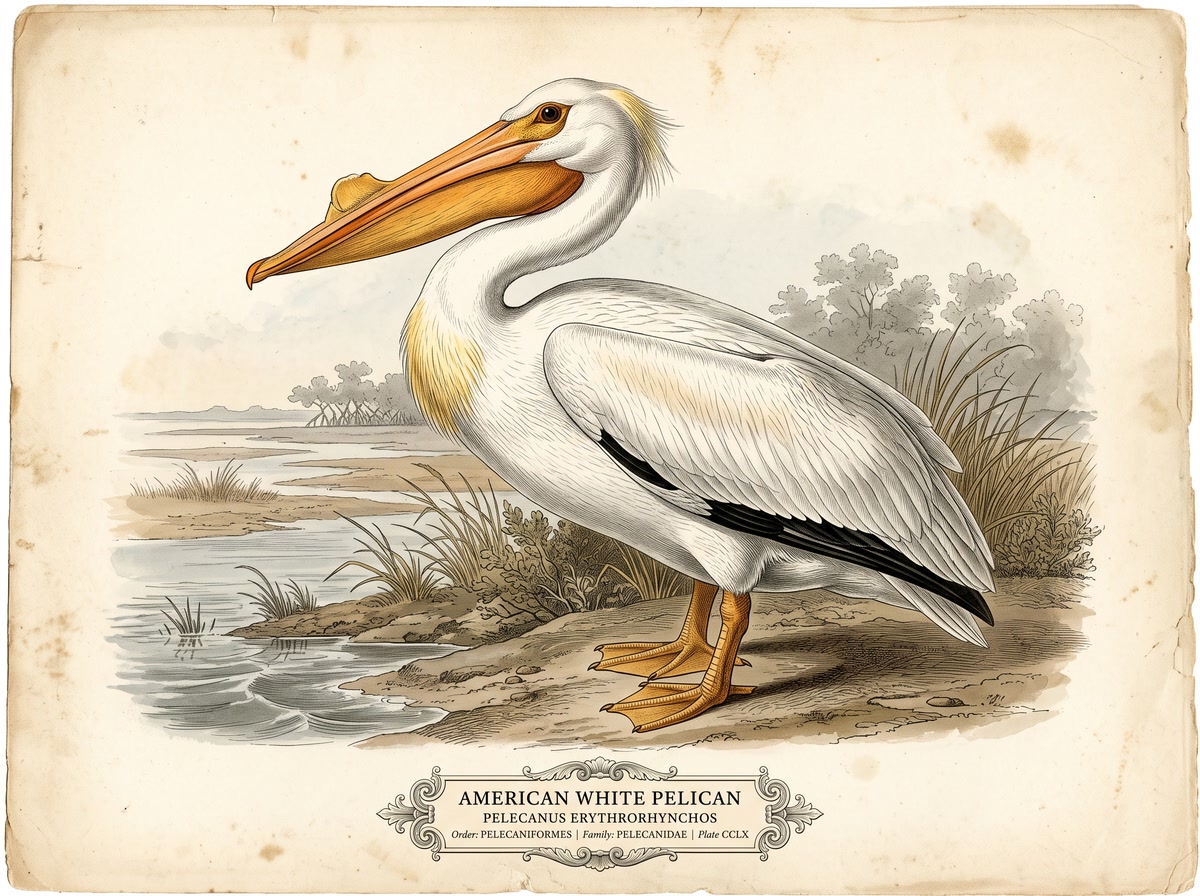
One of North America's largest birds, boasting a magnificent 9-foot wingspan, glowing snow-white plumage, and jet-black primary flight feathers visible only in flight. Unlike brown pelicans, white pelicans never plunge-dive; instead, they fish in synchronized squadrons, circling and herding schooling fish into shallow shallows before scooping them into expansive 3-gallon gular pouches. Wintering flocks rest along open mudflats and shell keys where their formidable size deters all but the largest matriarch pythons.
RANGE: Coastal Marine Shallows, Florida Bay Mudflats • Lake Okeechobee Margins
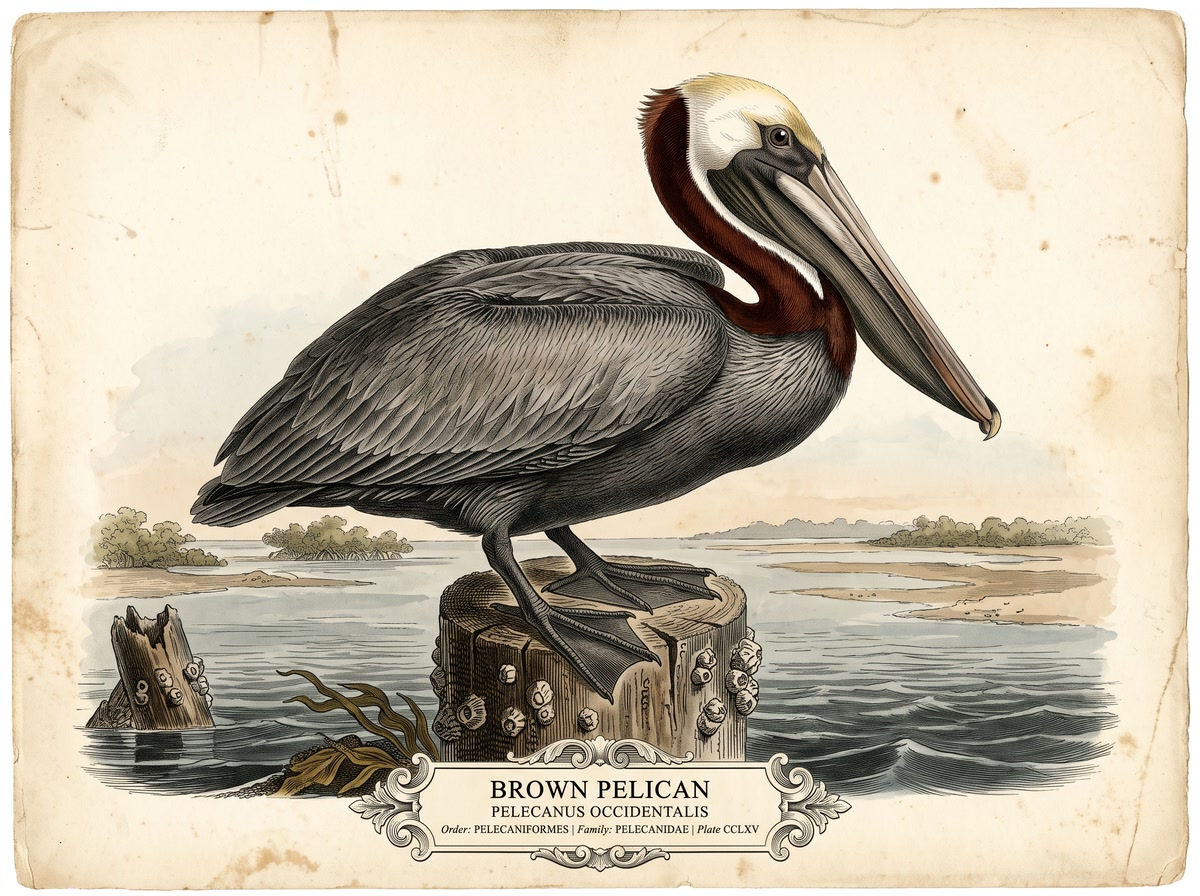
Iconic coastal aviator recognizable by its silver-brown body, creamy yellow crown, and massive elastic throat pouch. Masters an astonishing plunge-dive maneuver, spiraling down from heights of 60 feet and plunging bill-first into breaking surf, twisting in mid-air to cushion the impact while trapping gallons of water and fish. Colonial mangrove rookeries situated on outer mangrove islands remain vulnerable to climbing subadult pythons that navigate the twisted root canopies under cover of fog.
RANGE: Ten Thousand Islands, Florida Bay Mangrove Keys • Gulf Inlets
Plate #71 • AvifaunaNative
4:3 Verified Plate
Double-Crested Cormorant
Nannopterum auritum[Phalacrocoracidae]
Status:IUCN Least Concern • Semiaquatic Native Diver
Mass / Length:Mass: 1.5–2.5 kg (3.3–5.5 lbs) • Length: 70–90 cm • Wingspan: 1.1–1.3 m
Biome:Open Canals, Cypress Domes • Brackish Inlets
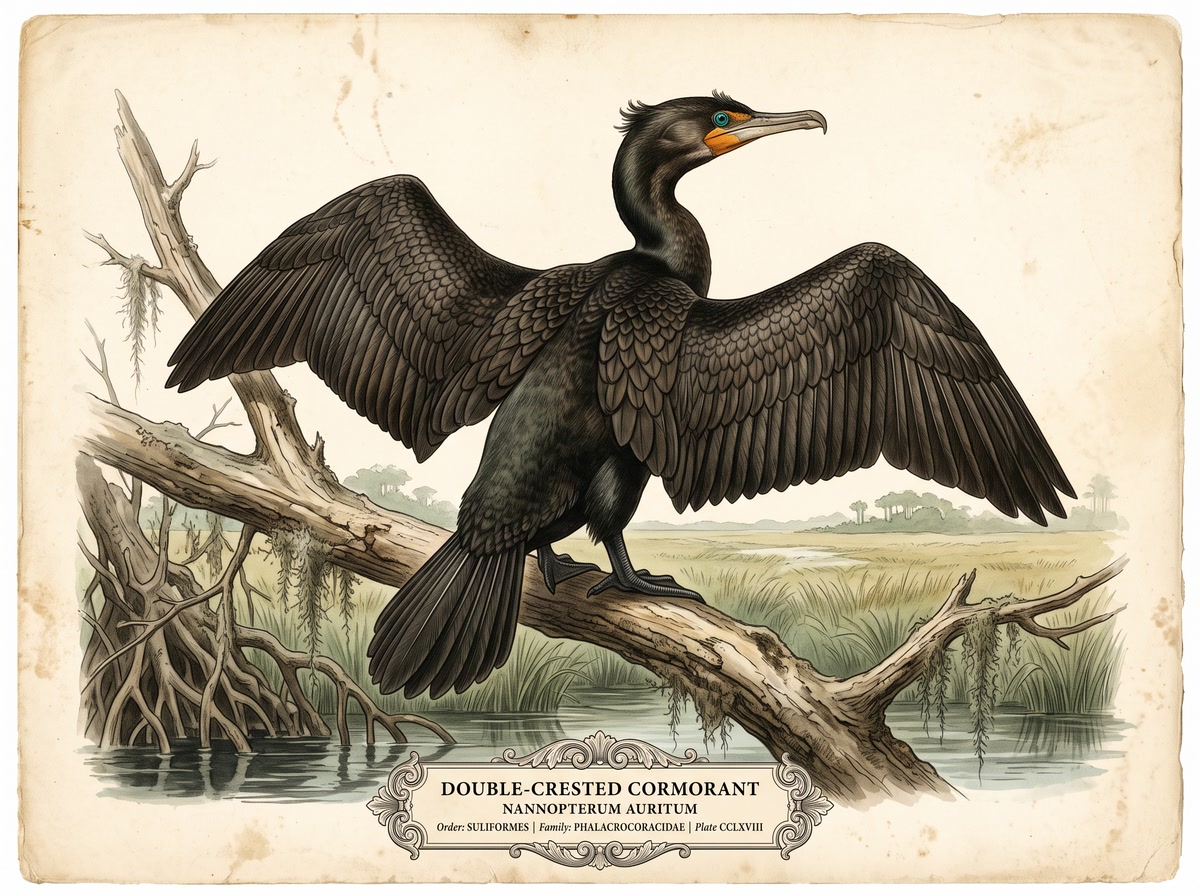
Gawky, matte-black diver with an orange throat patch and striking turquoise eyes. Lacks the waterproofing preen oils of true waterfowl, a physiological trait that reduces buoyancy to enable deep, rapid underwater pursuits but requires extended sun-drying periods where it perches with outspread wings on snag branches and channel markers. When swimming at water level, only its snake-like neck and hooked bill protrude, making it a high-frequency target for ambush strikes from submerged bull gators and pythons.
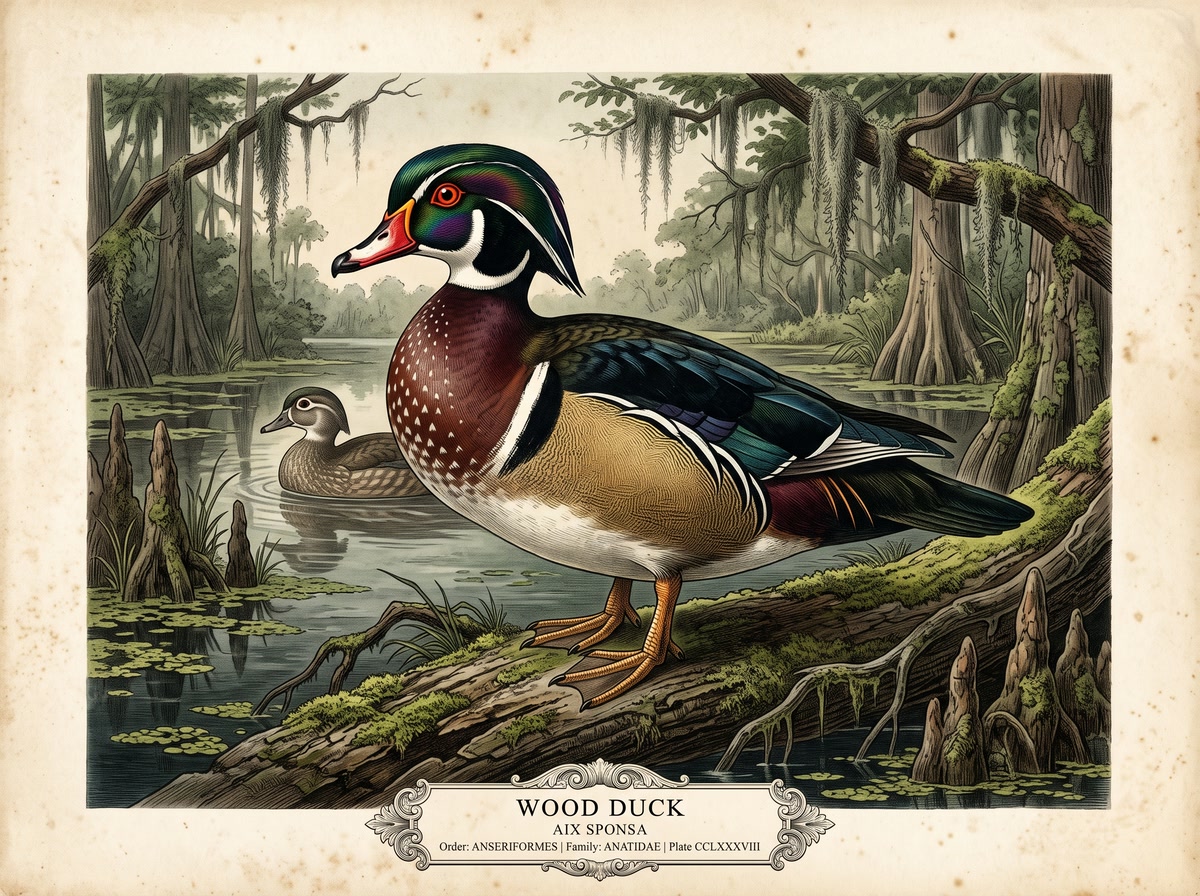
Renowned as North America's most flamboyantly iridescent waterfowl, the drake features an emerald crested helmet, striped white bridle, chestnut breast, and ruby-red eye rings. Possesses razor-sharp claws on its webbed toes that allow it to perch comfortably on high cypress limbs and nest inside dead cavity trees 30 feet above the blackwater. Ducklings take a terrifying leap from canopy hollows within 24 hours of hatching, braving snake-filled sawgrass roots below.
RANGE: Deep Cypress Domes, Strands • Shaded Forest Pools
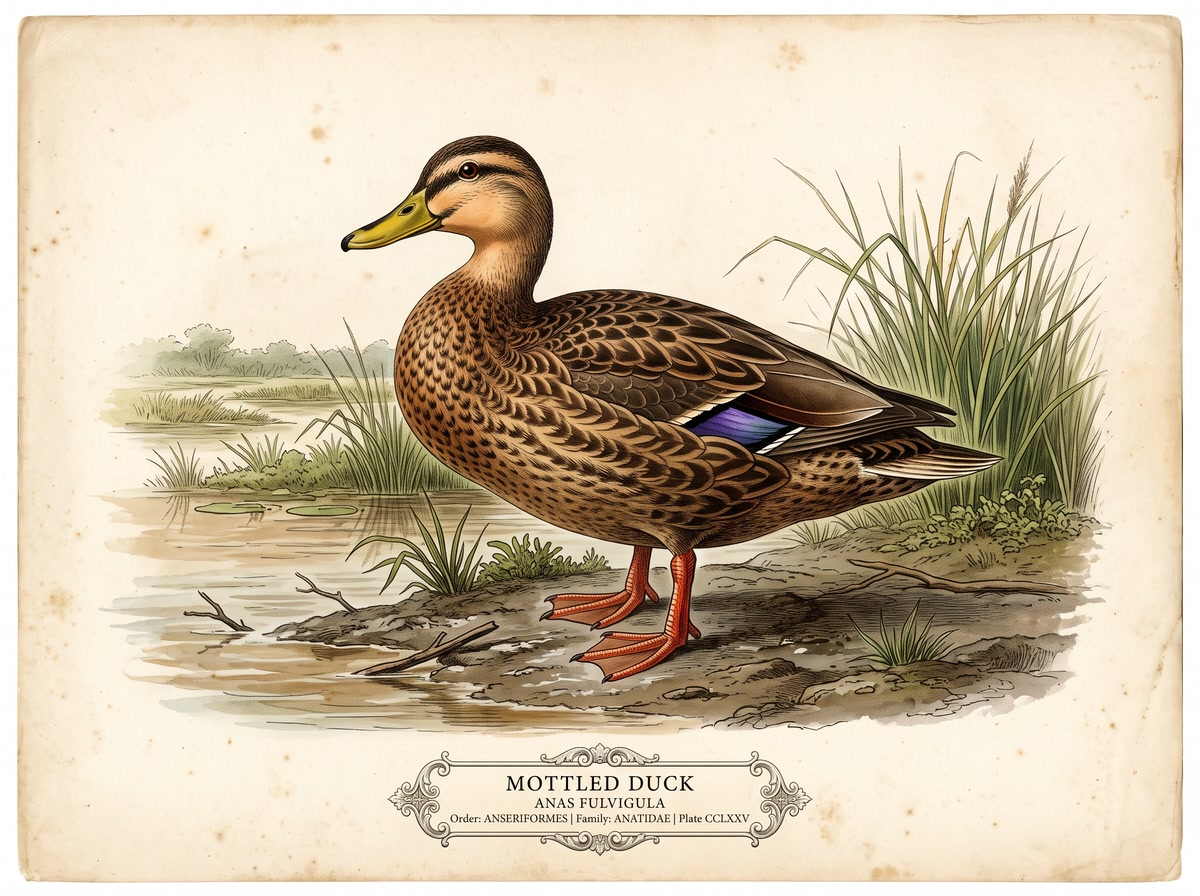
Closely related to the mallard but strictly resident to peninsular Florida, displaying rich umber plumage with scalloped buff margins, an unstreaked buff throat, and a bright yellow-green bill on drakes. Does not migrate north, nesting directly upon dry sawgrass clumps and cordgrass tussocks nestled just inches above water level. Extreme vulnerability to nest predation by invasive pythons and hybridization with feral domestic mallards has made its wild Everglades breeding population a critical conservation priority.
RANGE: Freshwater Marl Marshes, Shark Valley • Kissimmee Basin Sloughs
Plate #74 • AvifaunaNative Migratory
4:3 Verified Plate
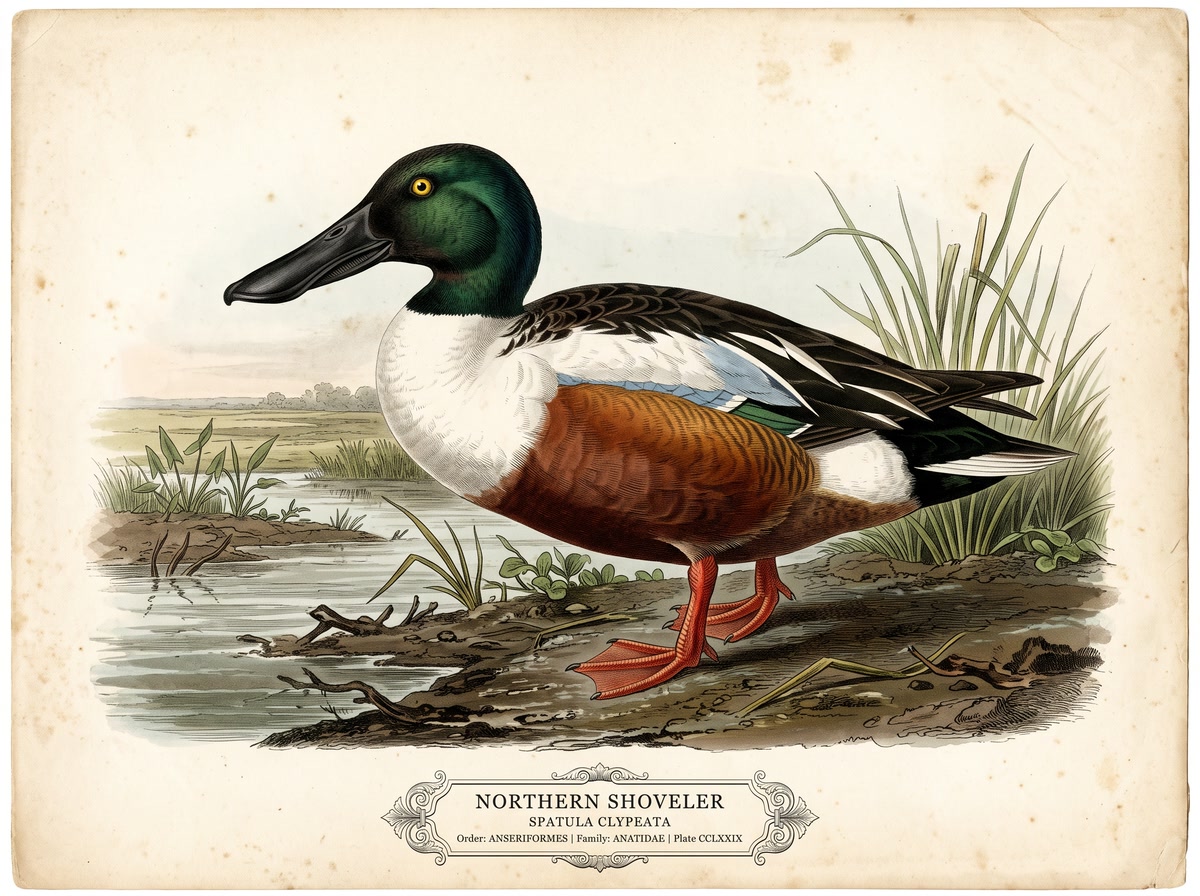
Northern Shoveler
Spatula clypeata[Anatidae]
Status:IUCN Least Concern • Specialized Filter Dabbler
Instantly diagnosed by its exaggerated, spoon-shaped spatulate bill lined with over 110 comb-like lamellae that function as a precision sieve. Drakes in winter breeding plumage showcase iridescent green heads, clean white chests, and chestnut bellies. Swims forward with its spatulate bill submerged just beneath the surface scum, filtering out microscopic invertebrates and duckweeds. Often feeds in tight spinning circles to churn up bottom muck in calm marsh backwaters.
Mass / Length:Mass: 350–450 g (0.77–1.0 lbs) • Length: 36–41 cm • Wingspan: 56–62 cm
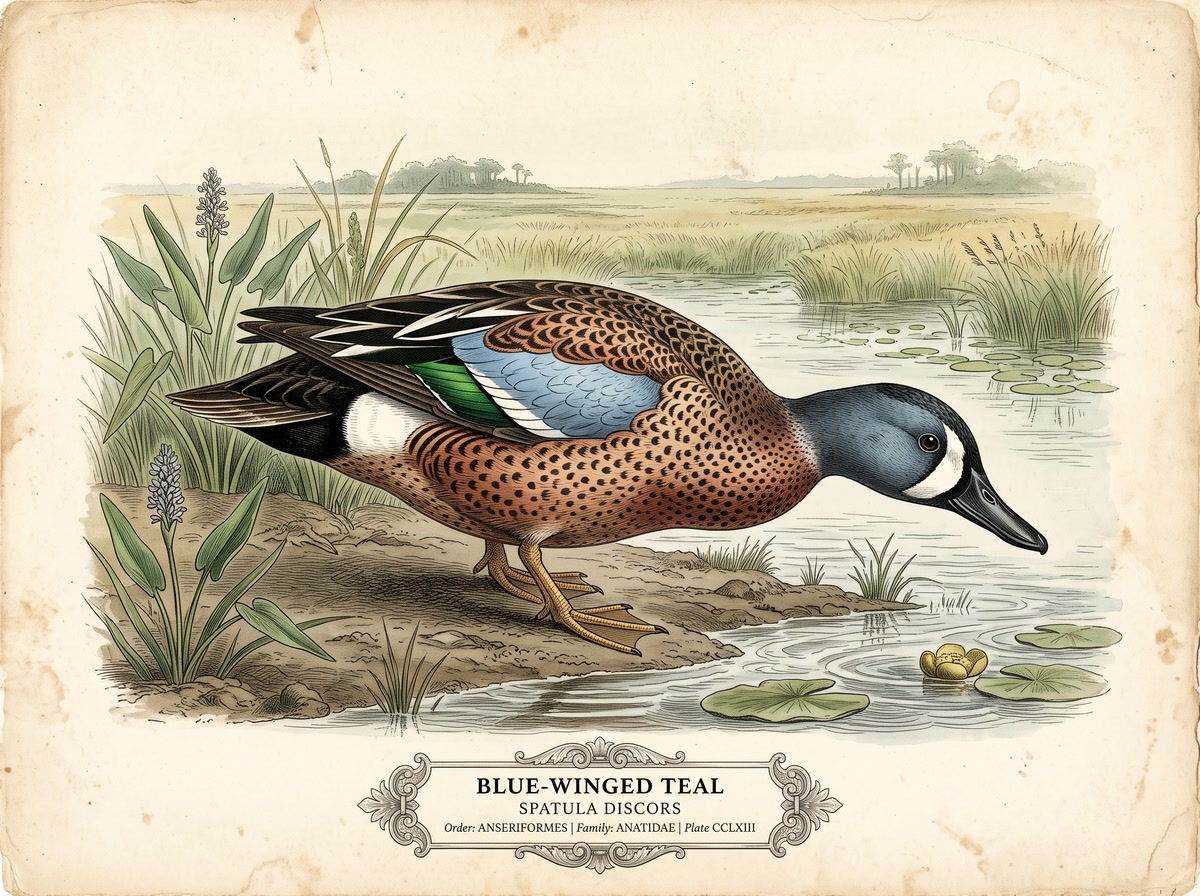
Biome:Sawgrass Ponds, Taylor Slough • Wet Marl Flats
Diminutive, lightning-fast dabbling duck renowned for its erratic, synchronized flock flight maneuvers that flash baby-blue upper wing coverts and iridescent green speculums. Winter drakes carry a prominent white crescent curving in front of the dark eye on a slate-colored head. Forages along the razor-thin margins between open water and emergent sawgrass, lifting off vertically without a running start the instant a predator breaks water.
Mass / Length:Mass: 3.5–5.2 kg (7.7–11.5 lbs) • Length: 100–120 cm • Wingspan: 1.8–2.0 m
Biome:Wet Prairies, Pastures • Pine Rockland Openings
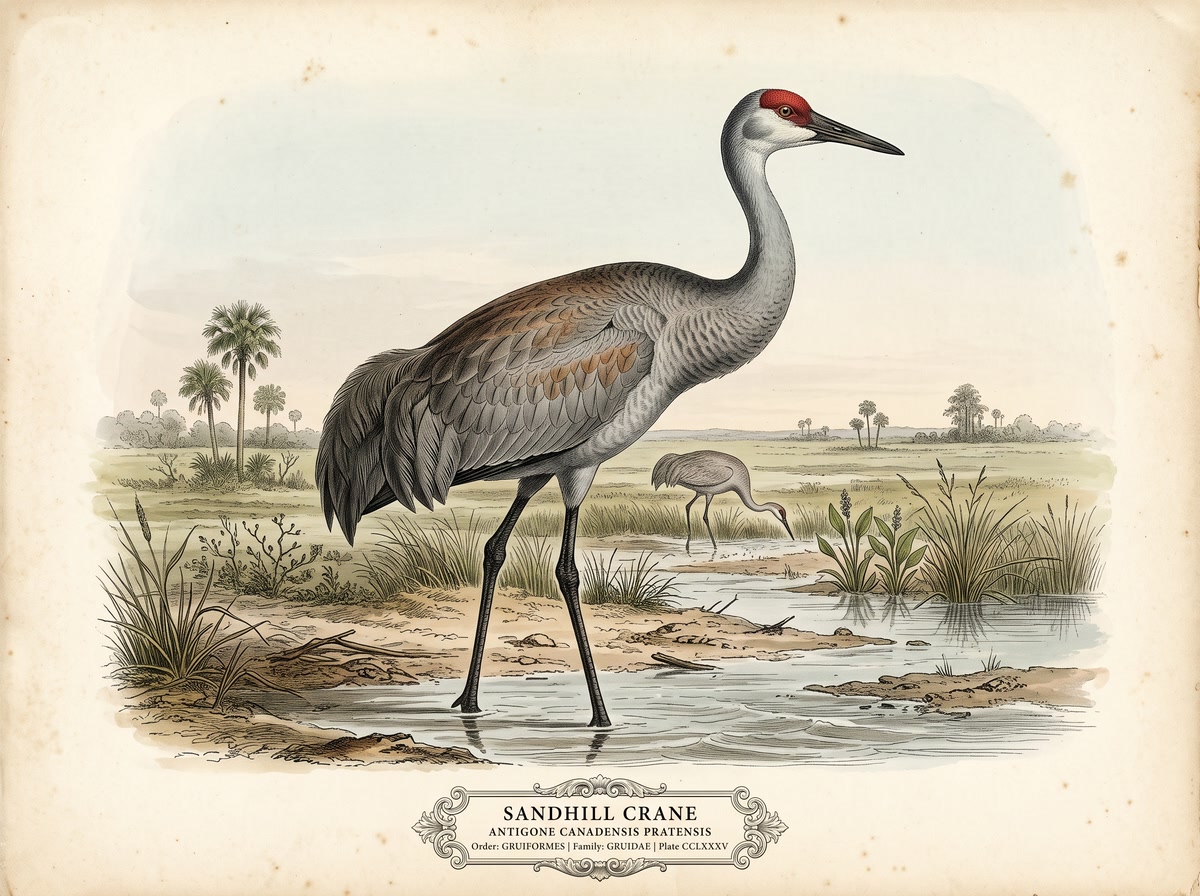
Majestic, prehistoric-looking wader standing over four feet tall, distinguished by an ashen grey body stained with wetland mud, a bright crimson crown patch, and a bugling trumpet call audible for over a mile. Pairs mate for life and perform intricate, leaping courtship dances with tosses of sawgrass blades. Builds extensive mound nests in shallow marsh water where protective parents will fearlessly stab their 5-inch dagger-bills at intruding raccoons and patrolling snakes.
RANGE: Wet Prairies, Kissimmee Prairies • Pine Flatwood Savannas
Plate #77 • AvifaunaNative
4:3 Verified Plate
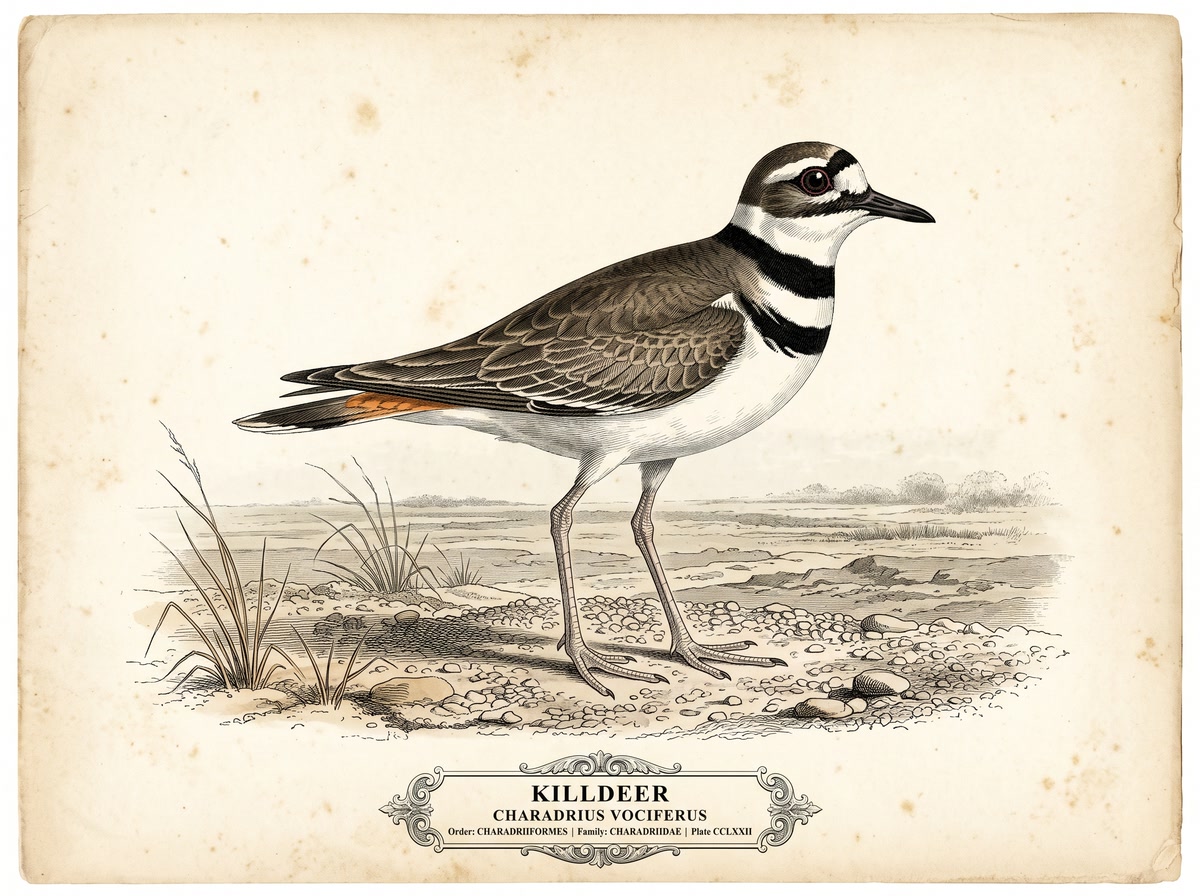
Killdeer
Charadrius vociferus[Charadriidae]
Status:IUCN Least Concern • Upland & Wetland Plover
Slender, vociferous plover with two bold black chest bands, large liquid brown eyes, and an unmistakable shrill 'kill-dee' alarm cry that echoes across open levees. When a predator approaches its ground scrape nest, the parent executes a legendary 'broken-wing display', feigning agonizing injury while fluttering just out of reach to lure snakes and foxes away from camouflaged chicks before bursting into effortless flight.
Diet Role:Aquatic insectivore (aquatic bugs, brine shrimp, small fish)
Mass / Length:Mass: 140–190 g (0.31–0.42 lbs) • Length: 35–39 cm • Wingspan: 68–71 cm
Biome:Calcitic Marl Pools, Slough Margins • Salt Pans
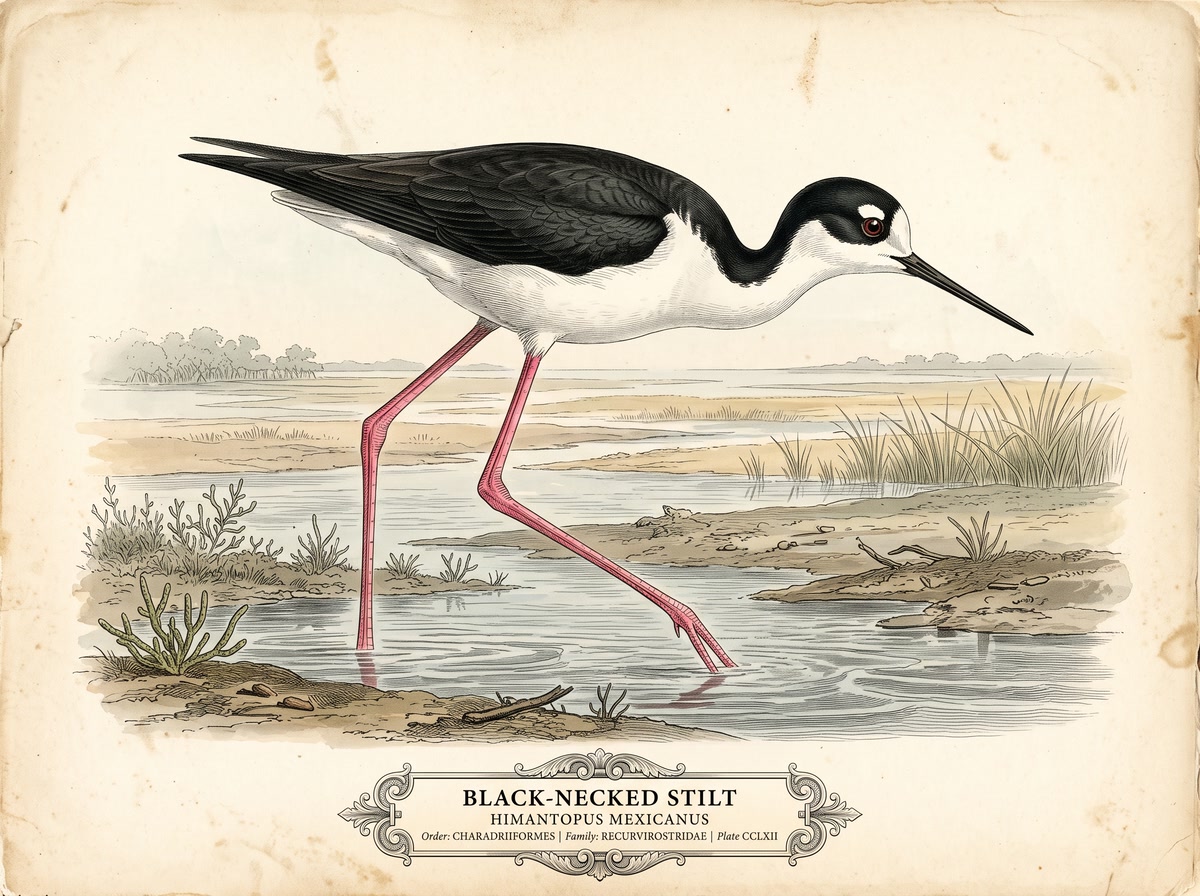
Striking, tuxedo-patterned shorebird possessing the second-longest legs in proportion to body size of any bird on Earth. Its flamingo-pink stilts measure up to 9 inches, allowing it to wade into belly-deep marsh waters unreachable by smaller waders while probing with a needle-thin black beak. Emits piercing, persistent yelping shrieks while diving aggressively at snakes that slither near its muddy nesting hummocks.
RANGE: Shallow Water Conservation Impoundments • Brackish Mudflats
Mass / Length:Mass: 250–400 g (0.55–0.88 lbs) • Length: 32–41 cm • Wingspan: 48–52 cm
Biome:Salt Marshes, Red Mangrove Labyrinths • Tidal Creeks
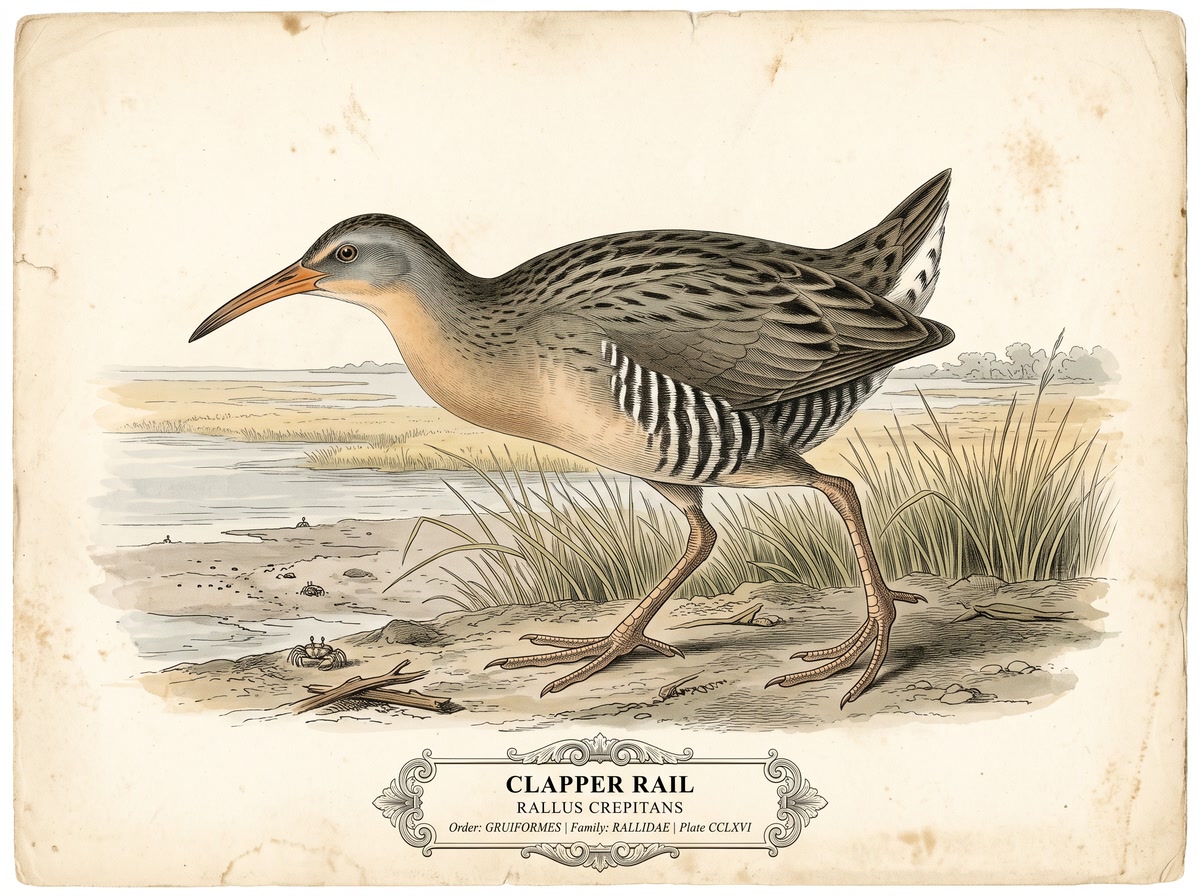
Chicken-sized, laterally compressed marsh bird designed by evolution to squeeze effortlessly through impenetrable stands of black needle-rush and tangled prop roots without rattling a single stalk. Features olive-grey barred flank feathers, a slightly decurved bill, and a rapid, clattering 'kek-kek-kek' call that echoes across mangrove channels at dawn. Spends low tide stalking fiddler crabs on exposed mudbanks, where its cryptically mottled plumage provides total camouflage against python eyes.
RANGE: Ten Thousand Islands Mangroves • Coastal Saline Marshes
Plate #80 • AvifaunaNative
4:3 Verified Plate
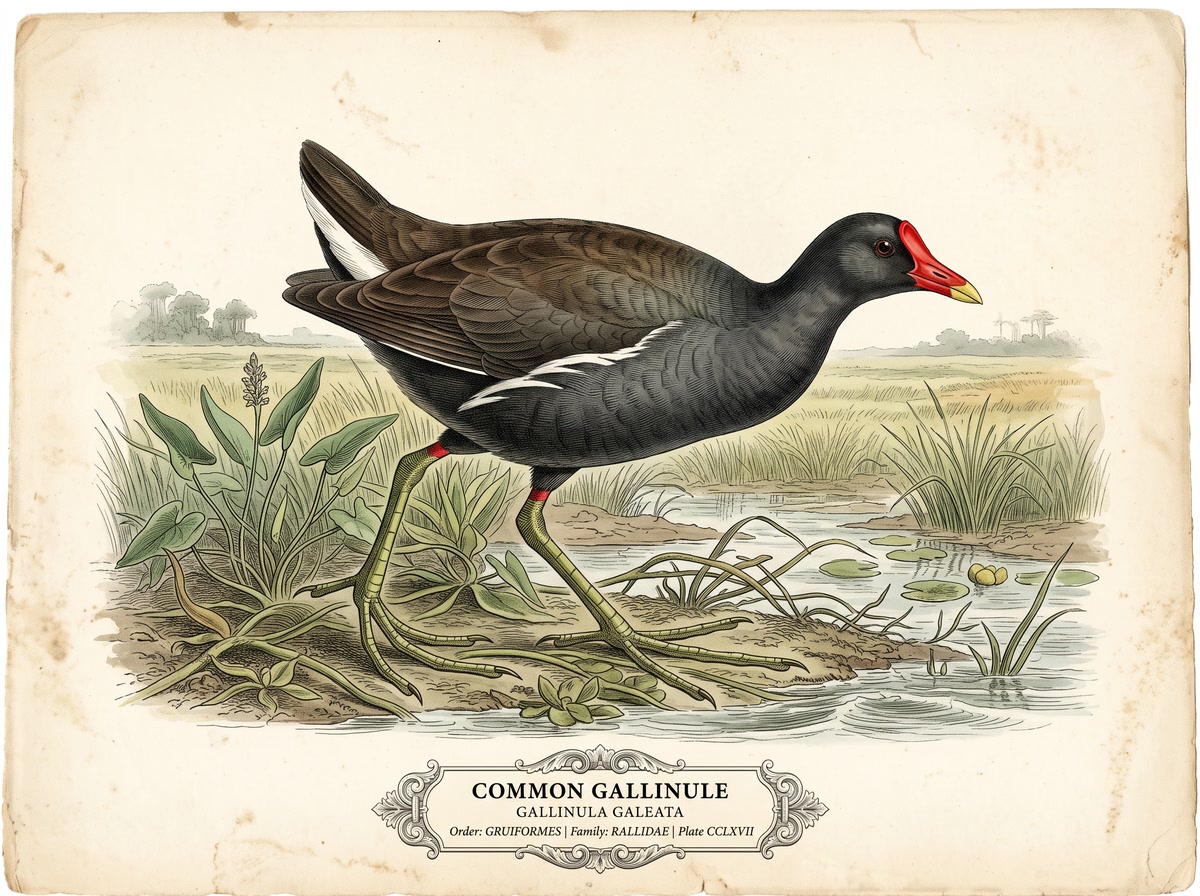
Common Gallinule
Gallinula galeata[Rallidae]
Status:IUCN Least Concern • Abundant Marsh Resident
Charcoal-bodied marsh rail decorated with a brilliant scarlet frontal plate, yellow bill tip, and a bold white flank stripe. Possesses extraordinarily long yellow-green toes that distribute its weight over floating lily pads and spatterdock leaves like biological snowshoes. Emits loud, chicken-like clucks, whines, and squawks from deep inside cattail thickets. When frightened, it skitters over the lily pads on foot rather than taking to the air.
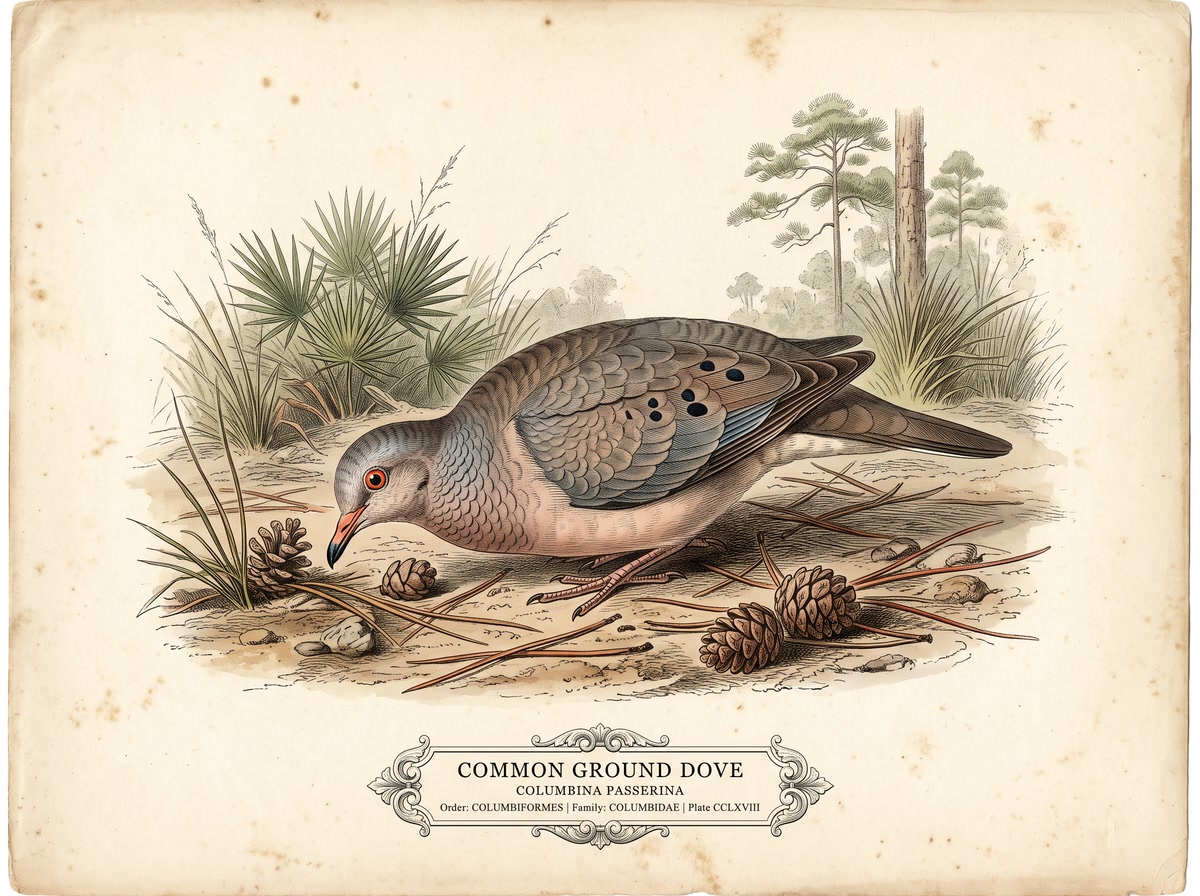
Scarcely larger than a sparrow, this is North America's smallest native dove. Displays soft grey-brown plumage with scaled iridescent breast feathers, a stubby black-tipped coral beak, and dazzling cinnamon-rufous wing linings revealed during explosive flushes. Forages deliberately on dry sandy soil, bobbing its head rhythmically with every step. Its small body and habit of nesting on low shrub boughs or open soil make it frequent prey for juvenile snakes.
RANGE: Pine Rocklands, Long Pine Key • Sandy Canal Levees
Plate #82 • AvifaunaNative
4:3 Verified Plate
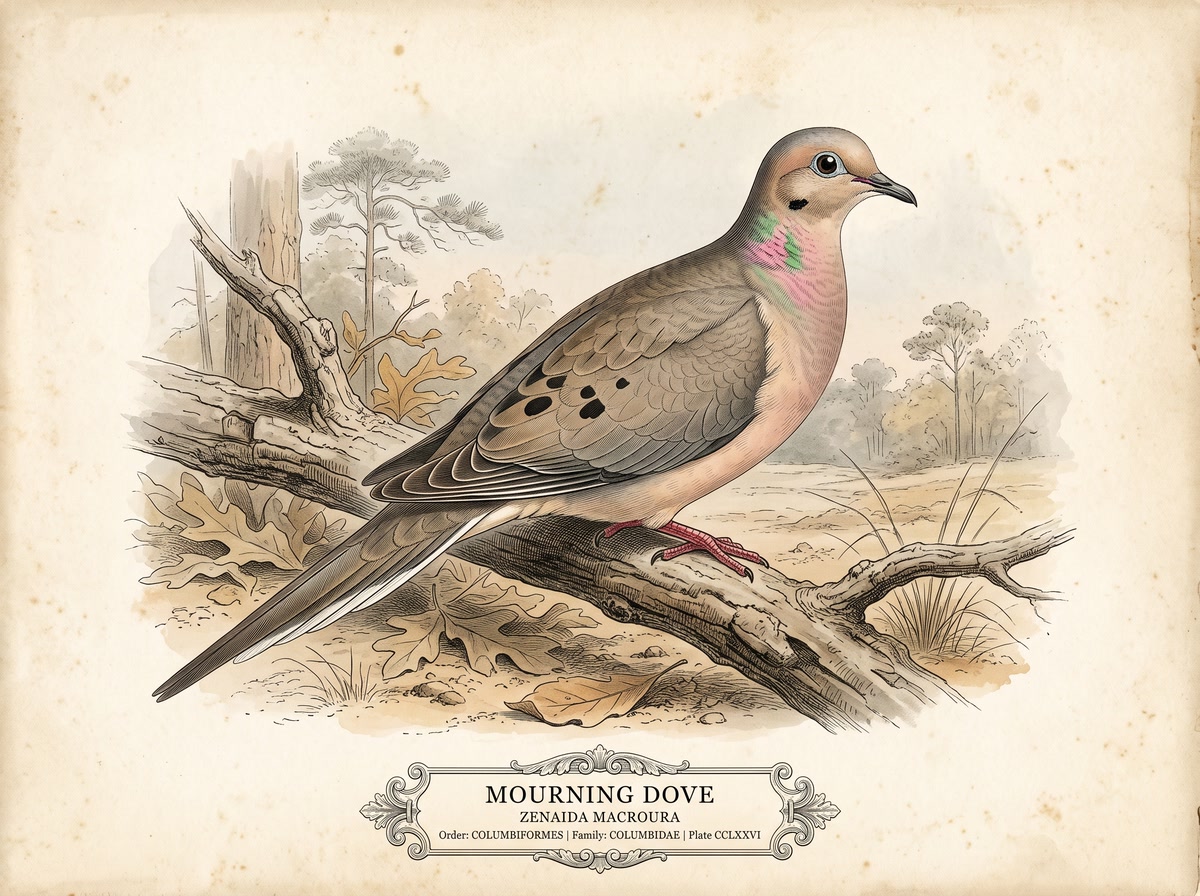
Mourning Dove
Zenaida macroura[Columbidae]
Status:IUCN Least Concern • Upland Granivore
Diet Role:Ground granivore (sunflower seeds, panicum, pine mast)
Mass / Length:Mass: 110–170 g (0.24–0.37 lbs) • Length: 28–33 cm • Wingspan: 37–45 cm
Graceful, fawn-brown dove with a pointed diamond tail tipped in white, black wing spots, and a mournful, soft cooing territorial call. Produces a loud whistling flutter on takeoff caused by specialized notched flight feathers that warn flock mates of approaching ambush predators. Forms loose flocks on dry levee gravel and upland pine ridges where it searches for seeds, serving as a staple meal for arboreal rat snakes and ambush-hunting pythons.
RANGE: Pine Rockland Openings, Levee Edges • Agricultural Borders
Plate #83 • AvifaunaNear Threatened
4:3 Verified Plate
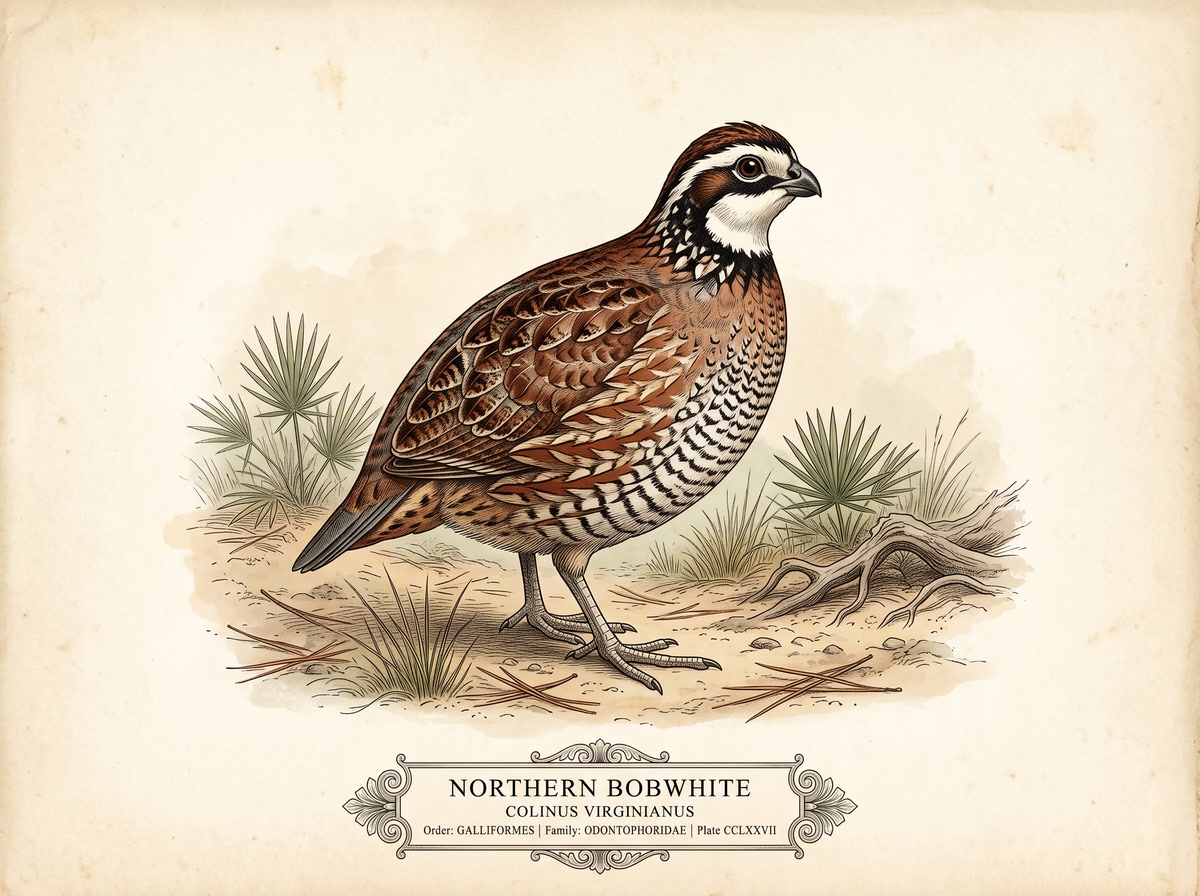
Northern Bobwhite
Colinus virginianus[Odontophoridae]
Status:IUCN Near Threatened • Native Prairie Quail
Diet Role:Omnivore (seeds, green shoots, beetles, spiders)
Mass / Length:Mass: 140–200 g (0.31–0.44 lbs) • Length: 24–28 cm • Wingspan: 33–38 cm
Biome:Dry Prairies, Pine Flatwoods • Hammock Margins
Chubby, intricately camouflaged ground-dwelling quail adorned with reddish-brown, buff, and black chevron patterns. Cocks exhibit a stark white throat and supercilium bordered in jet black, whistling their iconic 'bob-WHITE' whistle across open grasslands. Roosts in tight circular coveys facing outward like spokes on a wagon wheel to detect scent and vibrations of approaching predators, detonating in an explosive, disorienting covey flush when breached.
RANGE: Dry Prairie Savannas, Big Cypress Pine Flatwoods • Glades Borders
Plate #84 • AvifaunaNative
4:3 Verified Plate
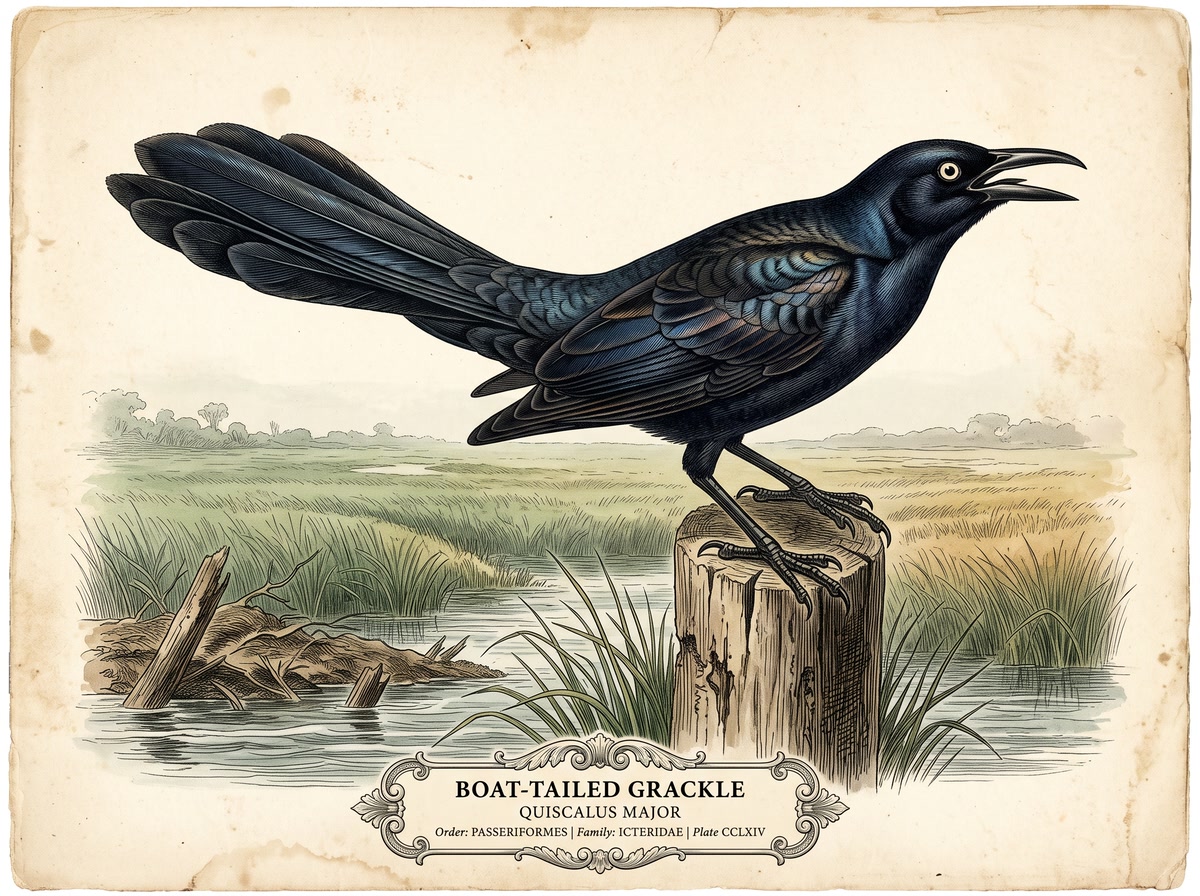
Boat-Tailed Grackle
Quiscalus major[Icteridae]
Status:IUCN Least Concern • Boisterous Wetland Resident
Exuberant, unmistakable songbird featuring dramatic sexual dimorphism: males are large, glossy blue-black with enormous, keeled boat-shaped tails that flex vertically during territorial displays, while females are warm rusty brown and half their mates' size. Forages along the mud-line of every Everglades canal, stabbing at crayfish and frog tadpoles. Colonies loudly mob swimming snakes with harsh clacking rattles, acting as living sentinels of the swamp.
Mass / Length:Mass: 250–340 g (0.55–0.75 lbs) • Length: 36–41 cm • Wingspan: 84–92 cm
Biome:Canals, Mangrove Coasts • Tree Island Hammocks
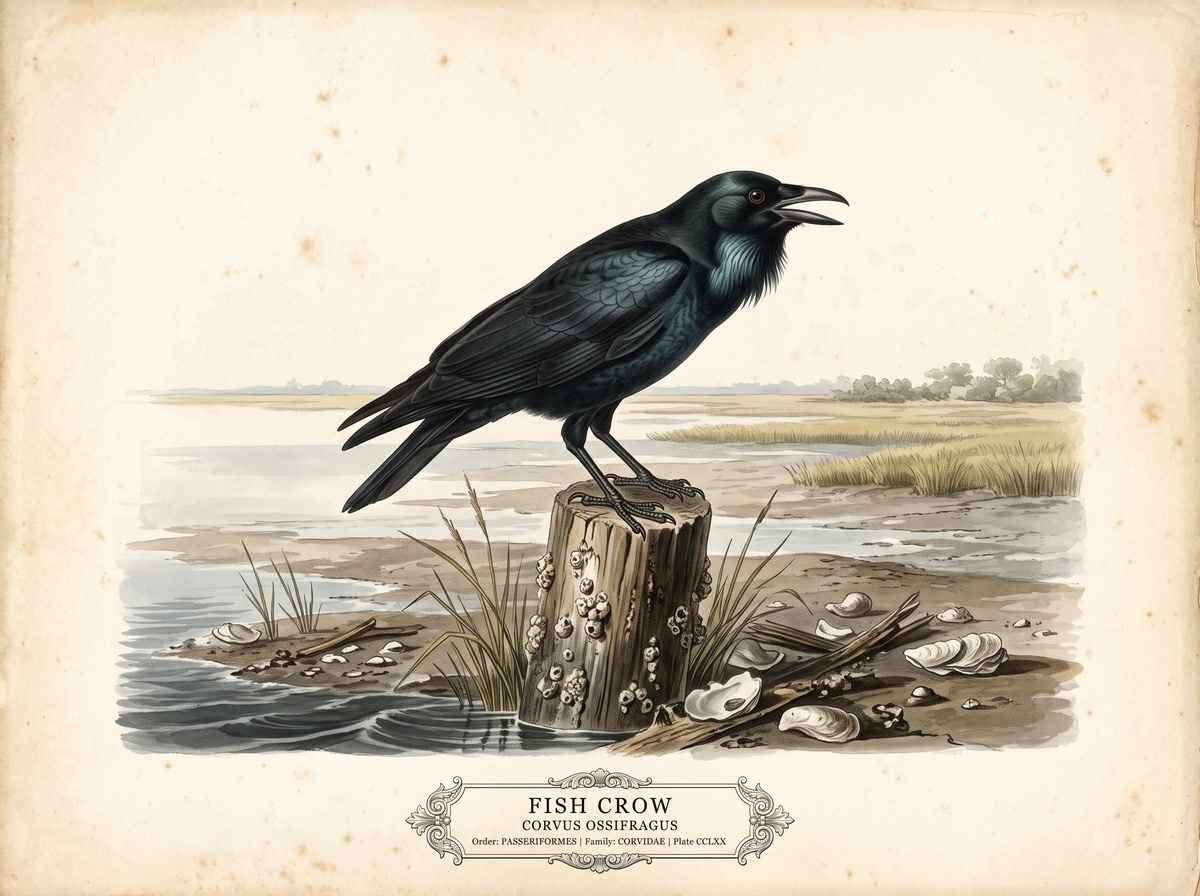
Slightly smaller and sleeker than the American Crow, distinguished unmistakably by its nasal, two-syllable 'uh-uh' call. Possesses exceptional spatial memory and social problem-solving skills, regularly following female alligators and softshell turtles to excavate newly laid nest clutches. Patrols canal banks in intelligent family troops, scavenging carrion left behind by python kills and sounding aerial alarms the instant an apex constrictor breaks surface.
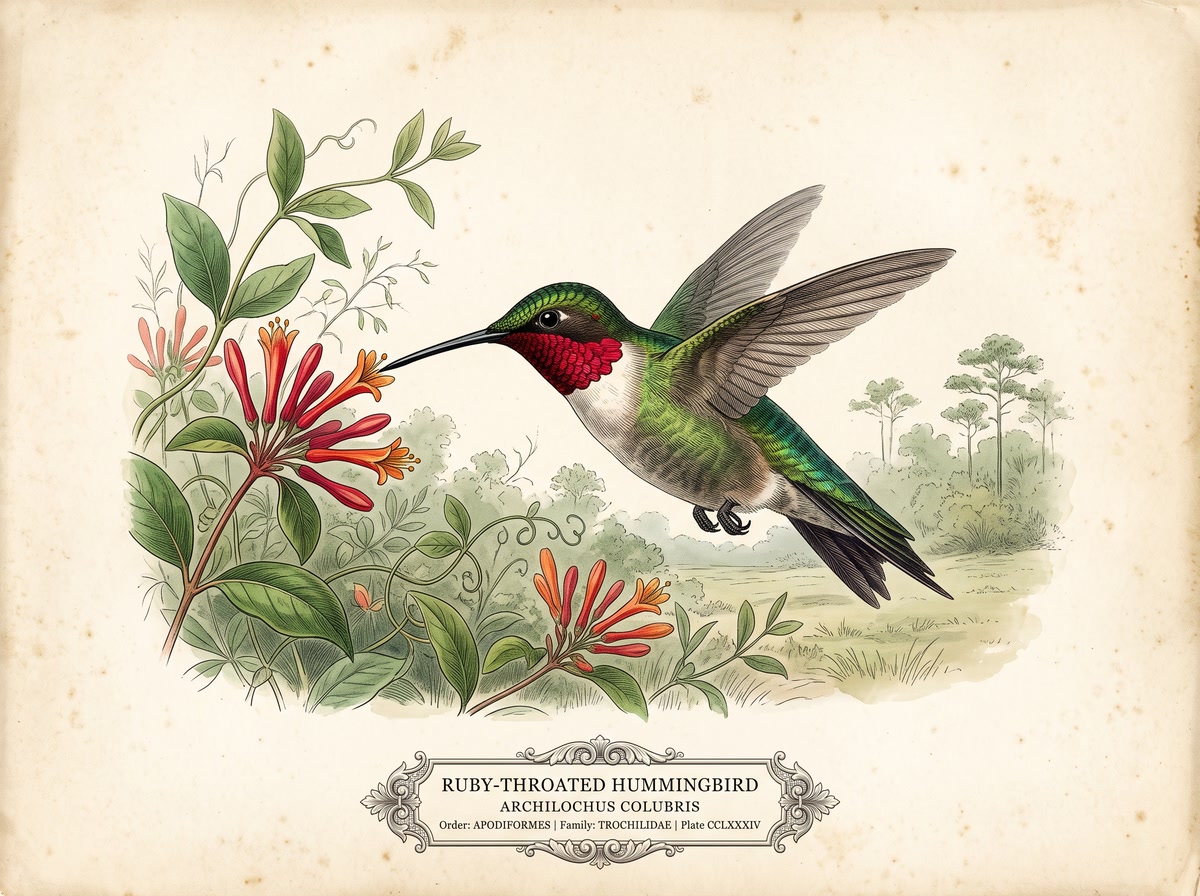
Mass / Length:Mass: 3.0–3.8 g (0.11–0.13 oz) • Length: 7–9 cm • Wingspan: 8–11 cm
Biome:Hardwood Hammocks, Firebush Thickets • Pine Rockland Edges
A jewel of the hammocks weighing less than a nickel, flashing metallic emerald back plumage and an iridescent ruby gorget on males that flares crimson in sunlight. Flaps its wings at up to 53 beats per second, allowing sustained backward flight and stationary hovering while feeding on tubular scarlet blooms of wild coffee and firebush. Embarks on an astounding 500-mile non-stop flight across the Gulf of Mexico during migration, resting in coastal Everglades hammocks.
RANGE: Tree Island Hardwood Hammocks, Pineland Firebush Clearings
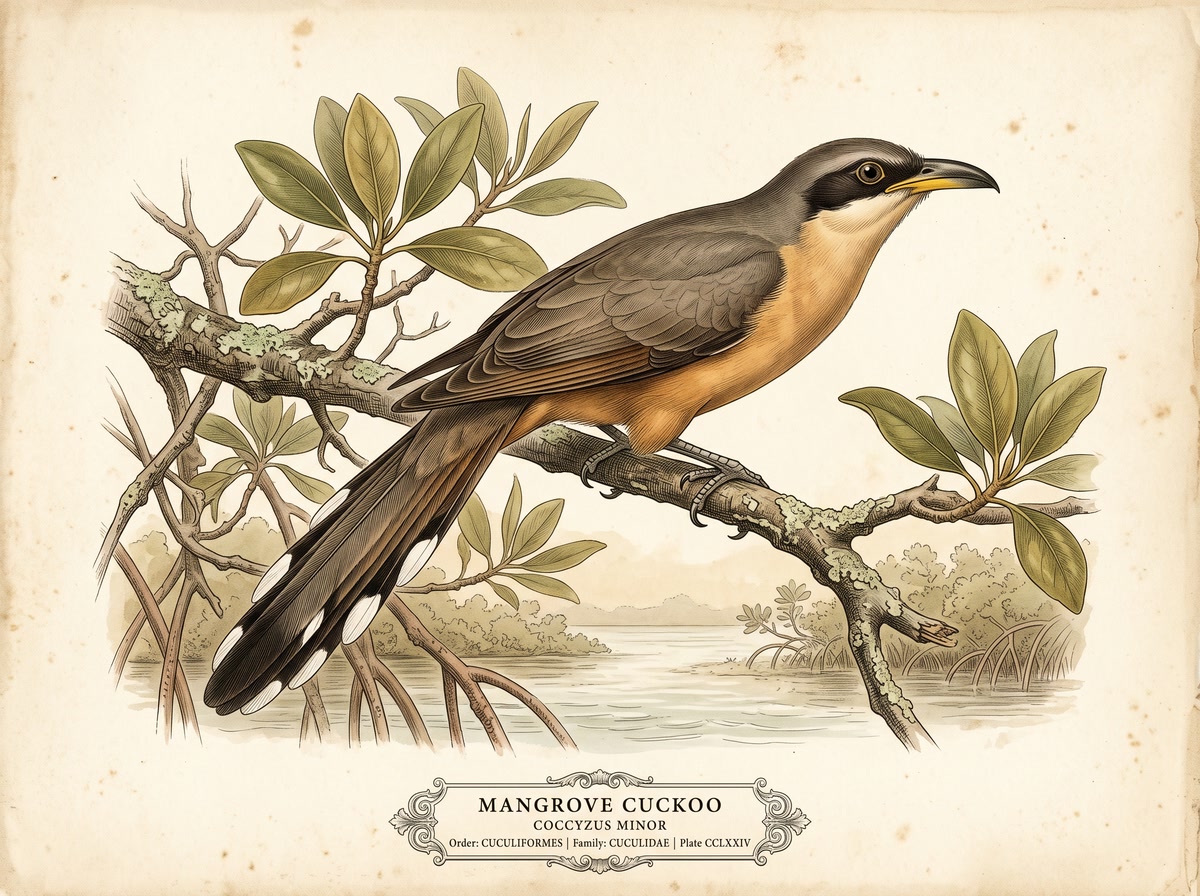
Diet Role:Insectivore (giant caterpillars, katydids, tree frogs)
Mass / Length:Mass: 60–75 g (0.13–0.17 lbs) • Length: 28–31 cm • Wingspan: 38–42 cm
Biome:Red & Black Mangrove Wilderness • Coastal Hammocks
Extremely secretive and elusive coastal specialist, featuring warm buff-cinnamon underparts, a dark charcoal eye mask, and a long tail adorned with oversized white thumbprint spots on black rectrices. Moves with agonizing slowness through the dense, salt-encrusted mangrove canopy, freezing for ten minutes at a time to spot giant sphinx moth caterpillars. Its guttural, wooden 'gawk-gawk-gawk' call is far more frequently heard than its shy physical form is seen.
RANGE: Ten Thousand Islands, Coastal Mangrove Fringes • Florida Bay Keys
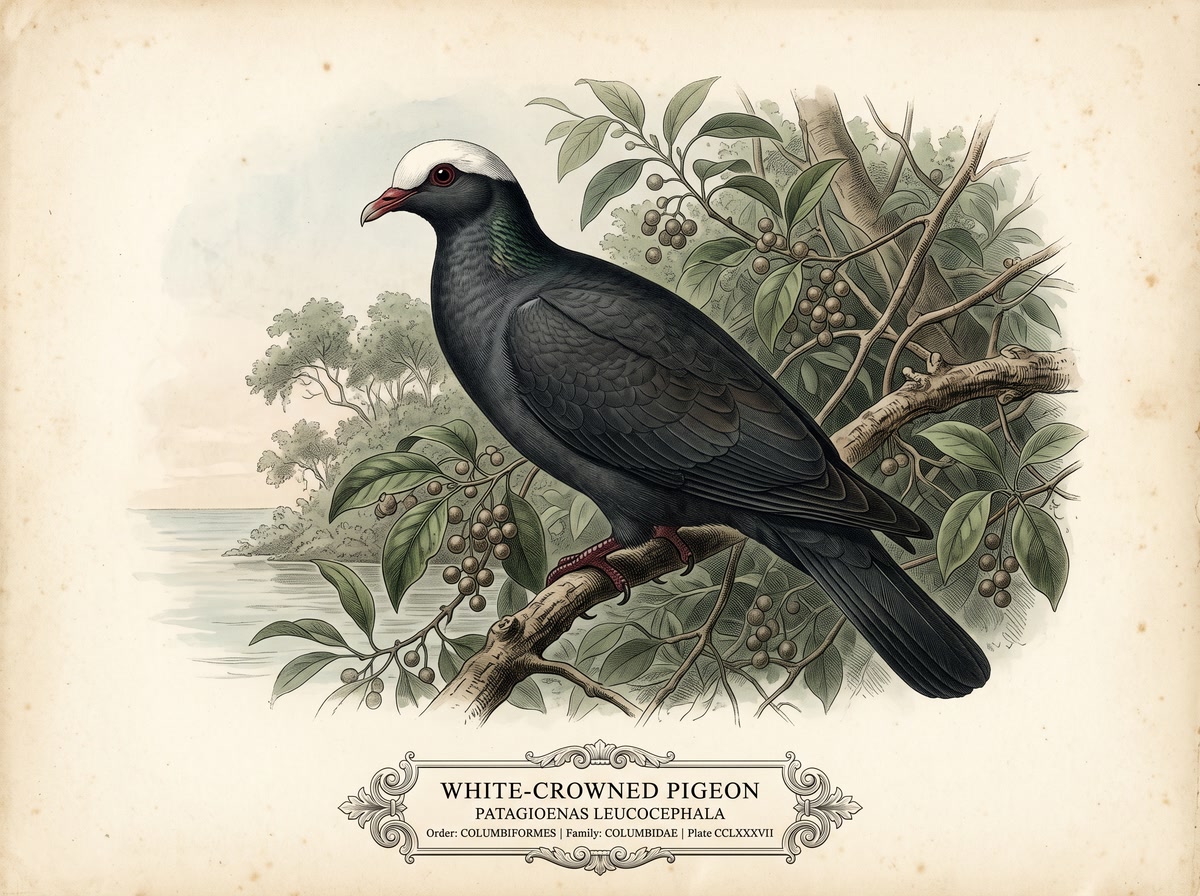
Stately tropical arboreal pigeon dressed in slate-charcoal plumage crowned with a brilliant snowy cap and an iridescent emerald nape. Serves as the quintessential primary seed disperser for South Florida's endangered tropical trees, commuting dozens of miles daily from nesting mangrove keys to mainland hammocks to feed on toxic poisonwood fruits that it consumes with total immunity. Heavily impacted by invasive python predation on offshore mangrove nesting islands.
Mass / Length:Mass: 35–45 g (0.08–0.10 lbs) • Length: 16–19 cm • Wingspan: 38–42 cm
Biome:Florida Bay Estuary • Open Gulf Pelagic Waters
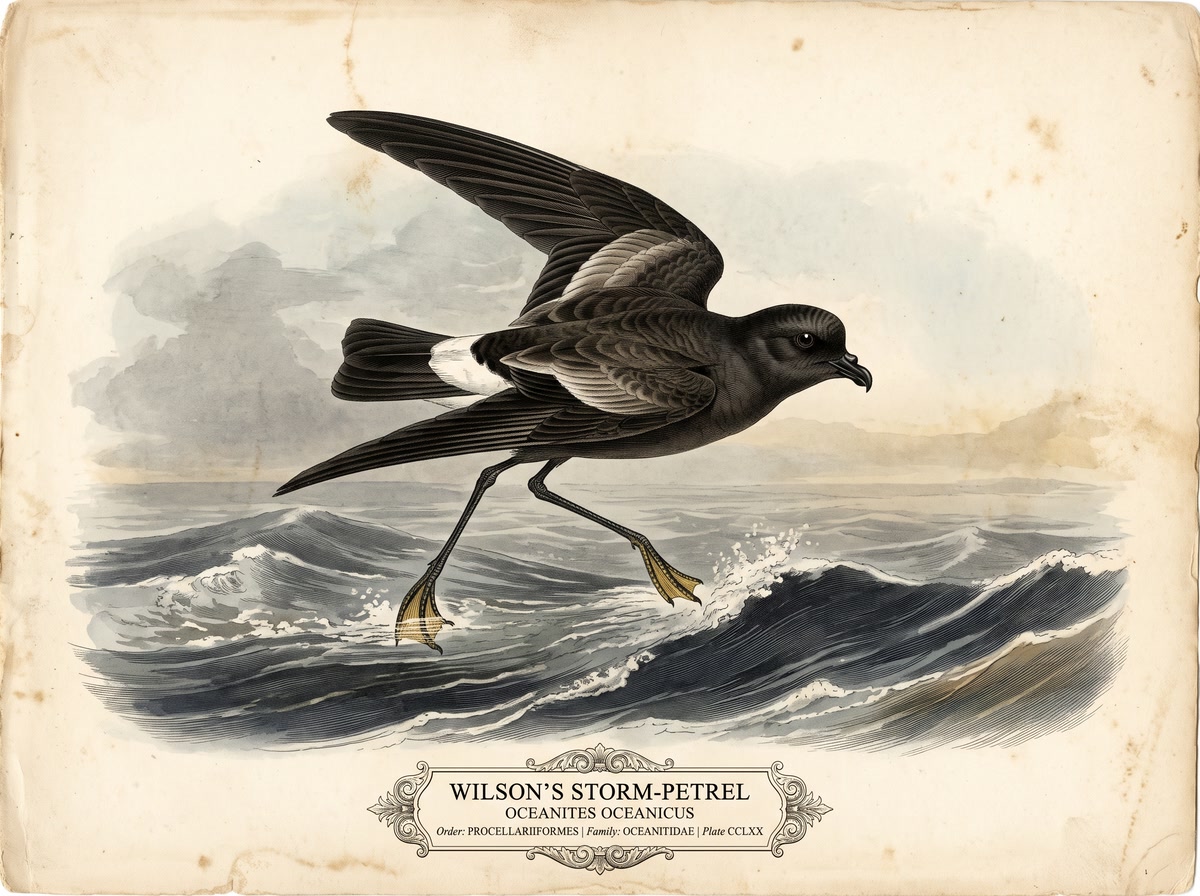
A true oceanic wanderer scarcely larger than a swallow, displaying sooty black plumage set off by a luminous white rump patch and long spindly legs with yellow-webbed feet. Executes an iconic pattering dance across open marine waters, pattering its feet across wave troughs while wings flap overhead to pluck microscopic plankton from the sea surface without settling. Enters Florida Bay passes and coastal bays during major storm surges and tropical blowouts.
RANGE: Open Florida Bay Waters, Coastal Passes • Gulf Marine Limits
Plate #90 • AvifaunaNative
4:3 Verified Plate
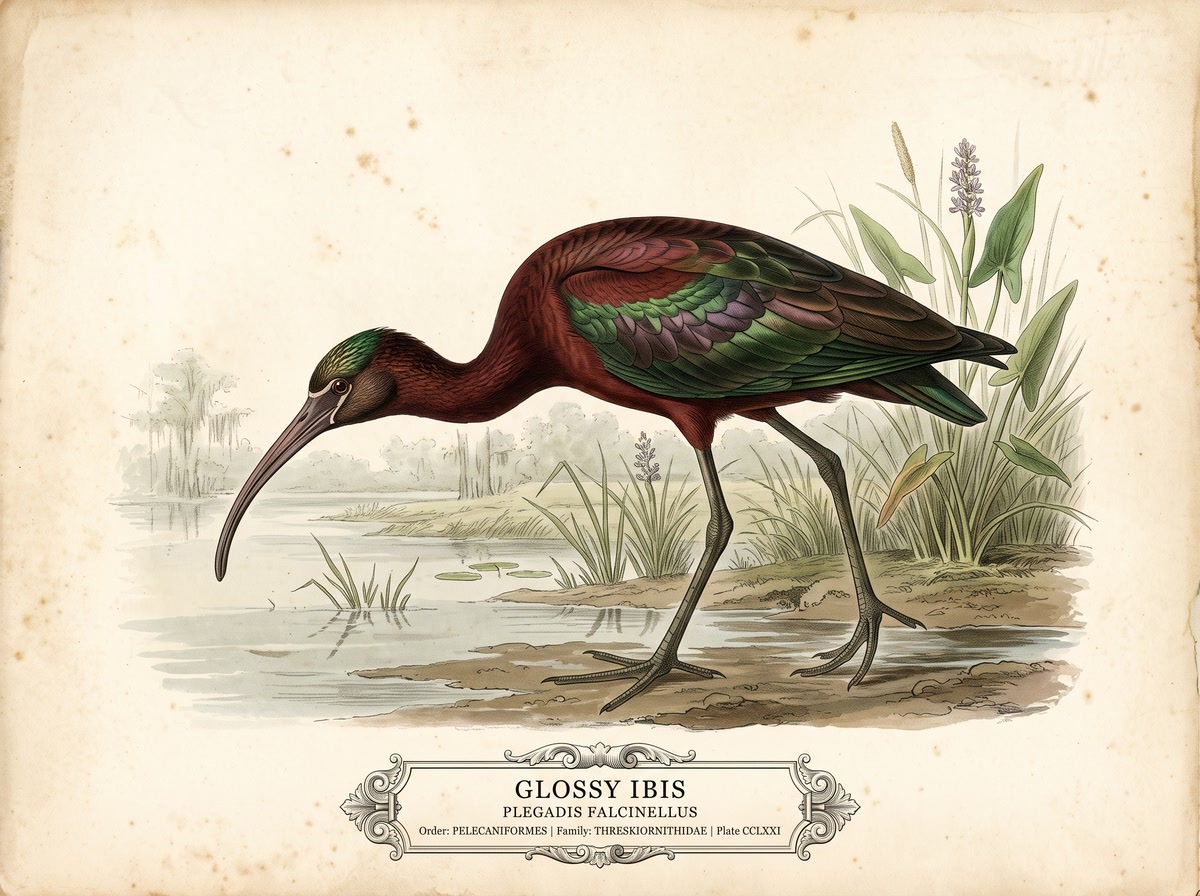
Glossy Ibis
Plegadis falcinellus[Threskiornithidae]
Status:IUCN Least Concern • Richly Iridescent Wader
Appears dark and silhouetted from afar, but close inspection in Florida sunlight reveals breathtaking iridescence of deep chestnut, bottle green, and bronze sheen on the wings. Possesses a slender, downcurved sickle bill that it sweeps through soft marl mud and submerged peat to locate hidden burrowing crayfish and water bugs by touch alone. Nests colonially in mixed rookeries alongside herons and egrets in deep willow heads.
RANGE: Shark Valley Sloughs, Marl Prairies • Water Conservation Areas
Plate #91 • AvifaunaRare Vagrant
4:3 Verified Plate
Common Greenshank
Tringa nebularia[Scolopacidae]
Status:IUCN Least Concern • Rare Migratory Vagrant
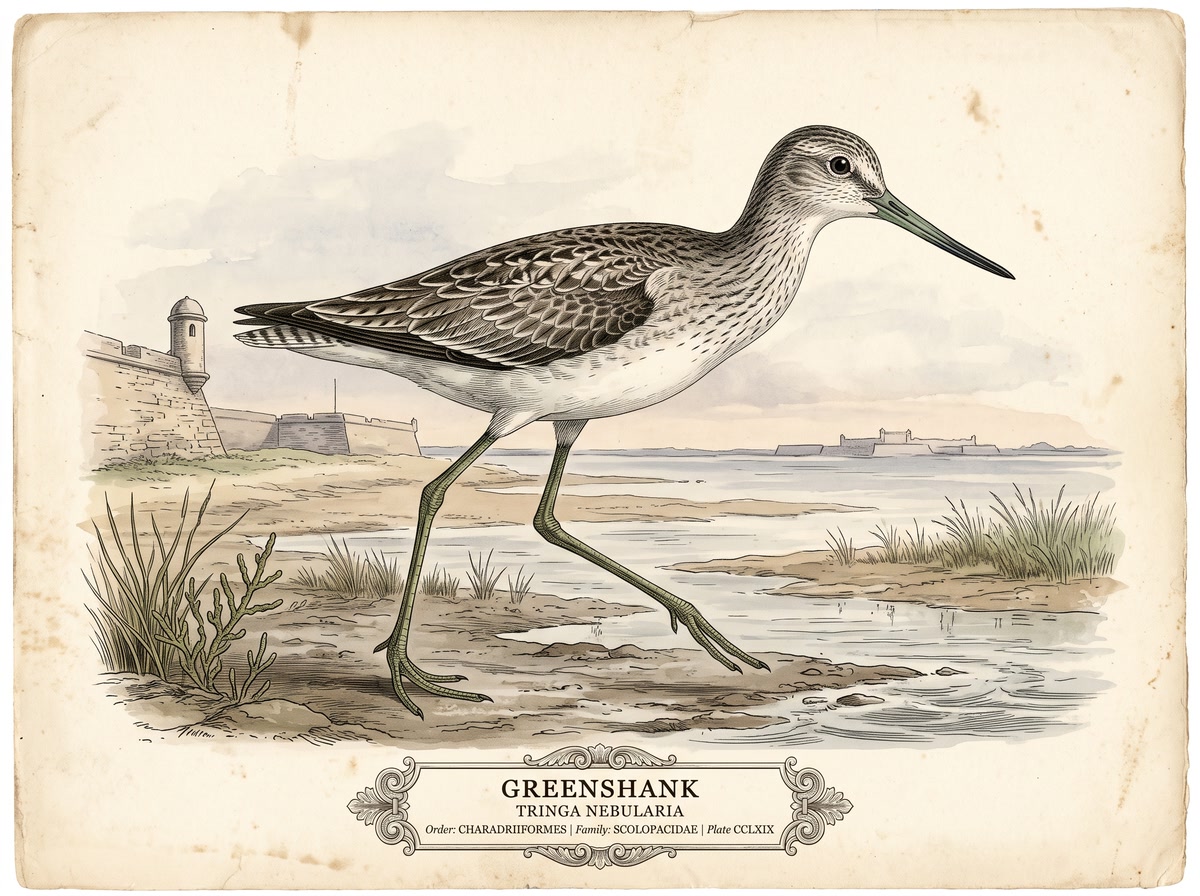
An elegant, long-legged wader possessing a slightly upturned, sturdy dark bill and pale willow-green legs. A renowned globetrotting migrant that rarely touches the coastal salt marshes and mangrove mudflats of southern Florida during transatlantic wanderings. Feeds aggressively, chasing down small killifish and fiddler crabs through shallow estuarine pools with rapid dashes and sideways lunges of its chisel-like beak.
RANGE: Coastal Mangrove Lagoons, Tidal Flats • Florida Bay Shallows
Mass / Length:Mass: 250–450 g (0.55–1.0 lbs) • Length: 31–38 cm • Wingspan: 45–62 cm
Biome:Open Sloughs, Deep Canals • Spatterdock Basins
Compact, thick-billed diving bird affectionately nicknamed the 'hell-diver' for its supernatural stealth. Has the unique ability to trap or release air within its feathers, allowing it to sink slowly like a submarine until only its nostrils and eyes break the water surface. Summer breeding adults boast a stark black vertical band across their ivory bill. Regularly swallows large amounts of its own breast feathers to line its stomach and cushion sharp fish bones.
Mass / Length:Mass: 800–1350 g (1.8–3.0 lbs) • Length: 45–65 cm • Wingspan: 1.1–1.4 m
Biome:Pine Rocklands, Levee Roads • Prairie Edge Trees
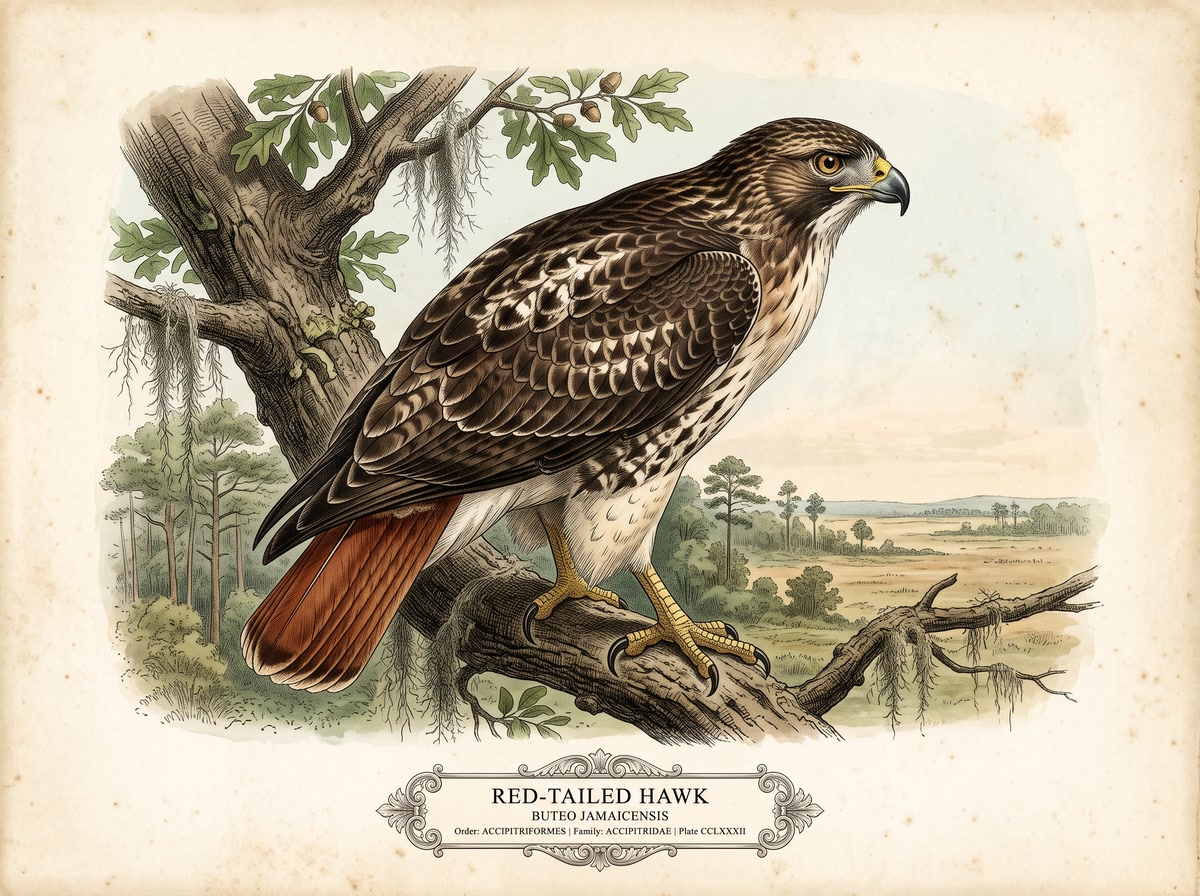
The quintessential North American raptor, recognized by its broad rounded wings, chocolate-mottled belly band, and brilliant brick-red tail plumage. Perches high upon dead pine snags or utility poles along levee borders, scanning open sawgrass with eyesight eight times sharper than a human. Dives at speeds exceeding 120 mph to pin young pythons, cotton rats, and racers to the earth with 200 psi talon grip pressure.
RANGE: Pine Rockland Canopies, Tamiami Levees • Glades Savanna Margins
Plate #94 • AvifaunaWoodland Sentinel
4:3 Verified Plate
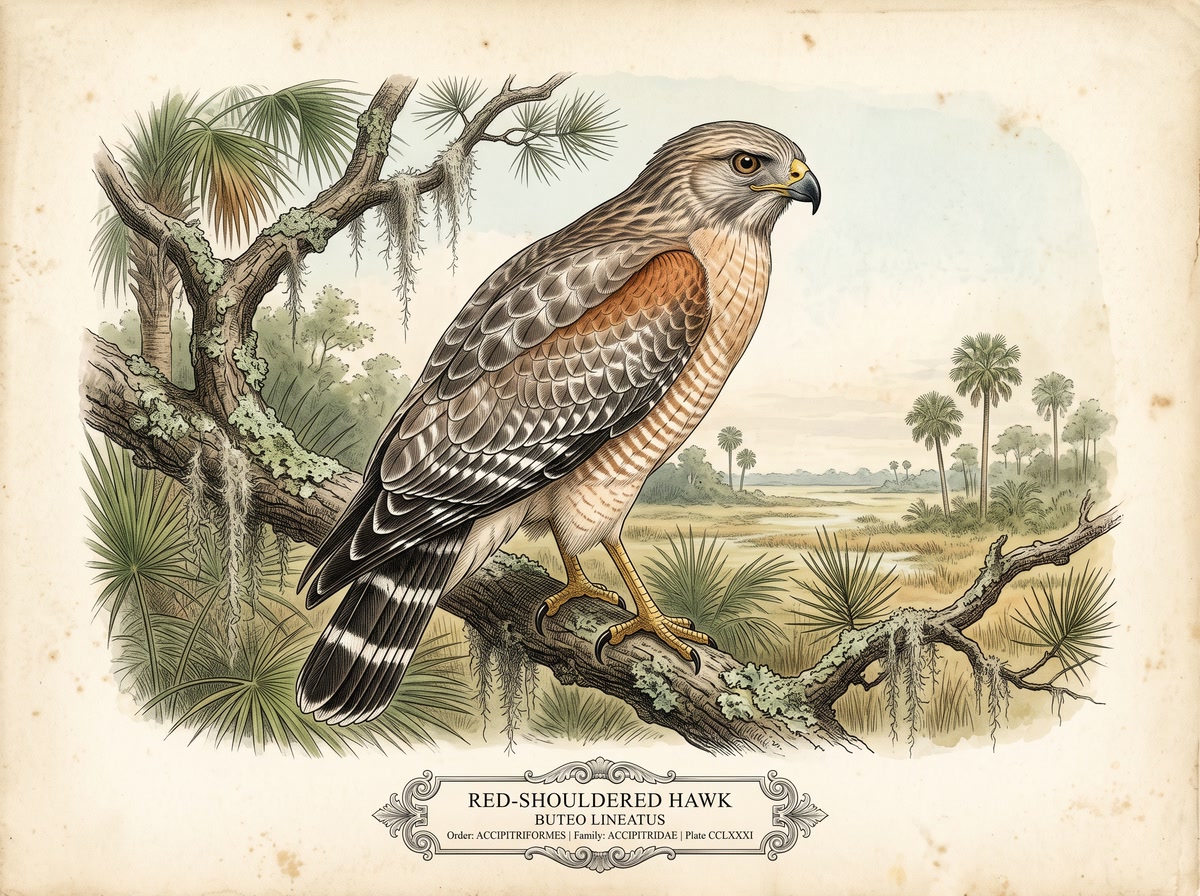
Red-Shouldered Hawk
Buteo lineatus[Accipitridae]
Status:Protected Native • Forest Canopy Sentinel
Diet Role:Carnivore (water snakes, frogs, crayfish, small rodents)
Mass / Length:Mass: 450–700 g (1.0–1.5 lbs) • Length: 38–48 cm • Wingspan: 90–105 cm
The undisputed soundtrack of the Everglades swamps, filling the cypress canopy with its piercing, screamed 'kee-aah' calls. The Florida subspecies (*B. l. extimus*) is paler than its northern cousins, displaying crisp checkered black-and-white wings and rich rufous shoulder patches. Specializes in snatching snakes, tree frogs, and sirens directly out of shallow swamp water with lightning talon sweeps, though it keeps clear of mature constrictors.
RANGE: Big Cypress Domes, Hardwood Hammock Canopies • Shark Valley Tree Islands
Plate #95 • AvifaunaNocturnal Keystone
4:3 Verified Plate
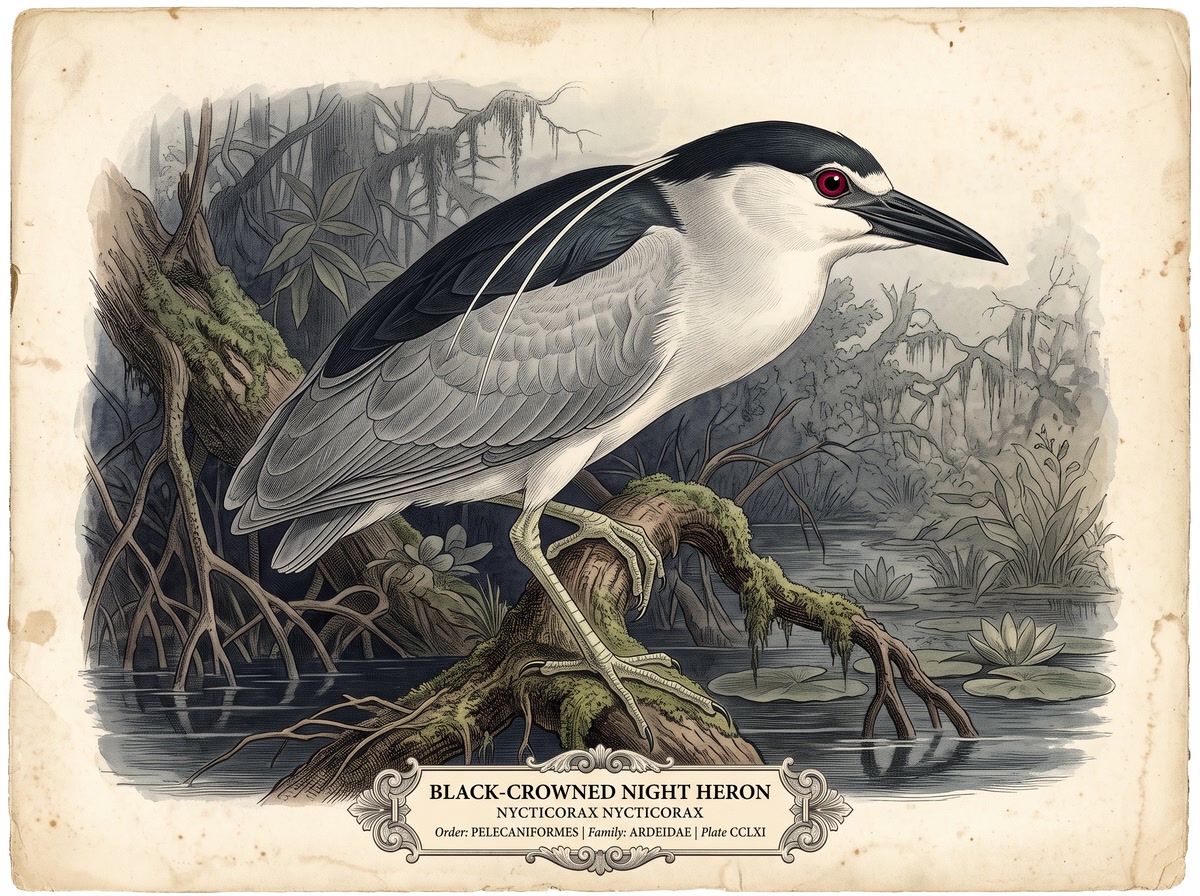
Black-Crowned Night Heron
Nycticorax nycticorax[Ardeidae]
Status:IUCN Least Concern • Nocturnal Keystone Wader
Diet Role:Nocturnal carnivore (fish, crabs, frogs, young waterbirds)
Mass / Length:Mass: 700–1000 g (1.5–2.2 lbs) • Length: 58–66 cm • Wingspan: 1.1–1.2 m
Stocky, hunched nocturnal hunter armed with an obsidian cap and back, pale silver-grey wings, and piercing ruby-red eyes calibrated for low-light hunting. During breeding season, adults sprout long, slender white head plumes that trail down the neck. Roosts motionless in shaded mangrove canopies by day, descending to shallow sloughs at dusk to ambush aquatic prey with bone-crushing bill snaps under cover of total darkness.
RANGE: Tree Island Willow Heads, Mangrove Sloughs • Canal Backwaters
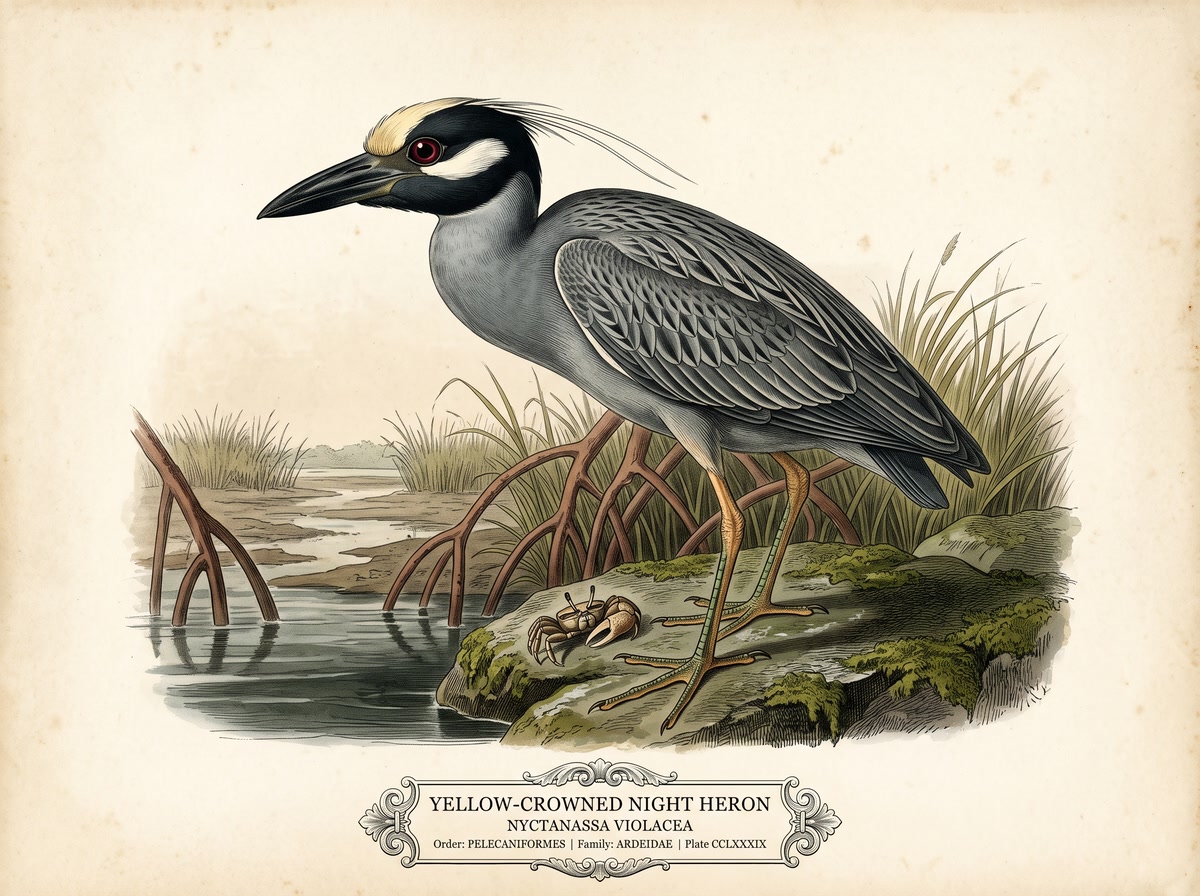
Sleeker and longer-legged than its black-crowned cousin, distinguished by an intricate black-and-white facial harness, creamy amber-yellow crown plume, and a thick, heavy black bill built specifically for cracking hard carapaces. Forages by slowly pacing through intertidal mangrove roots at slack tide, using its heavy bill to snatch and pulverize blue crabs and burrowing mud crabs with effortless mechanical precision.
RANGE: Ten Thousand Islands Mangroves, Coastal Estuaries • Shark River Slough
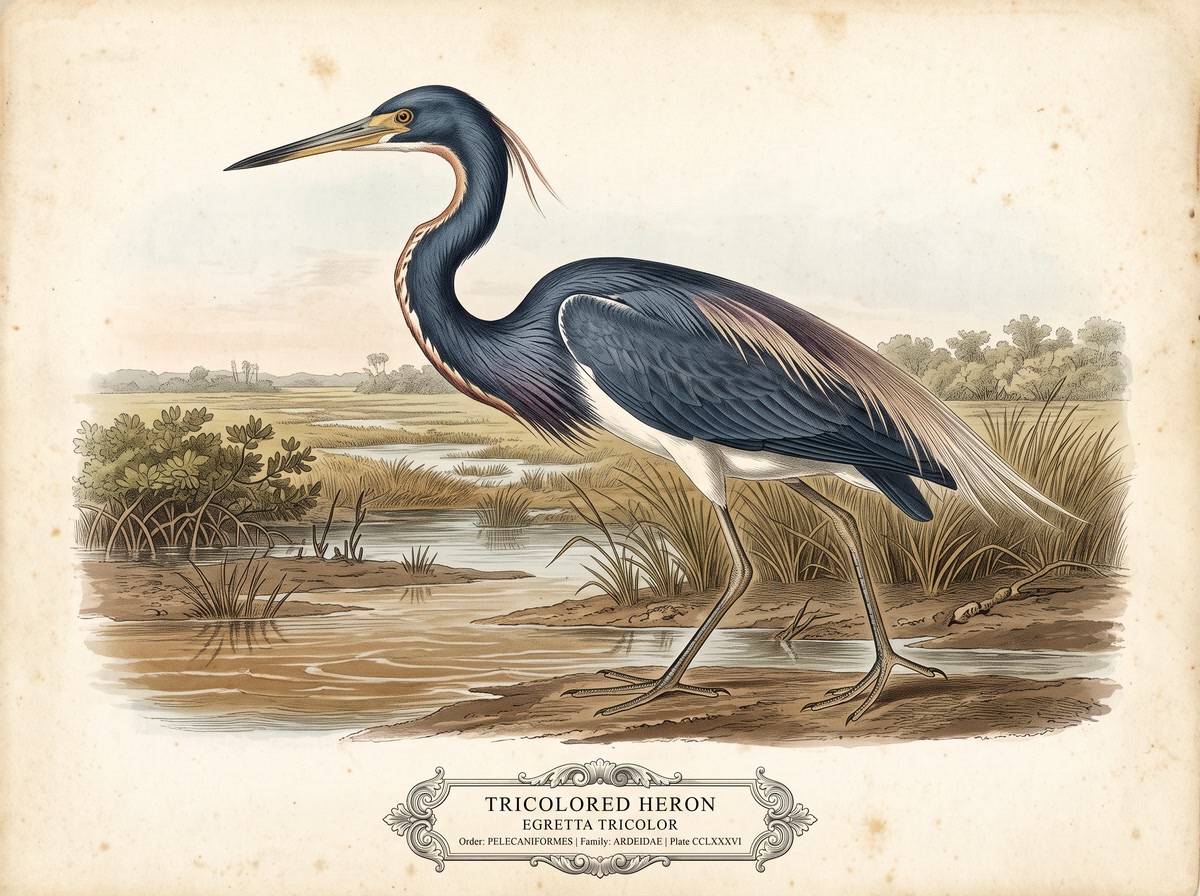
Historically known as the 'Lady of the Waters' for its slender, serpentine grace, dressed in slate-blue plumage with a contrasting clean white belly, rufous throat stripe, and electric blue orbital skin. Hunts aggressively by running through ankle-deep water, flapping its wings to shadow the glare and herding panicked minnows into tight clusters before harpooning them with an impossibly slender dagger bill.
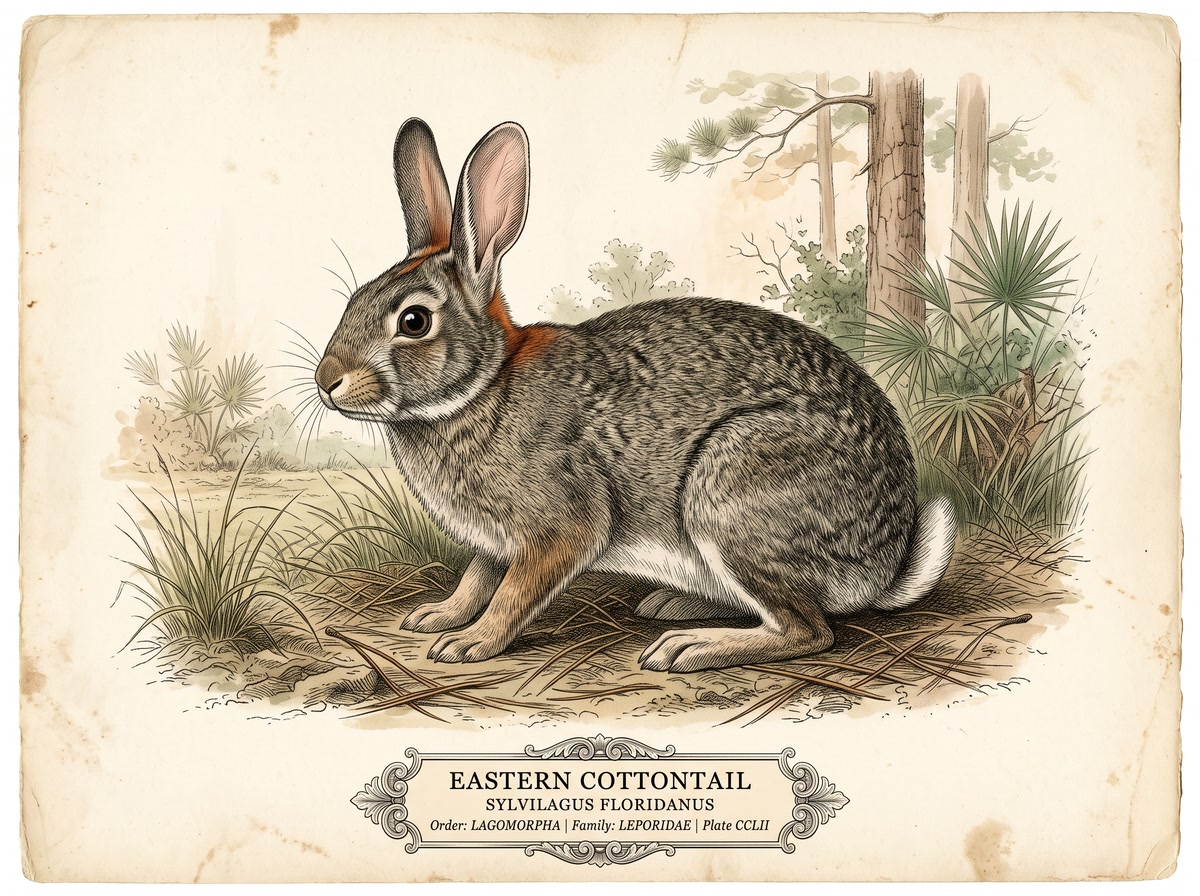
Grizzled brown-and-buff lagomorph featuring longer ears and legs than the marsh rabbit, accented by a rust-colored nape patch and a puffy, snowy-white underside to its tail. Prefers drier upland pinelands, levee brush, and hammock fringes, reaching speeds up to 18 mph in zig-zag escape dashes when flushed. Highly sensitive to ground vibrations, freezing motionless in low grass to evade thermal detection by patrolling constrictors.
RANGE: Pine Rocklands, Elevated Levee Roads • Agricultural Field Edges
Plate #99 • MammalsState Threatened
4:3 Verified Plate
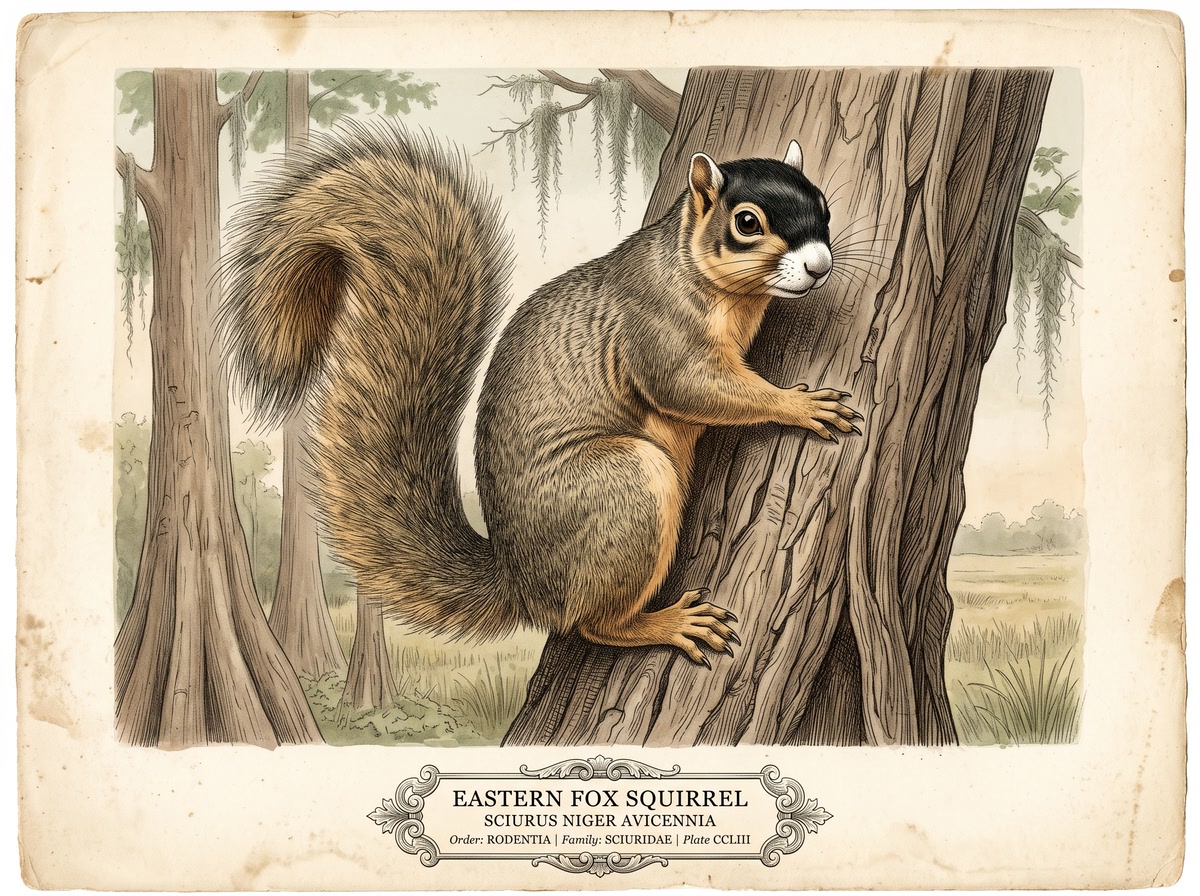
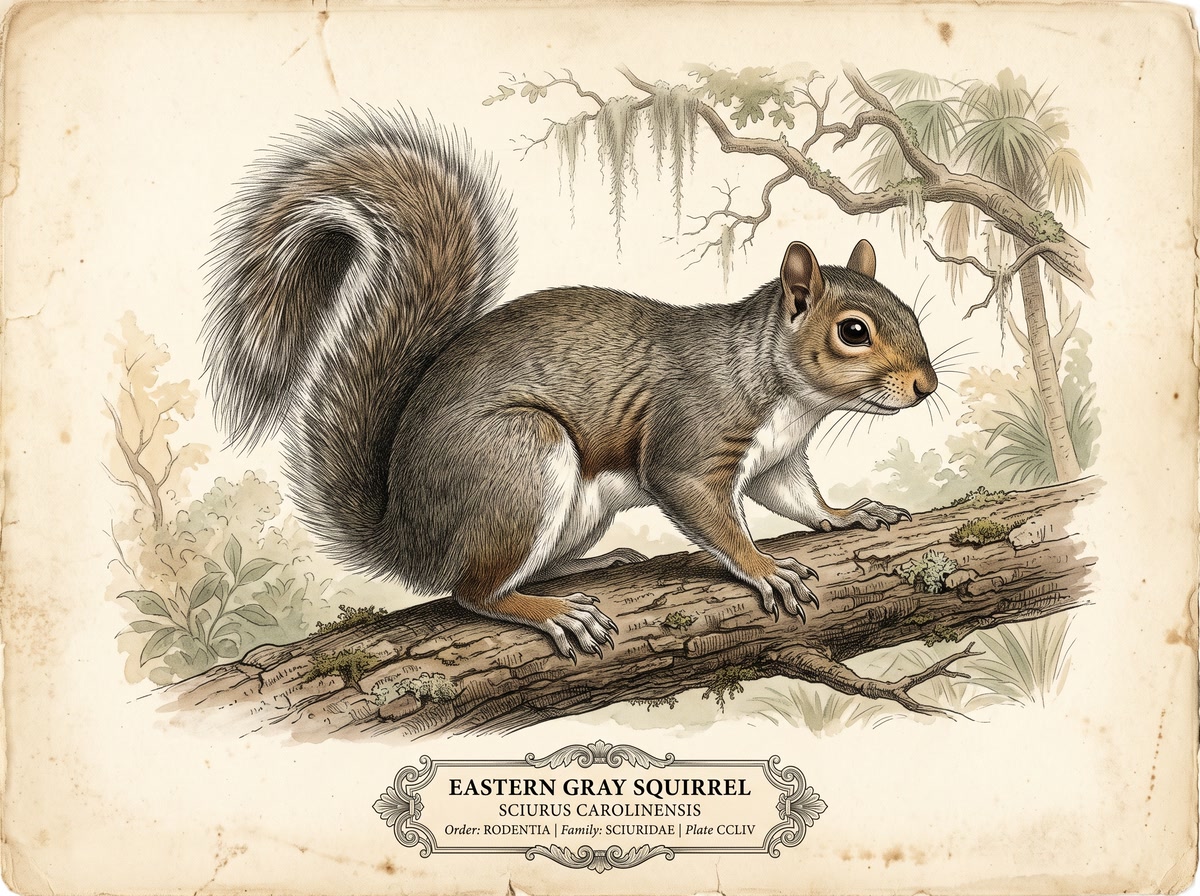
Eastern Fox Squirrel
Sciurus niger[Sciuridae]
Status:State Threatened (*S. n. avicennia*) • Forest Keystone
Mass / Length:Mass: 800–1300 g (1.8–2.9 lbs) • Length: 50–68 cm
Biome:Big Cypress Domes, Pine Flatwoods • Mangrove Borders
The largest arboreal rodent in North America, with the endemic Big Cypress subspecies (*S. n. avicennia*) displaying striking color phases ranging from tawny gold to dramatic jet-black with white nose blazes and ear tufts. Spends substantial time foraging on the forest floor, using powerful forepaws to excavate pine seeds and subterranean mycorrhizal fungi. Nests in massive Spanish moss dreys built high in bald cypress crowns.
RANGE: Big Cypress National Preserve, Pine Flatwoods • Cypress Strands
Mass / Length:Mass: 400–600 g (0.88–1.3 lbs) • Length: 38–50 cm
Biome:Hardwood Hammocks, Tree Islands • Live Oak Groves
Acrobatic tree-dweller sporting grizzled salt-and-pepper pelage, a snowy belly, and a luxuriant, bushy tail with white-tipped guard hairs that acts as a rudder during desperate canopy leaps. Buries hundreds of live oak acorns and cabbage palm berries across hammock islands, serving as an inadvertent forest planter. Constantly chatter-barks warnings from overhead branches whenever a large snake moves through the underbrush below.
RANGE: Hardwood Hammock Tree Islands • Elevated Ridge Forests
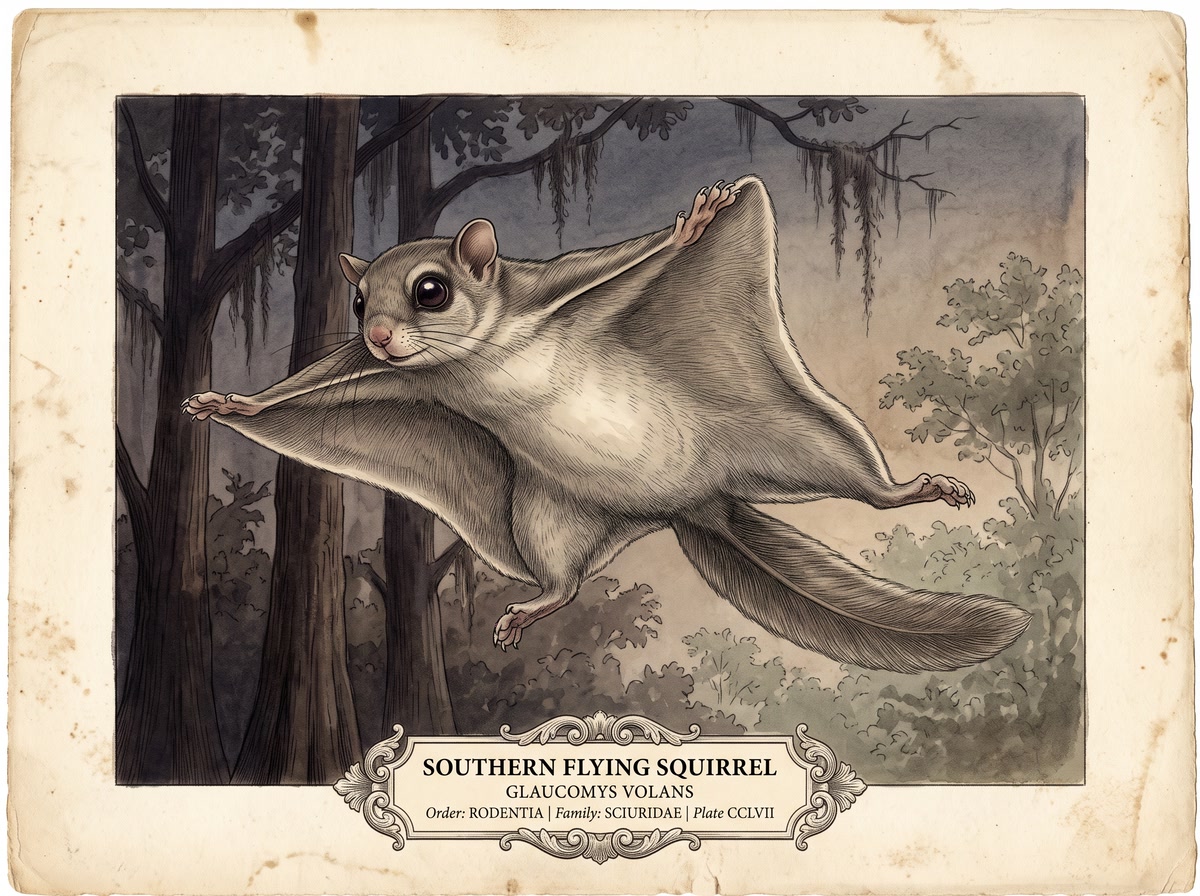
Mass / Length:Mass: 50–85 g (0.11–0.19 lbs) • Length: 20–25 cm
Biome:Mature Hardwood Hammocks, Cypress Hollows • Oak Canopies
The only strictly nocturnal squirrel in the region, possessing silky grey-brown fur, huge luminous black eyes adapted for midnight vision, and a specialized patagium membrane extending between wrists and ankles. Launches into silent glides across 150-foot forest canopy gaps, steering with a flattened tail before executing a soft four-paw stall landing on tree trunks. Nests communally in woodpecker cavities inside dead cypress snags.
RANGE: Tree Island Hardwood Hammocks • Old-Growth Cypress Domes
Plate #102 • MammalsInvasive / Exotic
4:3 Verified Plate
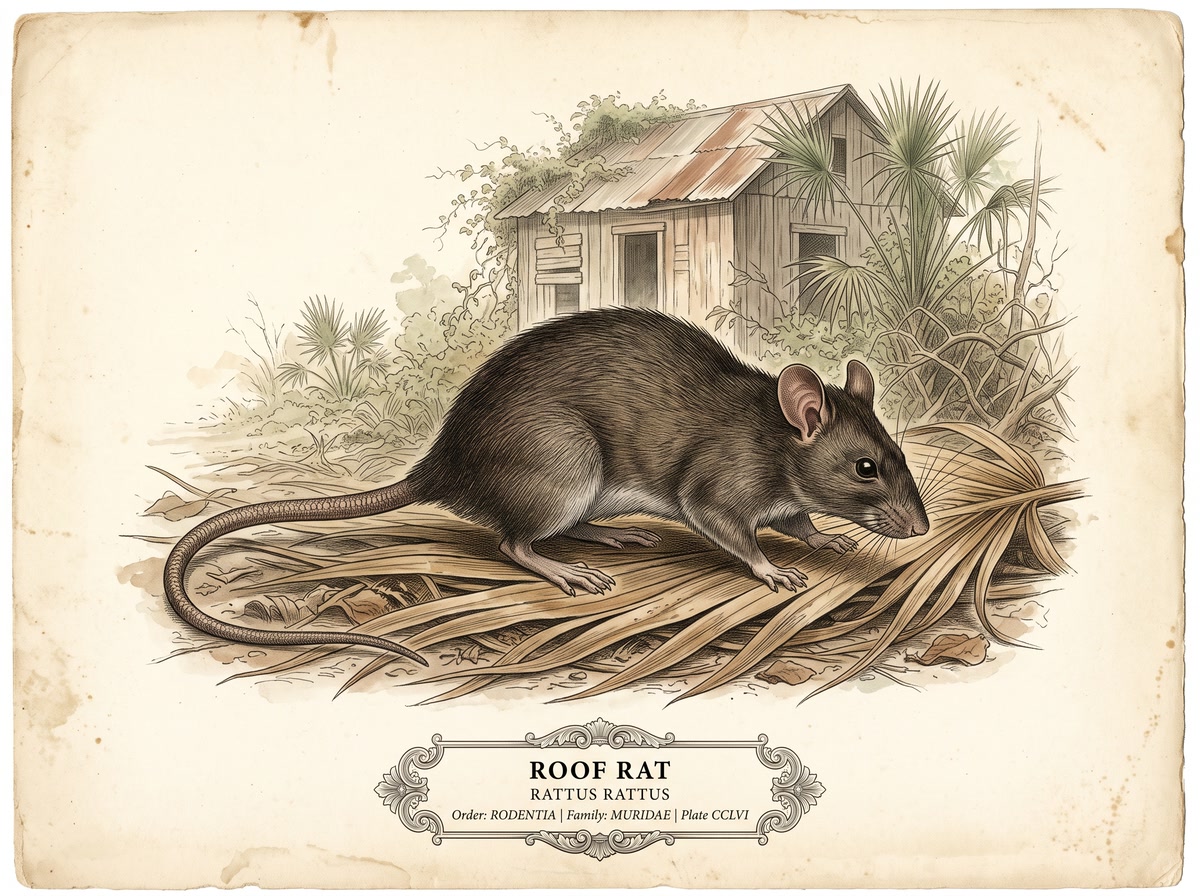
Roof Rat
Rattus rattus[Muridae]
Status:Exotic Invasive • Prolific Exotic Prey Base
Slender, agile climbing rat with a smooth slate-to-black coat and a scaly tail noticeably longer than its head and body combined. Introduced via European shipping centuries ago, it thrives in human-altered landscapes, agricultural packing facilities near Homestead, and canal infrastructure. Along with cotton rats, it forms the high-calorie dietary backbone that fuels explosive growth rates in invasive juvenile pythons across southern Miami-Dade.
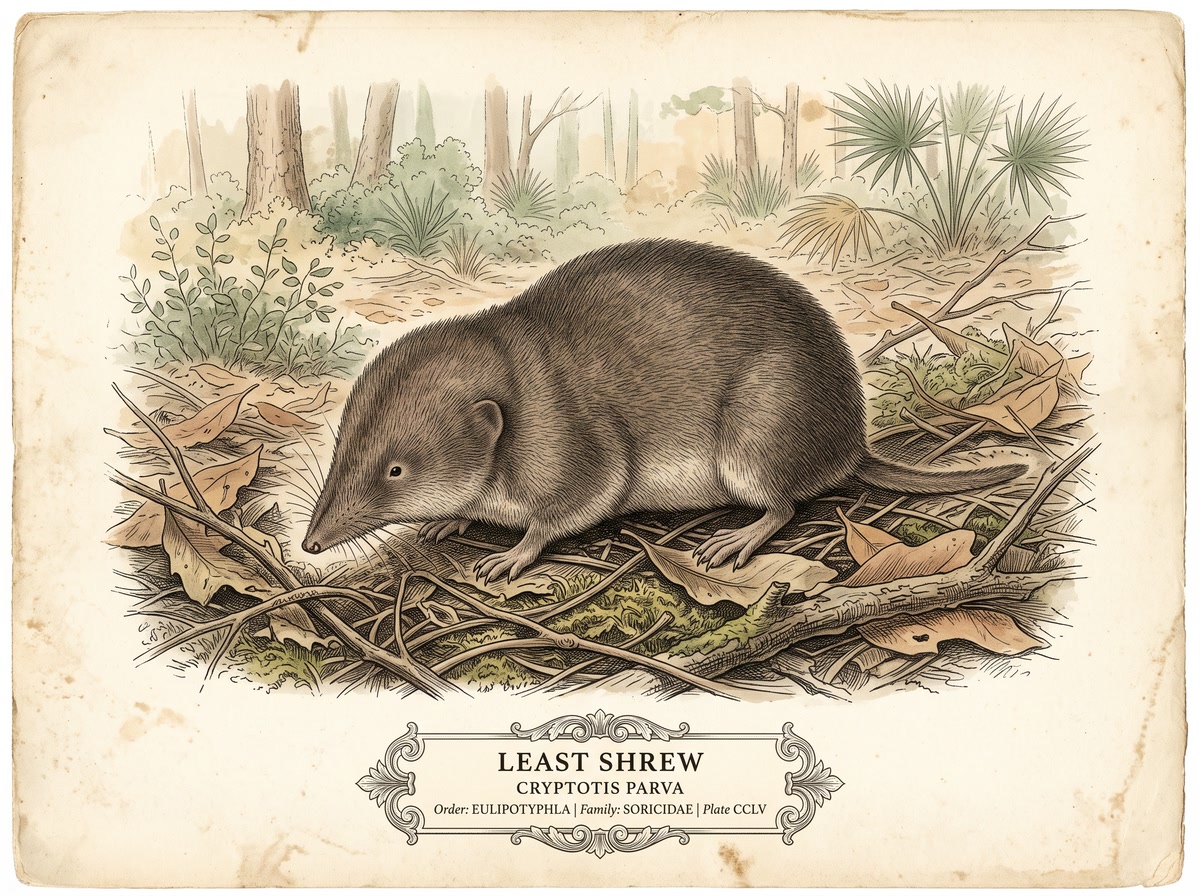
One of the tiniest mammals on the continent, weighing less than a quarter-ounce with velvety grey-brown fur, a pointed mobile snout, and a stubby tail. Possesses an astonishingly fast metabolic rate that forces it to consume its own body weight in insects every 24 hours to prevent starvation. Lives in cooperative multi-family burrow systems beneath dense sawgrass mats and rotting palm logs, constantly hunting small invertebrates.
RANGE: Sawgrass Marl Prairies, Levee Grasslands • Tree Island Margins
Plate #104 • MammalsVenomous Native
4:3 Verified Plate
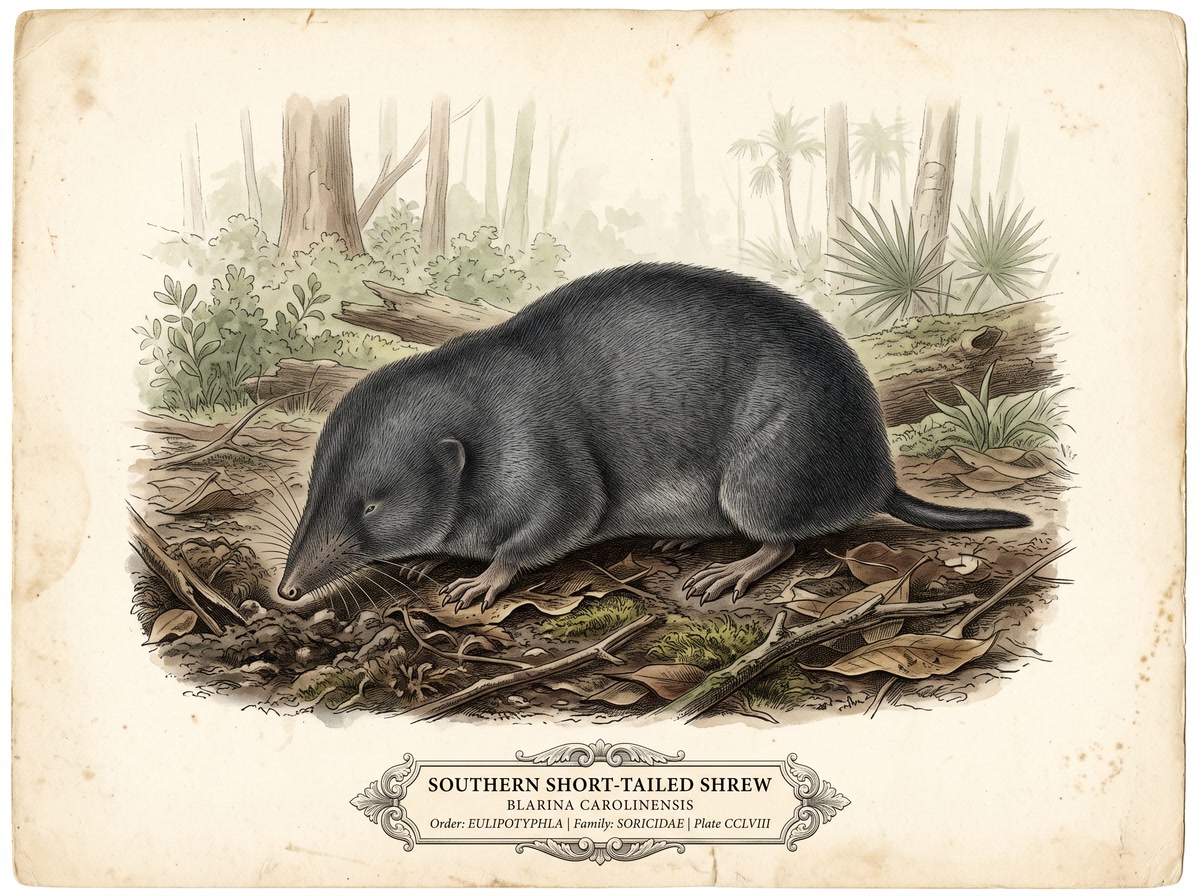
Southern Short-Tailed Shrew
Blarina carolinensis[Soricidae]
Status:IUCN Least Concern • Venomous Subterranean Hunter
Compact, slate-grey subterranean dynamo possessing tiny rudimentary eyes and one of the rarest mammalian adaptations: toxic venom secreted from submaxillary glands into grooved lower incisors. A single venomous bite immobilizes small frogs, mice, and giant insects, allowing the shrew to cache live paralyzed prey in subterranean larders. Uses primitive ultrasonic echolocation clicks to map dark labyrinthine tunnels beneath the swamp duff.
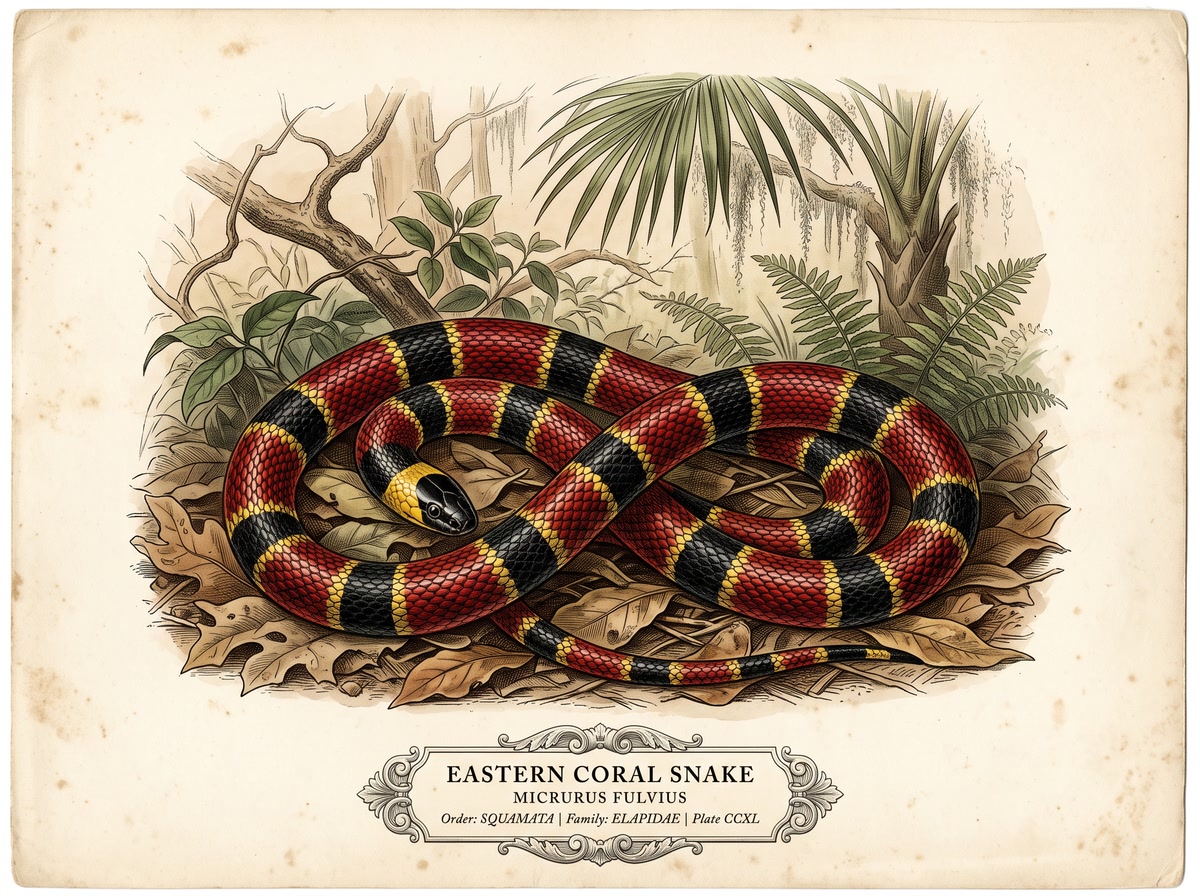
Florida's only native elapid, famous for the diagnostic warning sequence 'red touch yellow, kill a fellow'. Features fixed, hollow front fangs that deliver potent post-synaptic neurotoxins capable of inducing respiratory failure in vertebrates. Highly secretive and fossorial, spending 95% of its life buried beneath rotting pine straw and decaying logs, emerging after warm rains to hunt other reptiles. Occasionally ingested by large constrictors despite its deadly neurotoxin.
RANGE: Pine Rocklands, Long Pine Key • Dry Oak Scrub Hammocks
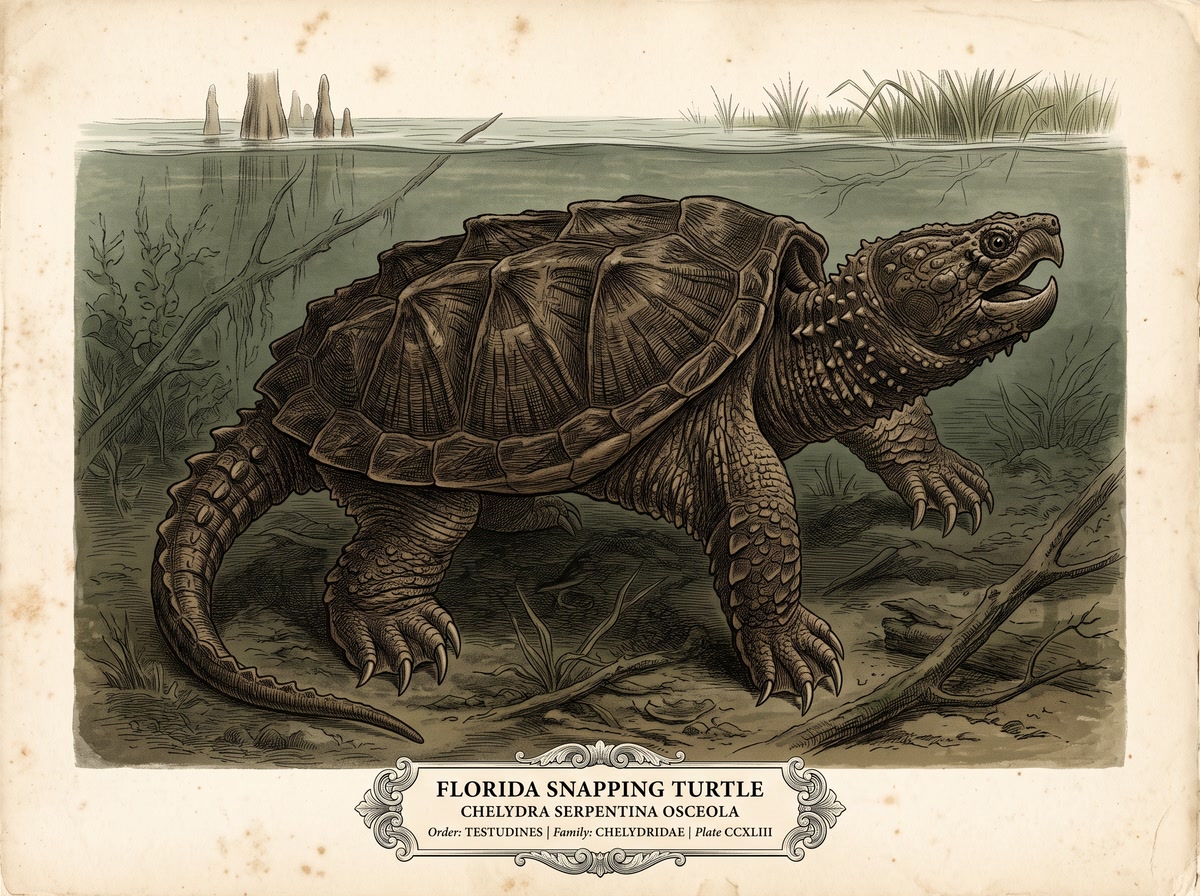
Prehistoric survivor identified by its heavily keeled carapace, hooked bone-cracking jaws, and long serrated tail resembling an alligator's. The Florida subspecies (*C. s. osceola*) carries distinctive barbed tubercles along the neck. Buries itself in soft muck with only nostrils exposed, delivering a blindingly fast, spring-loaded strike that can sever digits and easily decapitate subadult snakes. Large specimens represent a formidable hazard to swimming pythons.
RANGE: Deep Drainage Canals, Shark Valley Sloughs • Muddy Cypress Domes
Plate #107 • Apex & HerpetofaunaNative
4:3 Verified Plate
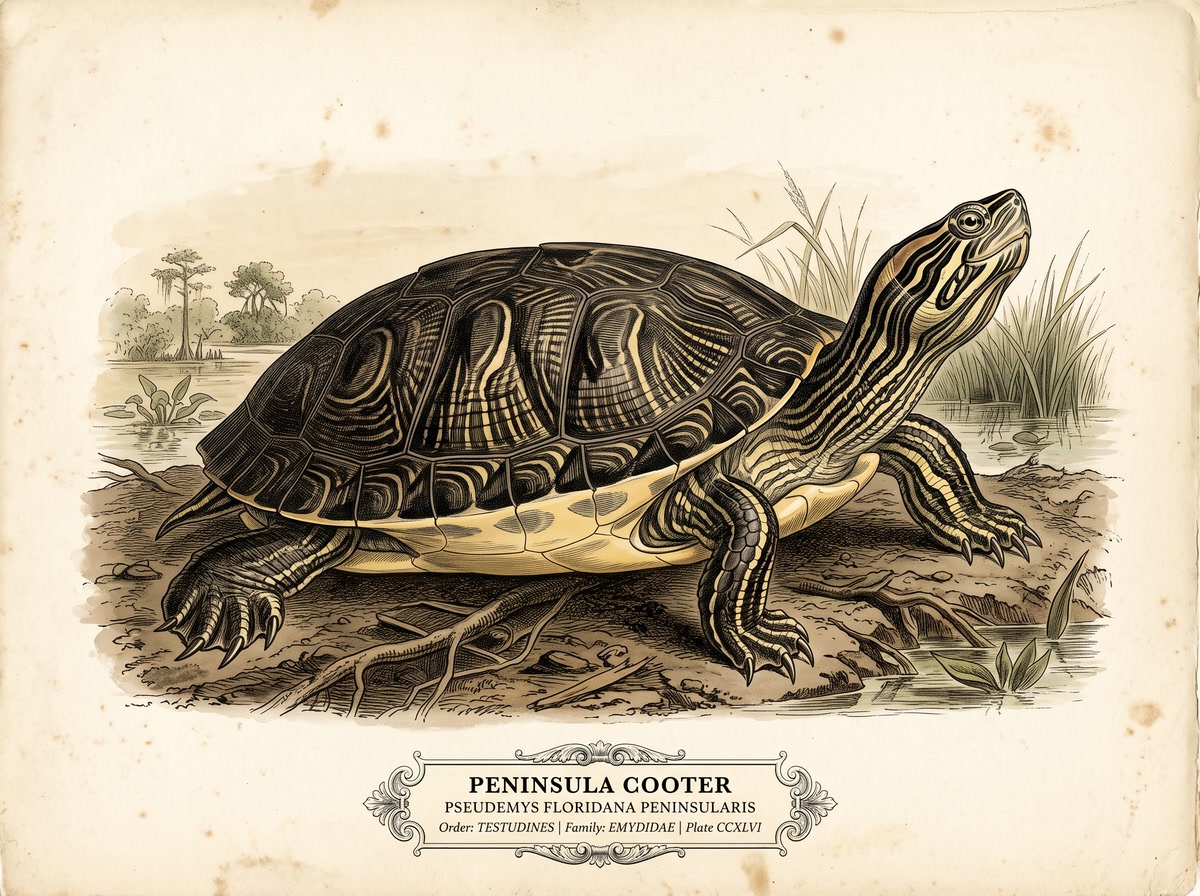
Peninsula Cooter
Pseudemys peninsularis[Emydidae]
Status:IUCN Least Concern • Herbivorous Keystone Turtle
Mass / Length:Mass: 3.0–6.5 kg (6.6–14.3 lbs) • Length: 25–38 cm carapace
Biome:Slow-Moving Rivers, Canal Waters • Open Water Sloughs
High-domed freshwater turtle displaying intricate yellow concentric whorls across its dark carapace and sharp yellow facial striping terminating in a hairpin turn between the eyes. Spends hours basking communally on half-submerged cypress logs to thermoregulate and synthesize vitamin D. Feeds almost exclusively on submerged aquatic vegetation, keeping open waterways clear of dense weed choked mats.
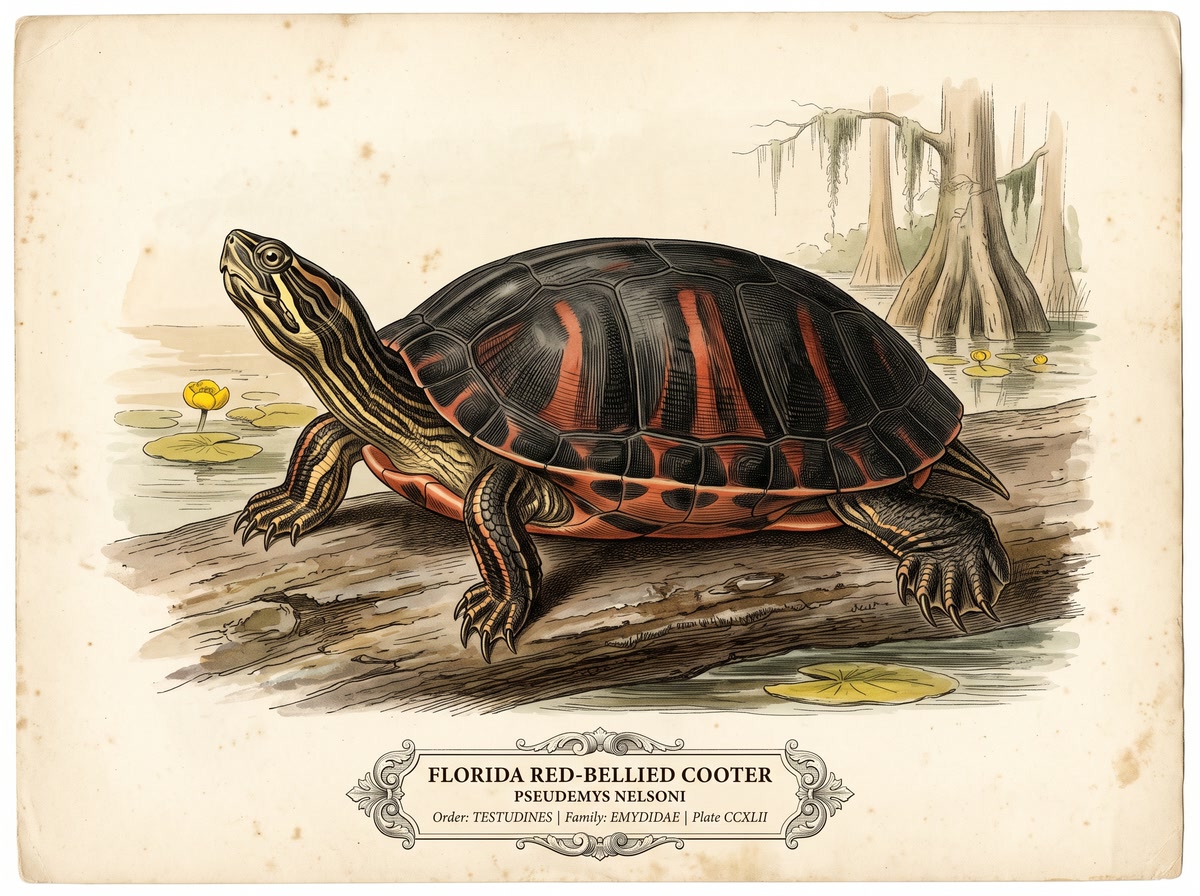
Distinguished by two prominent cusp-like cusps on the upper jaw, bright reddish-coral plastron, and broad red vertical bars running across carapace scutes. Maintains a famous commensal relationship with the American alligator: females boldly climb directly onto active alligator nest mounds to lay their own clutches inside the warm, decomposing vegetation, gaining free around-the-clock security against raccoons from the defensive gator mother.
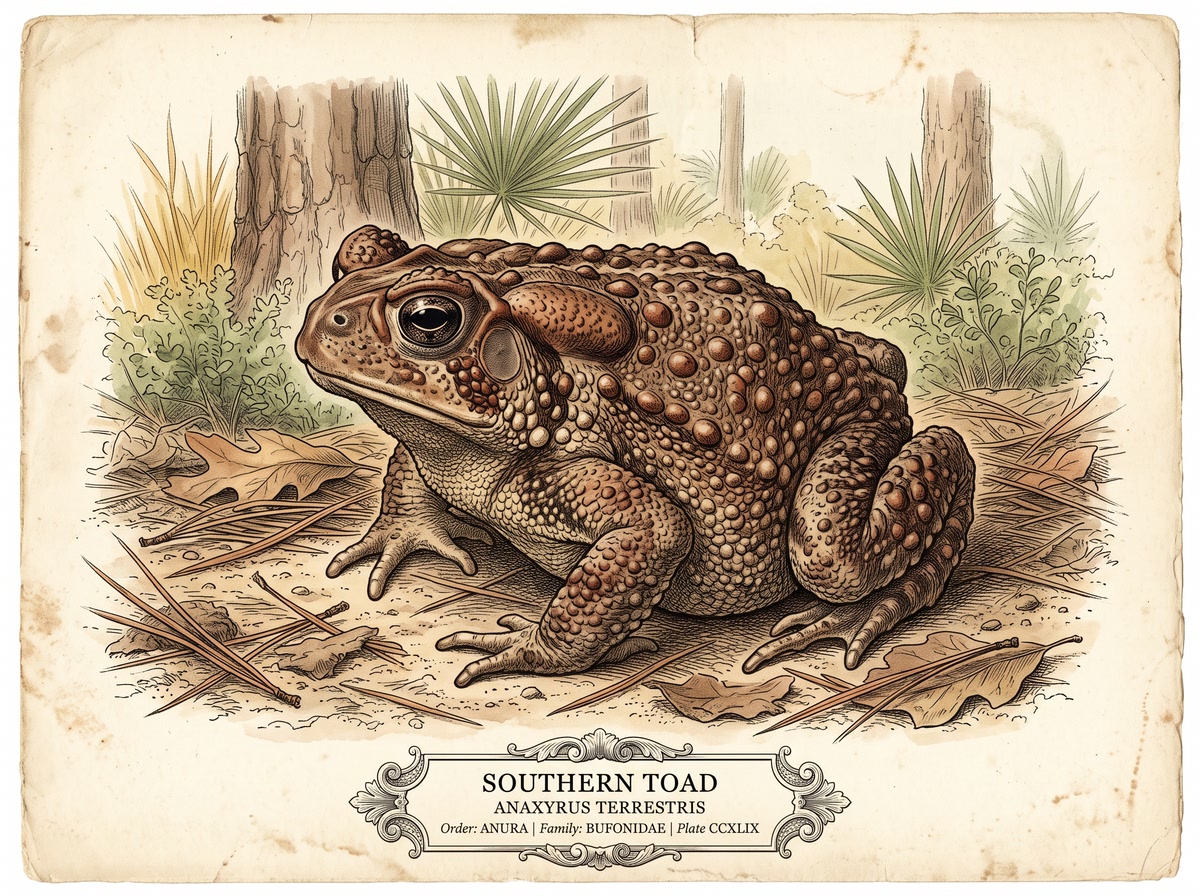
The quintessential native toad of peninsular Florida, featuring prominent raised cranial crests behind the eyes that terminate in pronounced swollen knobs. Emits a long, musical high-pitched trill across warm flooded ditches on summer nights. Possesses large parotoid glands behind the eyes that exude bufotoxin when squeezed by a predator, deterring mammalian carnivores though harmlessly ingested by immune garter and indigo snakes.
RANGE: Pine Rocklands, Upland Hammock Borders • Moist Sandy Glades
Plate #110 • Apex & HerpetofaunaNative Micro-Herp
4:3 Verified Plate
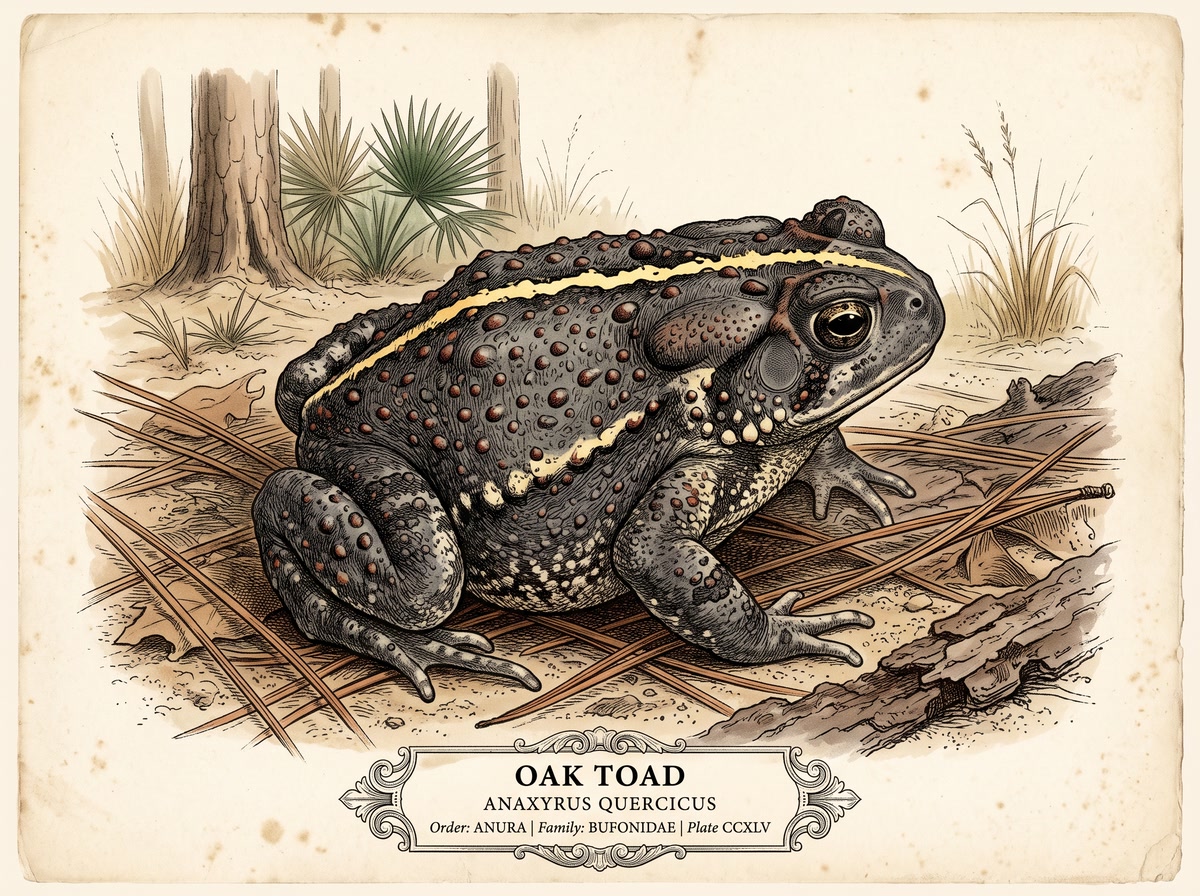
Oak Toad
Anaxyrus quercicus[Bufonidae]
Status:IUCN Least Concern • North America's Smallest Toad
Mass / Length:Mass: 5–12 g (0.18–0.42 oz) • Length: 2.0–3.3 cm
Biome:Pine Flatwoods, Oak Scrub • Sandy Rockland Margins
North America's smallest toad species, rarely exceeding an inch and a quarter in length. Features a dark brown to charcoal body bisected by a razor-sharp, creamy white or yellow dorsal stripe and tiny red tubercles. Active during daylight hours, hopping among pine needles and fallen leaves to feed almost exclusively on ants. During breeding outbursts, males inflate enormous football-shaped vocal sacs that dwarf their tiny bodies, piping like peeping chicks.
RANGE: Pine Flatwoods, Long Pine Key Openings • Sandy Palmetto Scrubs
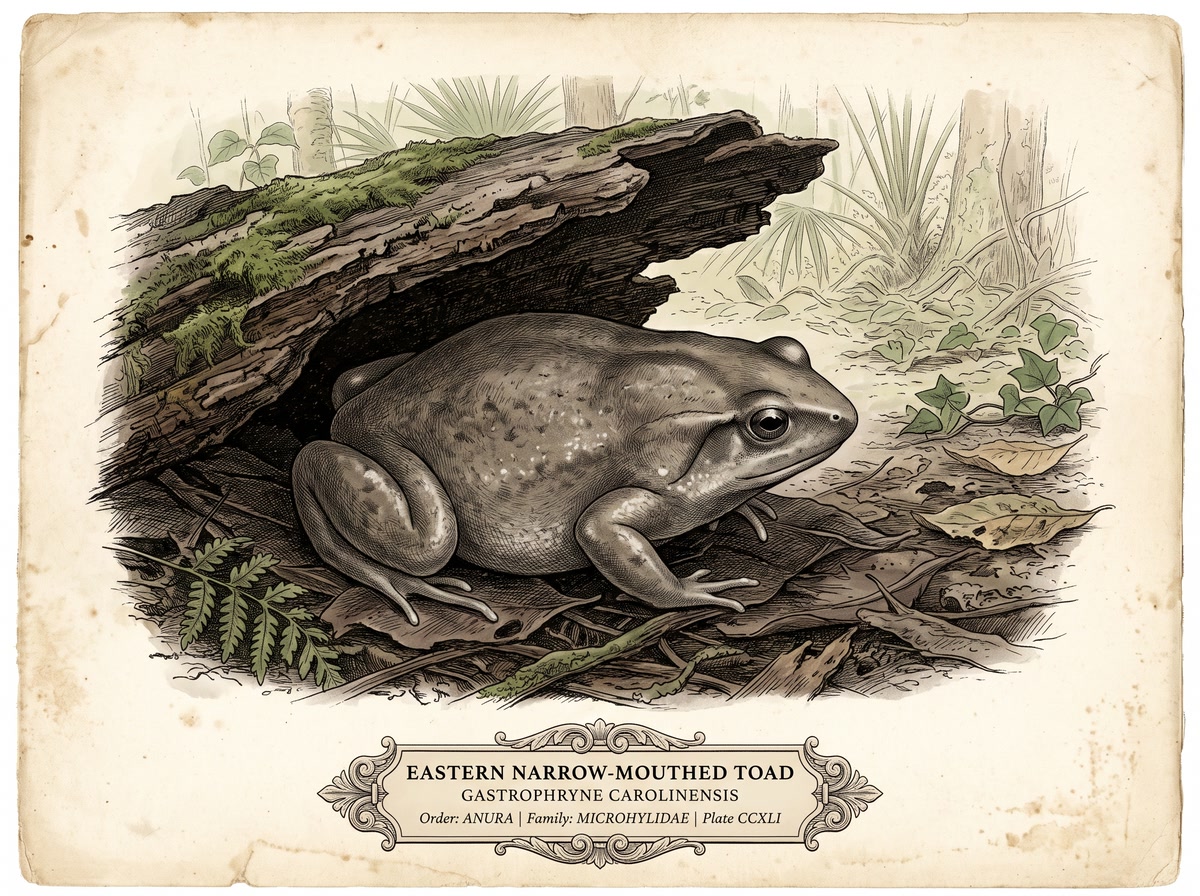
Status:IUCN Least Concern • Specialized Ant Specialist
Diet Role:Specialist ant & termite feeder
Mass / Length:Mass: 3–8 g (0.11–0.28 oz) • Length: 2.5–3.8 cm
Biome:Hardwood Hammocks, Leaf Duff • Moist Pine Flatwoods
A bizarre, pear-shaped fossorial amphibian possessing completely smooth moist skin, tiny bead-like eyes, and a sharp pointed snout with a distinctive skin fold behind the eyes. Not a true toad, but a microhylid adapted specifically to storm ant mounds: its skin secretes a toxic, mucus-based chemical that repels fire ants while it gorges on thousands of workers. Calls with a bleating, nasal 'waaaah' resembling an injured sheep.
RANGE: Tree Island Duff, Fallen Logs • Pineland Moisture Sinks
Mass / Length:Mass: 30–80 g (0.07–0.18 lbs) • Length: 5–9 cm
Biome:Freshwater Marshes, Sloughs • Canal Edges
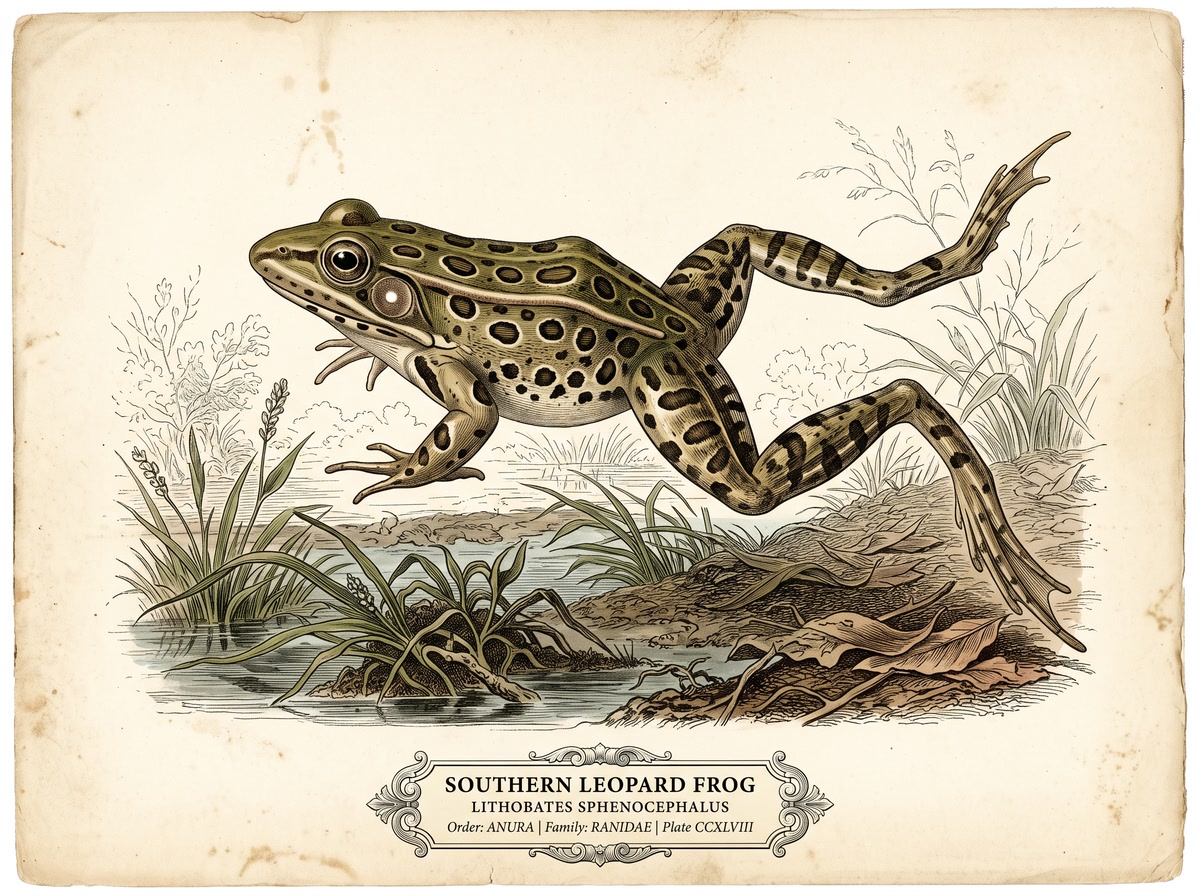
Sleek, emerald-to-bronze ranid frog adorned with dark circular leopard spots, prominent raised yellowish dorsolateral folds, and a white spot at the center of the tympanum. Capable of astounding 6-foot zigzag leaps through emergent sawgrass to escape predators, diving into bottom muck when pursued. Constitutes a foundational primary food source for wading birds, ribbon snakes, and juvenile pythons.
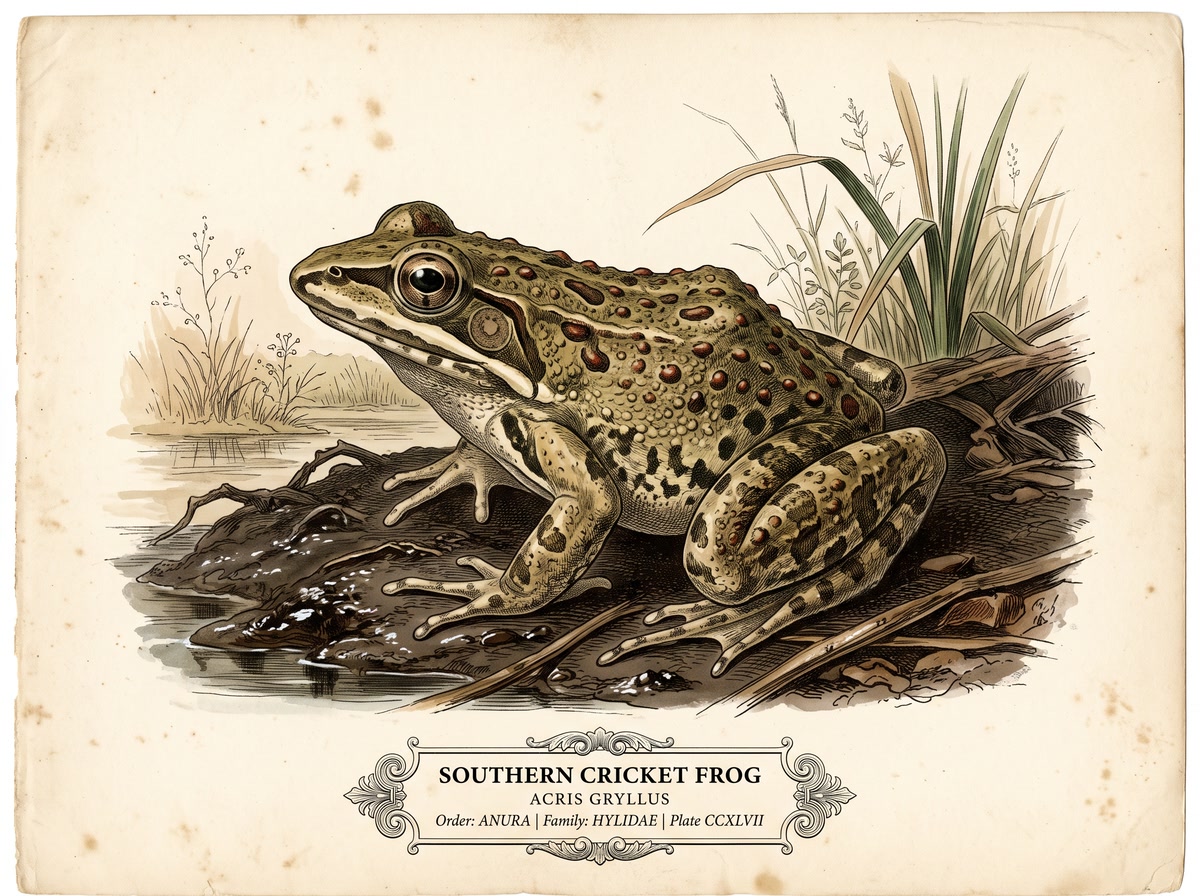
Warty, agile non-climbing treefrog featuring a diagnostic dark triangle between the eyes and a ragged stripe down the thigh. Despite belonging to the treefrog family, it lacks expanded toe pads and lives entirely along muddy water margins. Fills the swamp night with a metallic, clicking chorus that sounds like two glass marbles being struck together repeatedly. An exceptional jumper capable of launching multiple times its body length across open water.
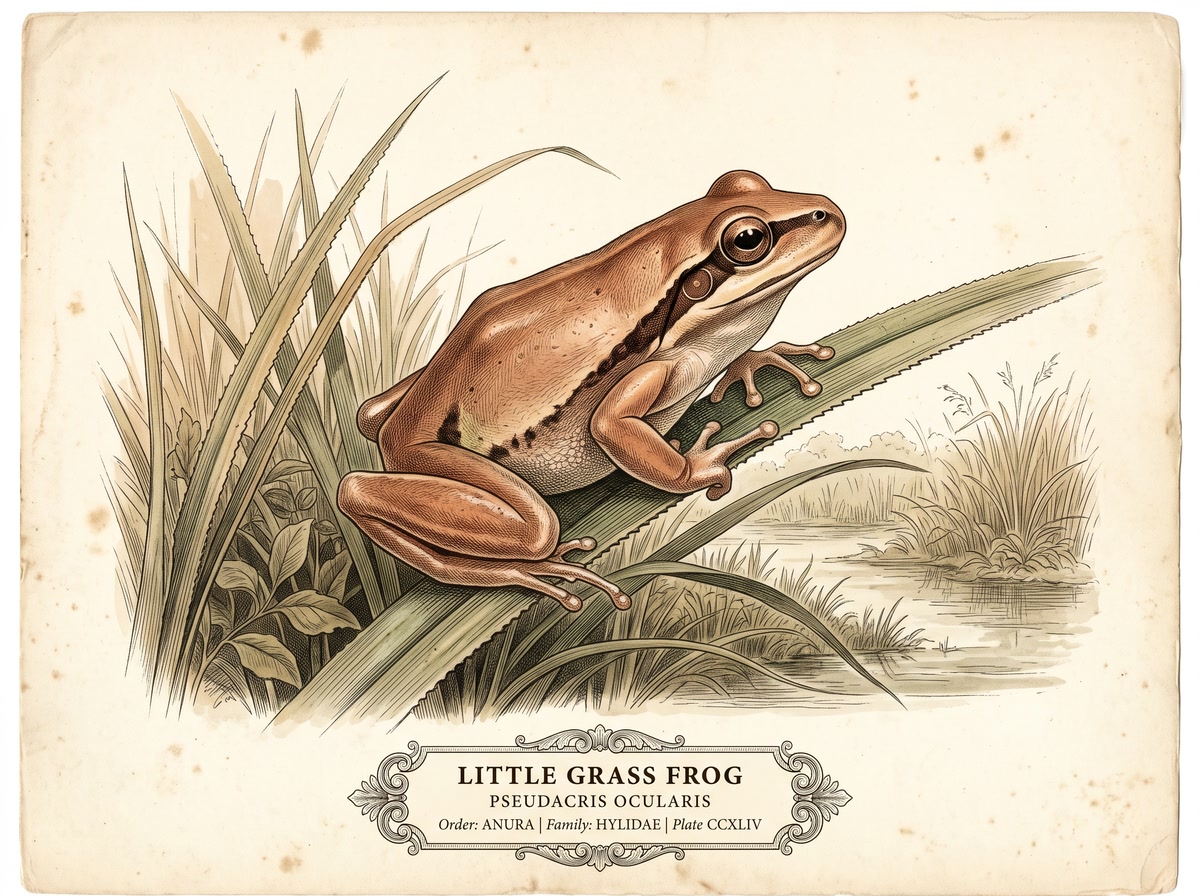
North America's smallest native frog and vertebrate marvel, barely larger than a housefly at just half an inch adult length. Features a tan to pinkish body bisected by a dark brown mask stripe that runs from snout through the eye onto the flank. Climbs low sawgrass blades and emergent sedges where it sounds a high-pitched, insect-like tinkling call resembling a tinkling watch spring after warm afternoon thunderstorms.
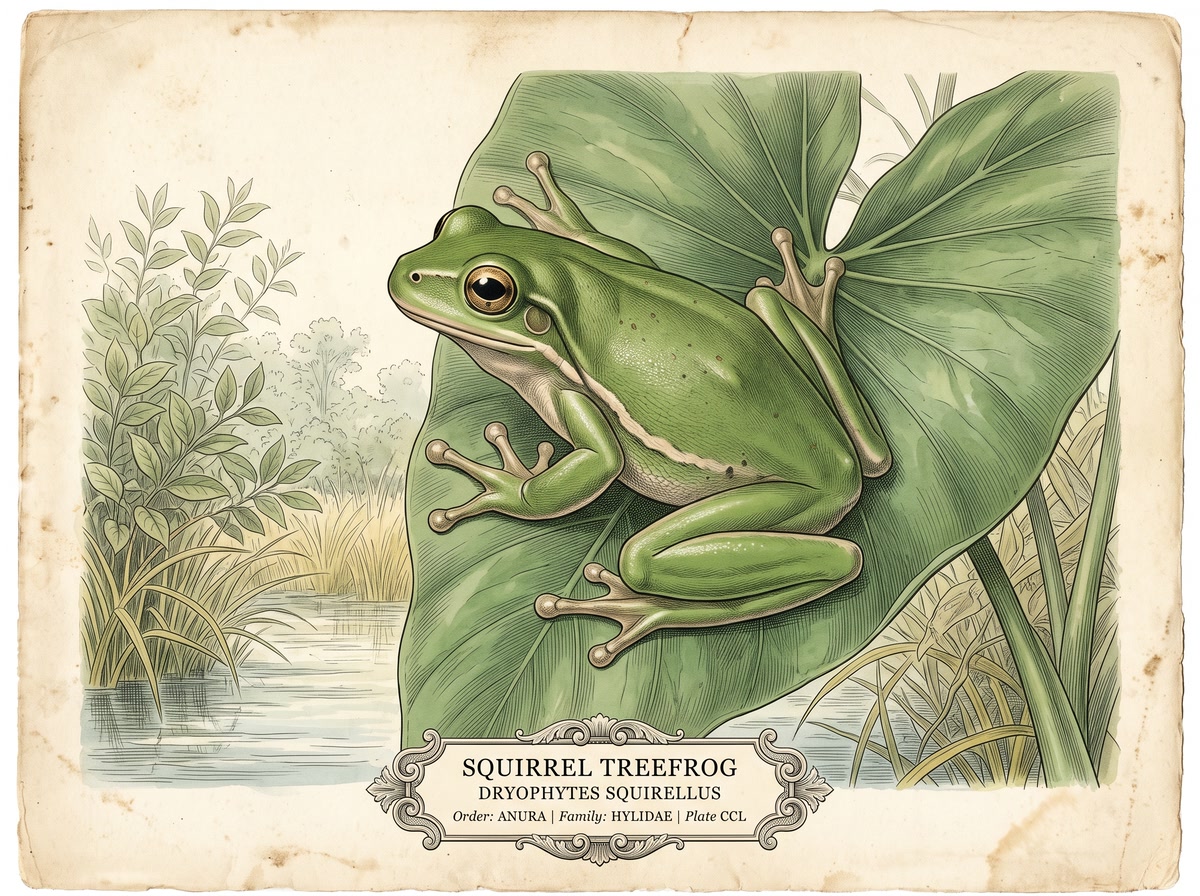
Masters chameleon-like color transformation, shifting rapidly from brilliant chartreuse green to mottled dull grey or chocolate brown depending on moisture, temperature, and background foliage. Equipped with round adhesive toe pads that enable effortless scampering up slippery cypress trunks and smooth palm fronds. Nicknamed the 'rain frog' for its raspy, squirrel-like scolding call uttered before impending tropical downpours.
RANGE: Tree Island Hammocks, Pine Rockland Palmettos • Cypress Swamps
Mass / Length:Mass: 2.5–11.0 kg (5.5–24 lbs) • Length: 50–105 cm
Biome:Mangrove Estuaries, Tidal Passes • Deep Freshwater Canals
Sleek, hydrodynamic predator marked by a prominent lateral black stripe, tapered pike-like snout, and divided dorsal fins. Highly sensitive to cold winter snaps, seeking warm deep canal basins and mangrove creek cuts when water temperatures drop below 60°F. Lurks beneath overhanging red mangrove roots, launching lightning-fast vacuum strikes that swallow schooling baitfish whole with an audible 'pop' sound.
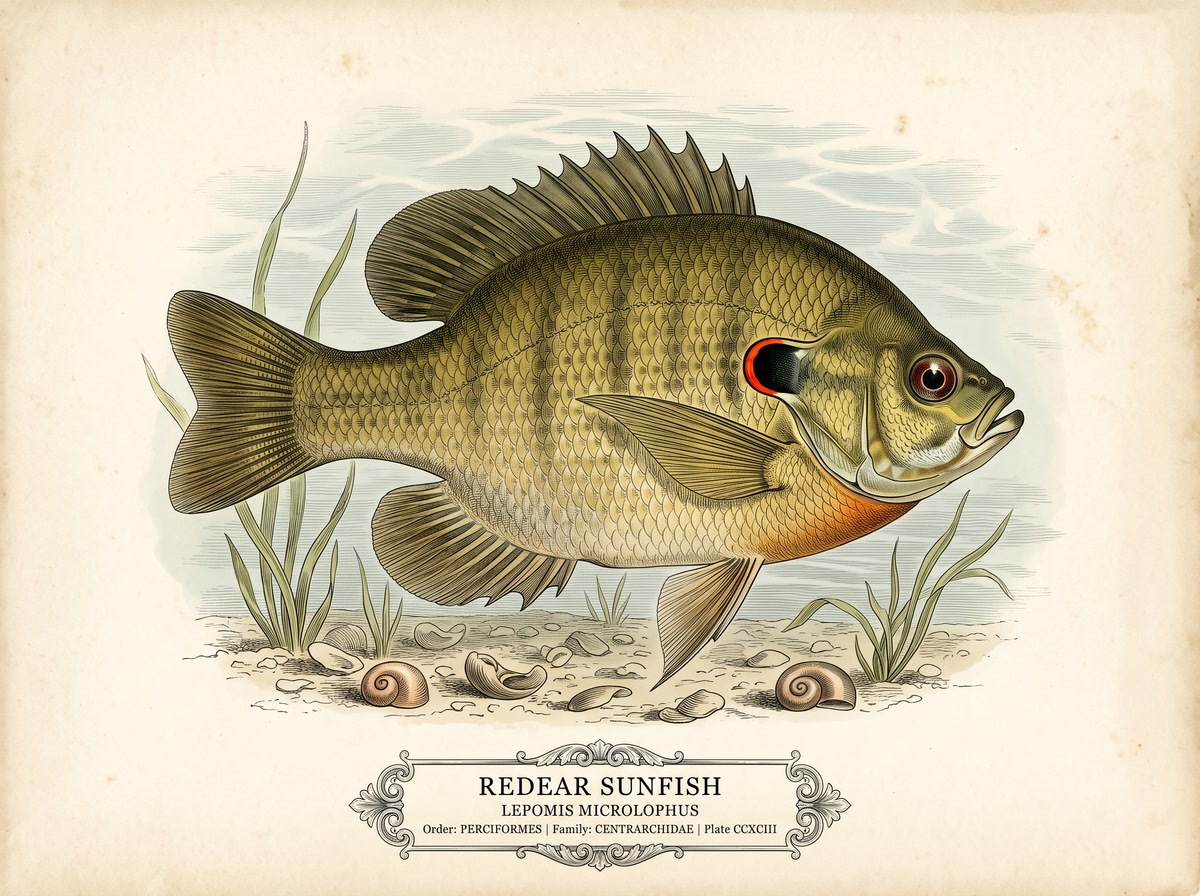
Deep-bodied, olive-green sunfish celebrated for the bright scarlet margin on its black opercular ear flap. Popularly known as the 'shellcracker' due to specialized molariform pharyngeal teeth located in the throat that effortlessly crush thick hard shells of native apple snails and freshwater mussels. Excavates saucer-shaped spawning beds in sandy limestone pockets where bull males aggressively guard egg nests against turtles.
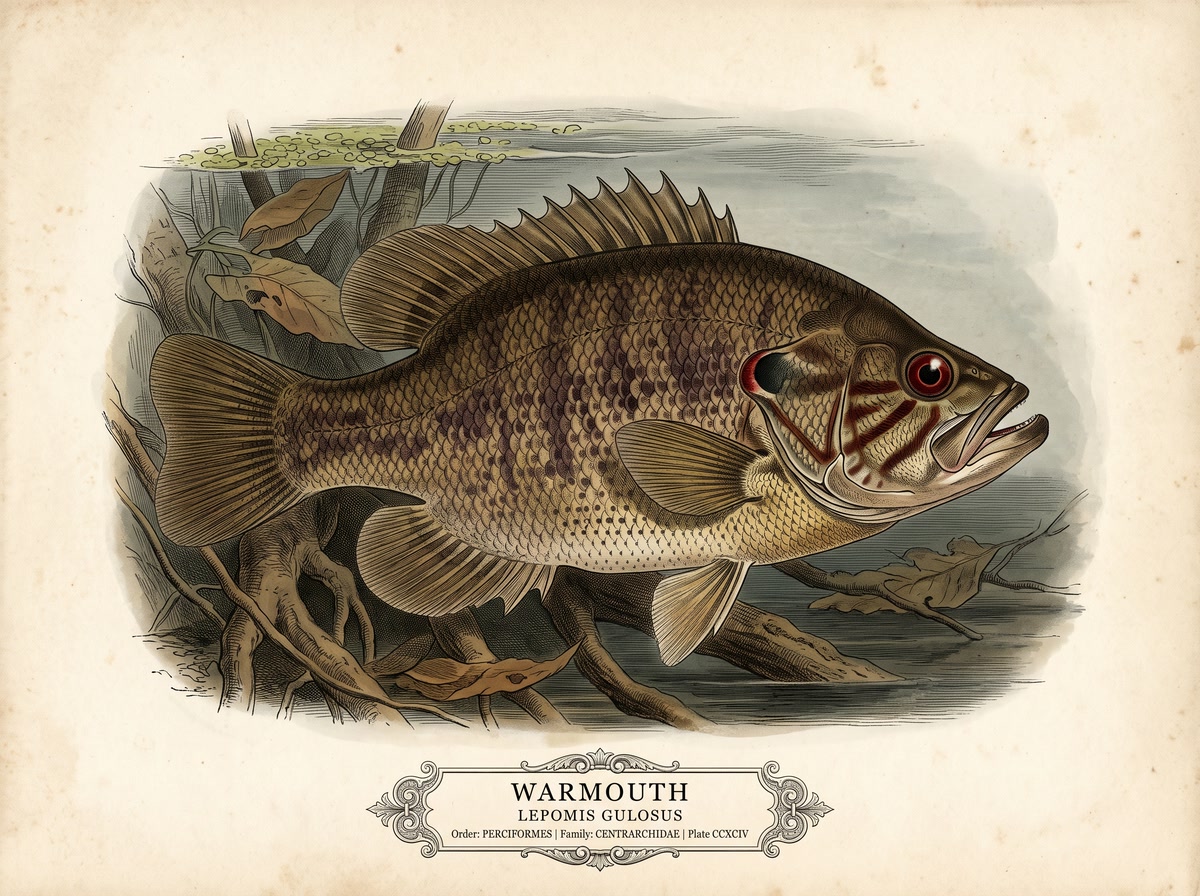
Robust, stocky swamp sunfish distinguished by a cavernous mouth, reddish-brown eyes, and three to five dark reddish-brown streaks radiating back from the eye across the cheeks. Thrives in stagnant, acidic, and oxygen-depleted blackwater where other panfish perish, sheltering inside submerged cypress knees and rotting log tangles. Ambushes nocturnal crayfish and salamanders with relentless pugnacity.
RANGE: Big Cypress Swamp Domes, Dark Peat Sloughs • Shaded Canals
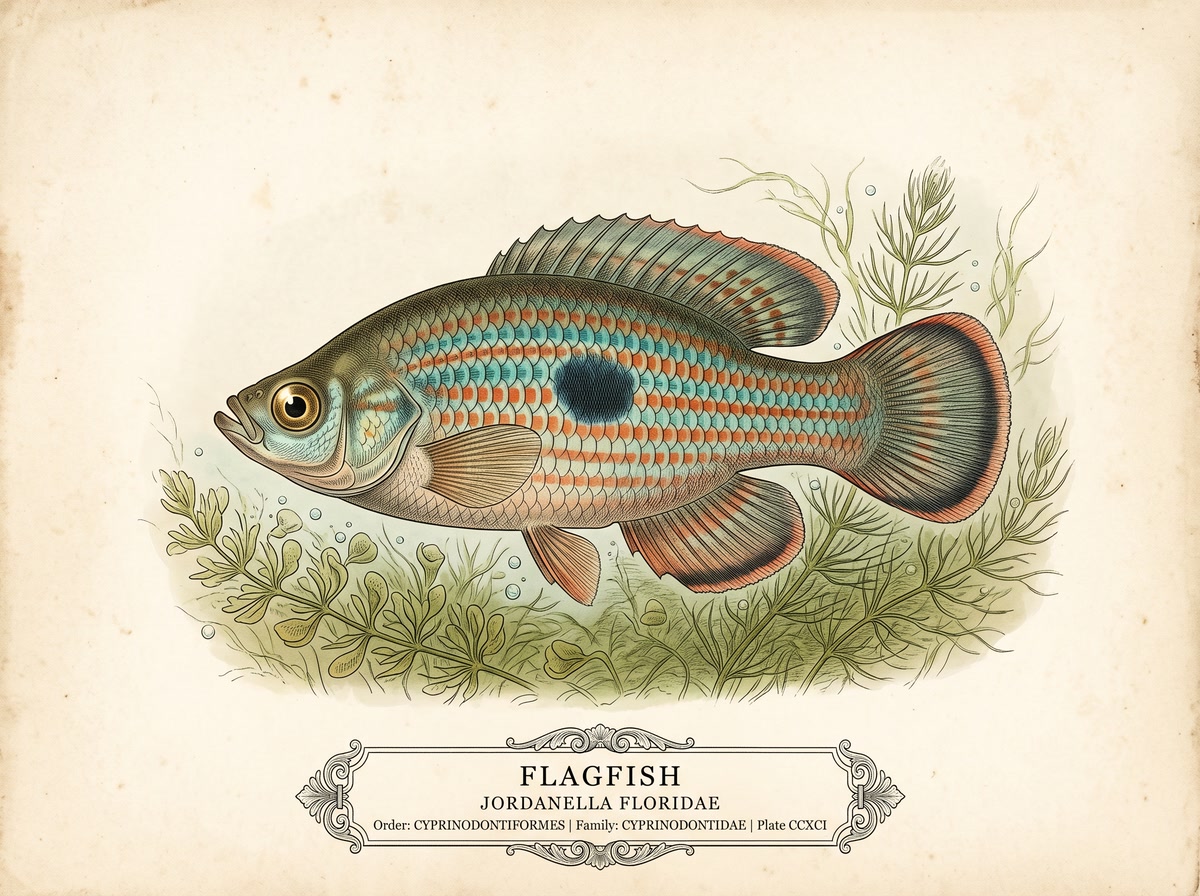
Spectacular endemic pupfish named for the male's striking coloration resembling the American Stars and Stripes, featuring alternating horizontal turquoise and crimson bars and a bold dark shoulder spot. Plays a critical ecological role in controlling nuisance algae and mosquito larvae in extremely shallow, sun-drenched marl waters. Males fiercely defend small hollows in the algae, fanning eggs with pectoral fins.
RANGE: Shallow Marl Prairies, Sawgrass Pool Margins • Solution Holes
Mass / Length:Mass: 600–1400 g (1.3–3.1 lbs) • Length: 25–36 cm
Biome:Freshwater Drainage Canals, Shark Valley Sloughs • Water Conservation Areas
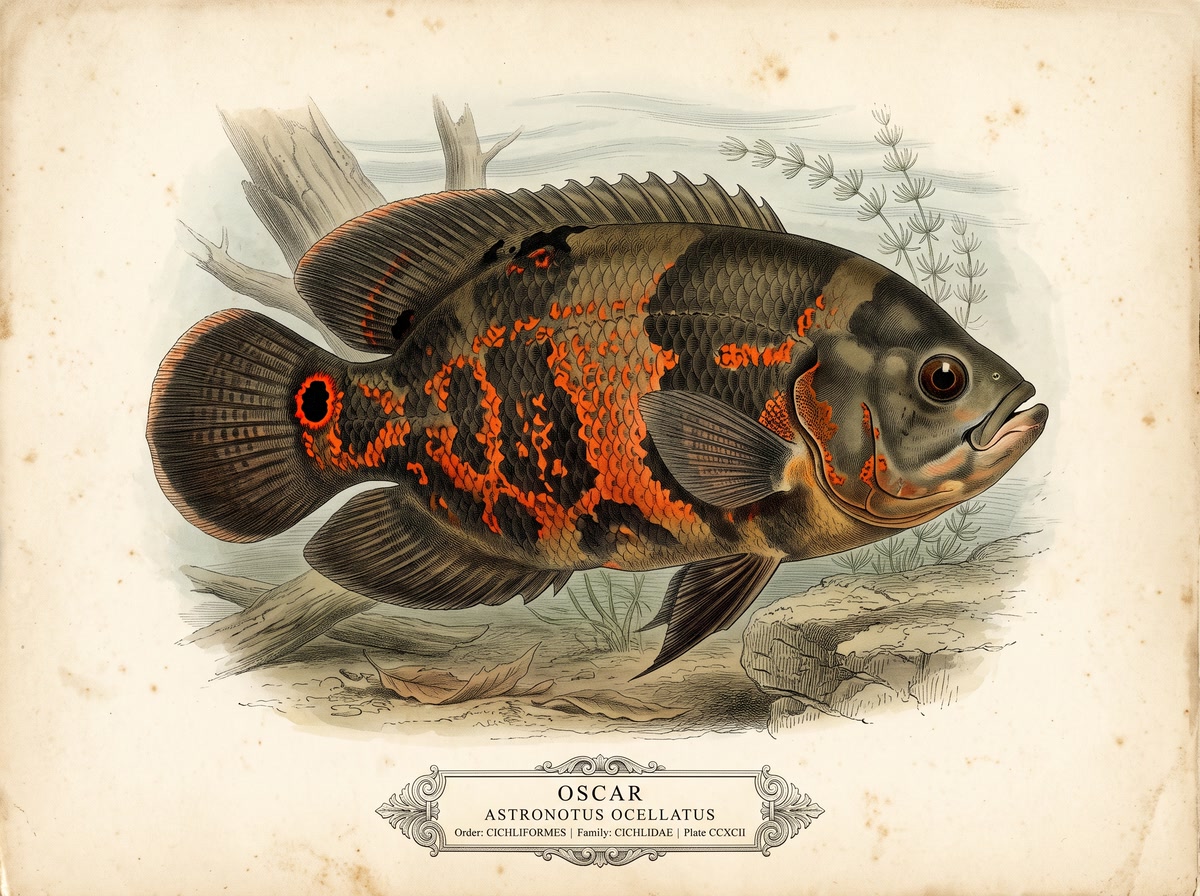
Heavily built South American cichlid introduced through aquarium releases in the 1950s, marked by dark olive-black marbling, fiery orange blotches, and a distinctive circular eye-spot (ocellus) circled in red at the base of the tail fin. Highly territorial and aggressive, it outcompetes native centrarchids for prime spawning beds along canal margins. Highly sensitive to cold shocks, it serves as rich high-calorie fodder for native bull alligators and invasive pythons.
RANGE: Tamiami Canal System, L-67 Canals • Water Conservation Areas 2 & 3